

Heart Failure Treatment and Surgery in India for Iraqis: What You Need to Know Before You Travel
A doctor’s honest guide for Iraqi families weighing advanced heart failure treatment abroad — costs, hospitals, the real treatment journey, and the questions worth asking before you book anything.
For an Iraqi patient whose heart has weakened to the point where climbing a single flight of stairs leaves them breathless, medication alone eventually stops being enough. Advanced heart failure is not a single diagnosis with a single treatment. It is a spectrum, from patients who benefit from a specific device to resynchronise the heart’s rhythm, to those who need a mechanical pump to support a failing heart, to the small number who ultimately need a transplant. Getting a patient the right treatment at the right stage, rather than the same standard medication regimen indefinitely, is what actually changes the outcome. I have spent 24 years guiding patients from across the Middle East, Africa, and South Asia through exactly this decision, and Iraqi families are an increasingly regular part of that work. What I tell every family calling from Baghdad, Basra, Erbil, or Sulaimani is the same thing I would tell my own relative: advanced heart failure needs a dedicated heart failure programme, not simply a cardiologist adjusting medication doses indefinitely, and the hospital’s access to the full range of device and surgical options, not just the most basic ones, is what determines whether a patient’s decline can genuinely be slowed or reversed. For a growing number of Iraqi families, once the options are compared honestly, that fuller range of options is found in India.
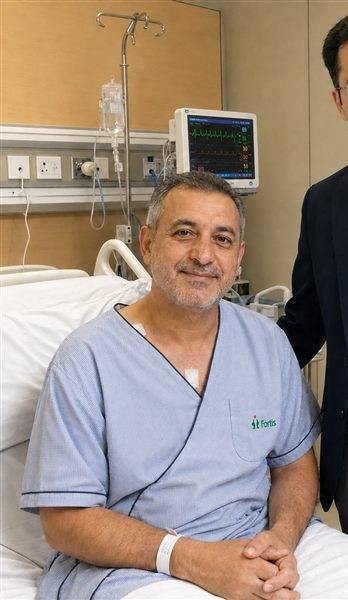
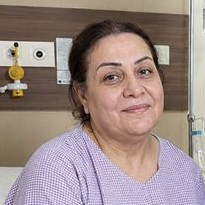
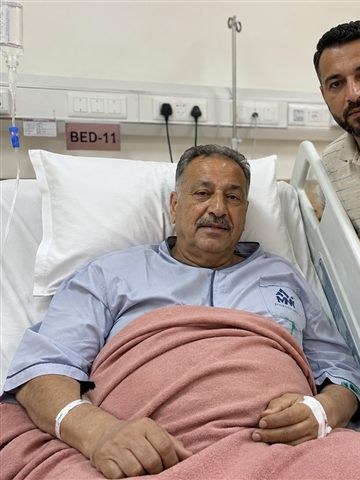
Healing Journeys of Iraqi Patients
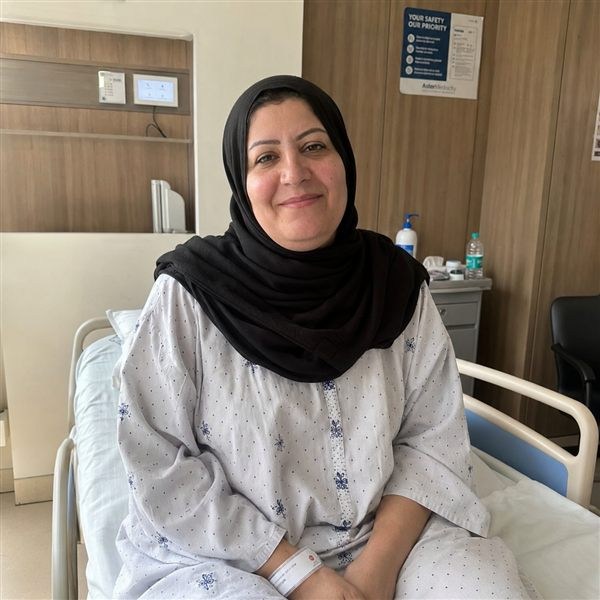


Key Takeaways
- Advanced heart failure is not a single condition with one treatment pathway. The source describes a spectrum ranging from device therapy that can resynchronise the heart's rhythm, to ventricular assist devices that mechanically support a failing heart, and ultimately, for a smaller number of patients, heart transplantation. The central principle is to identify the appropriate treatment stage rather than continuing the same medication strategy indefinitely when the disease has progressed.
- Iraq has meaningful cardiac-care capability, centred on Ibn Al-Bitar Hospital for Cardiac Surgery in Baghdad, with additional cardiac units in Basra, Nasiriyah, Najaf, and Mosul. Standard heart-failure medication and basic pacemaker implantation are available, and the guide recommends that families investigate suitable care within Iraq first. The more significant gap is consistent access to the full spectrum of advanced heart-failure therapies, including cardiac resynchronisation therapy, ventricular assist devices, and transplantation.
- India is presented as an option because leading heart-failure programmes can provide several levels of advanced treatment within the same system. Cardiac resynchronisation therapy, ventricular assist device implantation, and heart transplantation can be available under one dedicated programme, allowing the treatment plan to be escalated or changed as the patient's condition evolves without necessarily moving between unrelated hospitals.
- Transplant programme experience is another important consideration. The source states that leading Indian transplant centres perform heart transplants regularly and have established protocols for post-transplant immunosuppression and long-term follow-up. This type of infrastructure requires sustained programme experience and is particularly important for patients who may need lifelong specialist monitoring after transplantation.
- International-patient support can also influence the practical treatment journey. Indian programmes may provide Arabic-speaking coordinators and case managers who can review echocardiograms and heart-failure staging information remotely before travel. Many leading cardiac hospitals hold JCI or NABH accreditation, and some heart-failure specialists have trained or undertaken fellowships in the UK, US, or Germany.
- The cost chart on page 2 gives illustrative all-inclusive ranges for cardiac resynchronisation therapy device implantation of approximately USD 9,000–15,000 in India, compared with USD 25,000–38,000 in the United Kingdom, USD 22,000–32,000 in Germany, and USD 45,000–80,000 in the United States. These figures cover the device, procedure, and standard hospital stay. Ventricular assist device implantation and heart transplantation cost considerably more and depend heavily on individual circumstances.
- The treatment journey shown on page 3 indicates that a typical CRT patient may spend approximately two to three weeks in total. The illustrated pathway begins with remote consultation and echocardiogram/staging review, followed by arrival and pre-operative work-up, CRT device implantation around Day 3, hospital stay and device programming, and a final check before returning home. The source describes approximately three to five hospital days followed by additional days in India for programming and wound assessment. VAD and transplant patients require considerably longer stays.
- The page 3 checklist identifies six important factors: correct treatment stage, hospital accreditation, full-spectrum access to CRT/VAD/transplantation, transplant-programme track record, language and coordination, and a lifelong follow-up plan. Iraqi families should ask why a particular stage of treatment is being recommended, why a less invasive option was ruled out, and have existing echocardiograms and heart-failure staging documentation reviewed personally by a specialist before travel.
Quick Facts
- Treatment
- Advanced heart failure treatment and surgery
- Primary Patients
- Iraqi patients with advanced or treatment-resistant heart failure requiring specialist evaluation
- Main Speciality
- Advanced heart failure cardiology, cardiac surgery, and transplantation
- Key Specialist
- Dedicated heart failure specialist working within a multidisciplinary programme
- Treatment Spectrum
- CRT, ventricular assist devices, and heart transplantation
- CRT
- Cardiac resynchronisation therapy can help coordinate the beating of heart chambers that are out of sync
- VAD
- Ventricular assist devices mechanically support a failing heart and may serve as a bridge to transplant or longer-term therapy
- Heart Transplant
- An option for a small number of patients with advanced heart failure who meet transplant criteria
- Treatment Stage
- The correct escalation stage should be confirmed before selecting an advanced intervention
- Iraq Cardiac Capacity
- Cardiac services are available in Baghdad, Basra, Nasiriyah, Najaf, and Mosul
- Iraq Advanced-Care Challenge
- Consistent access to the full spectrum of advanced heart failure therapy is limited
- India Programme
- Leading centres can provide CRT, VAD implantation, and transplantation within dedicated heart-failure programmes
- Transplant Experience
- Established transplant centres have post-transplant immunosuppression and long-term follow-up protocols
- Pre-Travel Review
- Echocardiograms and heart-failure staging documentation should be reviewed by a specialist
- Hospital Accreditation
- JCI or NABH accreditation should be checked
- International Support
- Arabic-speaking coordinators and case managers may assist Iraqi patients
- Illustrative India CRT Cost
- USD 9,000–15,000
- UK Comparison
- USD 25,000–38,000
- Germany Comparison
- USD 22,000–32,000
- USA Comparison
- USD 45,000–80,000
- CRT Cost Coverage
- The illustrative India range includes the device, procedure, and standard hospital stay
- VAD Cost
- Meaningfully higher than CRT and dependent on individual circumstances
- Transplant Cost
- Meaningfully higher than CRT and dependent on individual circumstances
- Typical CRT Stay
- Approximately two to three weeks overall
- CRT Hospital Stay
- Approximately three to five days
- Device Programming
- Additional days in India may be required for programming and wound assessment
- VAD/Transplant Stay
- Considerably longer than a typical CRT journey
- Long-Term Care
- Advanced heart failure therapies require ongoing specialist monitoring
- Follow-Up
- Periodic device checks and structured remote follow-up may continue after returning to Iraq
- Author
- Dr. Dheeraj Bojwani
- Experience
- 24+ Years
In Brief
For Iraqi patients with advanced heart failure, the most important question is which treatment stage is appropriate, not simply which advanced procedure is available. The source recommends specialist review of echocardiograms and heart-failure staging before travel, with consideration of CRT, ventricular assist devices, or transplantation according to the patient's condition. A typical CRT patient may spend two to three weeks in India, including three to five hospital days and additional time for device programming and wound review, while VAD and transplant patients generally require substantially longer stays and lifelong specialist follow-up.
Why Iraqi Patients Are Looking Beyond Iraq for Heart Failure Treatment
Iraq’s cardiac care has real capability, centred on Ibn Al-Bitar Hospital for Cardiac Surgery in Baghdad, with additional cardiac units in Basra, Nasiriyah, Najaf, and Mosul. Standard heart failure medication and basic pacemaker implants are available, and many patients are managed well without ever leaving the country. That should always be the first option a family investigates.
Where the picture becomes harder is advanced heart failure treatment specifically: cardiac resynchronisation therapy devices for patients whose heart chambers beat out of sync, ventricular assist devices that mechanically support a failing heart as a bridge to transplant or as long-term therapy in their own right, and heart transplantation itself, which depends on a formal transplant programme, an organ allocation system, and lifelong specialist follow-up. This full spectrum of advanced heart failure therapy is concentrated in relatively few centres worldwide and is not yet consistently available inside Iraq. This is why a growing number of Iraqi families now travel for advanced heart failure treatment specifically, and India has become one of the most trusted destinations, not simply the cheapest one.
Why India Specifically for Heart Failure Treatment and Surgery, Not Just Overseas
Iraqi families researching treatment abroad quickly discover several destinations: Turkey, Jordan, Germany, and India are all commonly mentioned in the same breath. It is worth being direct about why India stands apart for advanced heart failure treatment specifically.
The first reason is the full spectrum of therapy under one roof. India’s leading heart failure programmes offer cardiac resynchronisation therapy, ventricular assist device implantation, and heart transplantation together, with a dedicated heart failure team that can move a patient between these options as their condition changes, rather than a family having to find a new hospital and start over each time a more advanced treatment becomes necessary.
The second reason is transplant programme volume and organ access. India’s leading transplant centres perform heart transplants regularly, with established post-transplant immunosuppression and long-term follow-up protocols built specifically around this patient population, an infrastructure that takes years to build and cannot be improvised for occasional cases.
The third reason is infrastructure built specifically for international patients, including Arabic-speaking coordinators and case managers who can review existing echocardiograms and heart failure staging remotely before a family ever travels. Finally, there is regulatory credibility: a large share of India’s leading cardiac hospitals hold JCI or NABH accreditation, many heart failure specialists have trained or held fellowships in the UK, US, or Germany, and India’s government has built a dedicated medical visa category for foreign patients and one attendant.
Understanding the Cost Picture of Heart Failure Treatment in India
Cost is a genuine concern for most Iraqi families facing this diagnosis, and it is where India’s advantage is hardest to ignore. The figures below reflect typical all-inclusive ranges for cardiac resynchronisation therapy device implantation, the most common advanced heart failure intervention, covering the device, procedure, and standard hospital stay. Ventricular assist device implantation and heart transplantation cost meaningfully more and depend heavily on individual circumstances, so I always urge families to get a written, itemised estimate once a heart failure specialist has confirmed the recommended treatment stage.
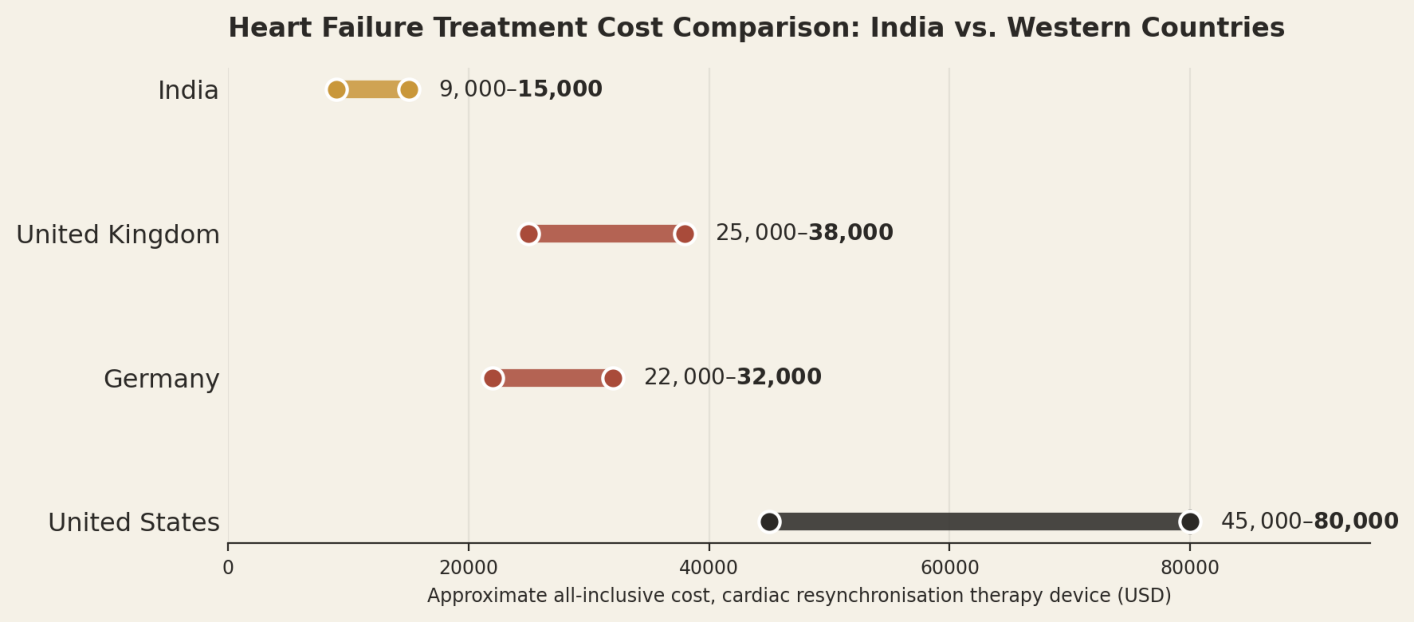
What stands out is not simply that India is cheaper than the United States, the United Kingdom, or Germany. It is that India offers the same device technology and internationally trained heart failure specialists at a fraction of Western prices, with transparent, package-based pricing that contrasts favourably with Western systems where a quoted “treatment cost” often excludes the device itself or extended ICU stays until the final bill arrives. Many hospitals also accept a partial advance deposit rather than full upfront payment, which is worth raising directly in the first consultation since it can meaningfully ease the financial planning involved in arranging funds from Iraq.
What Heart Failure Treatment in India Typically Looks Like
Families often worry most about how long a hospital stay will actually take and what ongoing care looks like afterward. Having coordinated this journey for many families, I find it helps enormously to see the process mapped out plainly before departure.
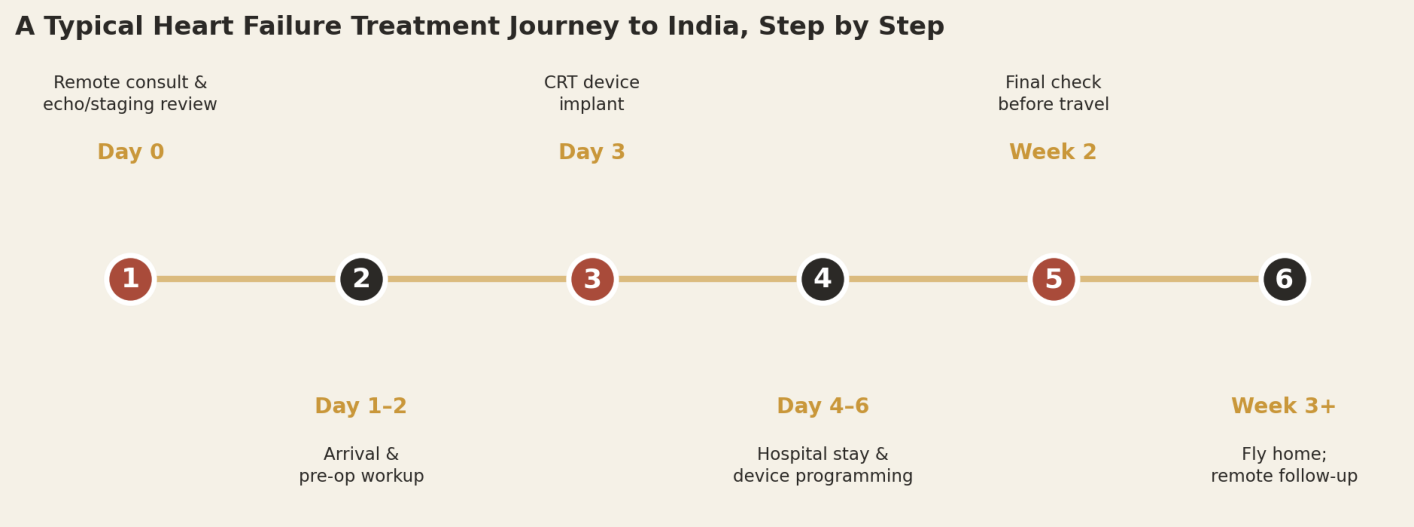
A typical cardiac resynchronisation therapy patient can expect three to five days in hospital and a further few days in India for device programming and a wound check before flying home, with a structured remote follow-up plan, including periodic device checks, continuing afterward; ventricular assist device and transplant patients require a considerably longer stay and ongoing specialist follow-up.
Factors Every Iraqi Patient Should Weigh Before Deciding Heart Failure Treatment in India
Beyond cost and destination, the Iraqi families I have advised over these 24 years tend to make better decisions, and face fewer complications, when they think through the following before booking anything.
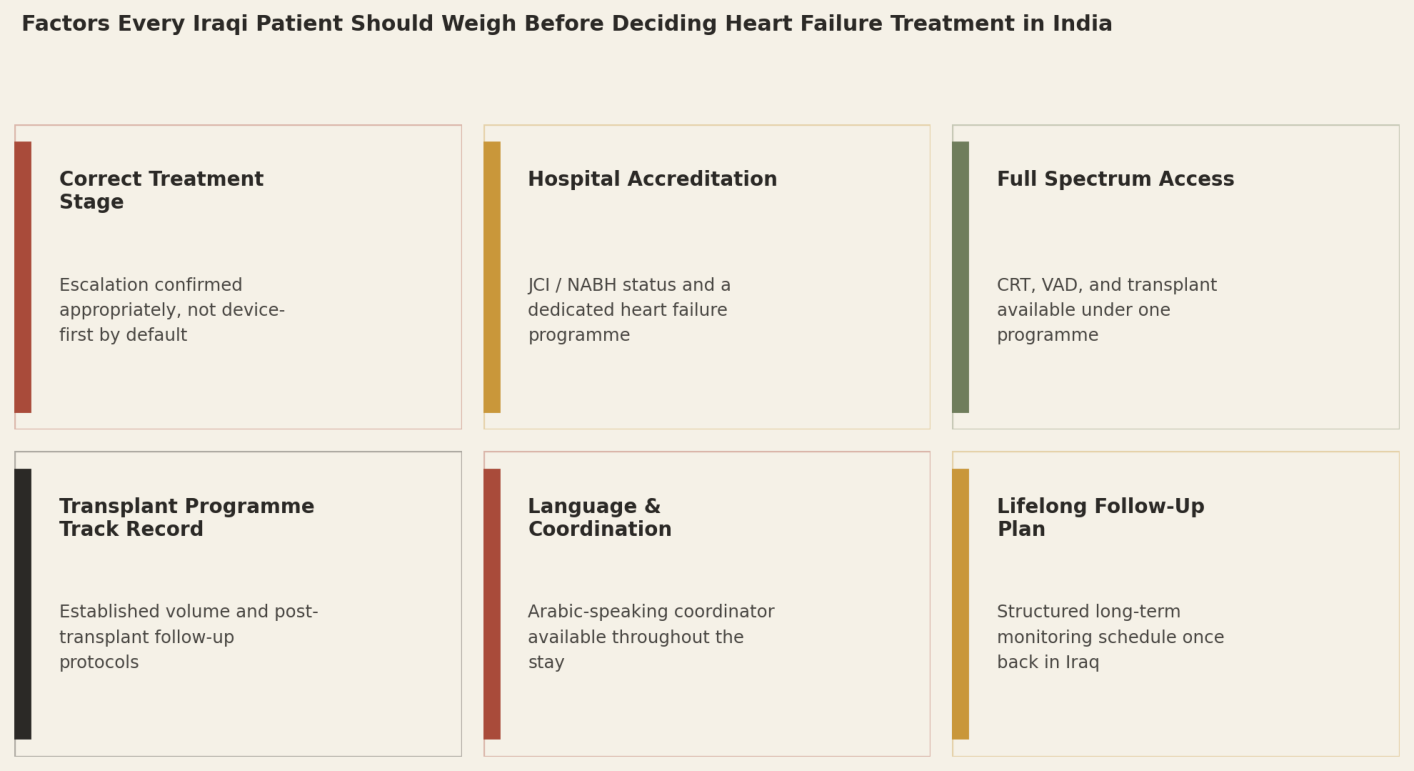
A few of these deserve a specific note. Ask directly which stage of heart failure treatment is actually being recommended, and why a less invasive option was ruled out first, since escalating treatment appropriately matters as much as accessing advanced technology. Existing echocardiograms and heart failure staging documentation should be translated and shared digitally before travel, since a specialist needs to review these personally before confirming the treatment plan. Families should also ask, in writing, what the long-term follow-up plan looks like once back in Iraq, since advanced heart failure therapies require lifelong monitoring.
A Closing Thought for Iraqi Families
Advanced heart failure deserves a dedicated programme that can escalate treatment appropriately as a patient’s condition changes, not a marketing brochure or the lowest quoted price for a single procedure. What the evidence consistently shows is that for Iraqi families weighing where to go, India offers a genuinely rare combination: the full spectrum of heart failure therapy under one roof, established transplant programme experience, meaningfully lower cost, and hospital systems built to support a family through years of ongoing care. Few destinations available to an Iraqi family today can offer this full spectrum of heart failure therapy at once. My role, and the role of any advisor a family works with, should be to help confirm the right stage of treatment honestly and make sure the plan in front of them fits their specific condition, budget, and timeline. Iraq’s families deserve the same standard of scrutiny and care in this decision as any family anywhere else in the world.
Sources & Further Reading
- World Health Organization — Iraq Health System Profile (who.int/countries/irq)
- National Institute for Health and Care Excellence (NICE, UK) — Chronic Heart Failure Guidance (nice.org.uk)
- UK Government — List of English-Speaking Doctors and Medical Facilities in Iraq (gov.uk/government/publications/iraq-doctors-and-medical-facilities)
- American Heart Association (AHA) — Advanced Heart Failure Treatment Options (heart.org)
- World Bank — Iraq Health Sector Reports (worldbank.org/en/country/iraq)
Frequently Asked Questions by Iraqi Patients about Heart Failure Treatment in India
What advanced heart failure treatments are available in India for Iraqi patients?
The guide discusses cardiac resynchronisation therapy, ventricular assist device implantation, and heart transplantation. The appropriate treatment depends on the patient's stage and individual clinical condition.
Is advanced heart failure treatment available in Iraq?
Iraq has established cardiac services and provides standard medication and basic pacemaker implantation. The source identifies more limited and inconsistent access to the full spectrum of advanced heart-failure therapies.
What is cardiac resynchronisation therapy?
CRT is a device-based treatment designed to improve coordination between heart chambers that are beating out of sync. It is one of the advanced treatment options discussed for selected heart-failure patients.
What is a ventricular assist device?
A VAD is a mechanical pump that supports a failing heart. According to the source, it may be used as a bridge to transplantation or as longer-term therapy in selected patients.
How much does CRT treatment cost in India for Iraqi patients?
The source gives an illustrative all-inclusive range of approximately USD 9,000–15,000 for CRT device implantation. The range includes the device, procedure, and standard hospital stay.
How much does a heart transplant cost in India?
The source does not provide a specific heart-transplant price. It states that transplantation costs meaningfully more than CRT and depend heavily on individual circumstances, so patients should obtain a written, itemised estimate after specialist assessment.
How long does an Iraqi patient need to stay in India for CRT?
A typical CRT patient may spend approximately two to three weeks in total, including three to five hospital days and additional time for device programming and wound assessment.
Do VAD and transplant patients need longer stays?
Yes. The guide specifically states that VAD and transplant patients require considerably longer hospital and overall treatment stays, together with ongoing specialist follow-up.
Should heart-failure records be reviewed before travelling to India?
Yes. Existing echocardiograms and heart-failure staging documentation should be translated and shared digitally so a specialist can personally review them and confirm the appropriate treatment stage.
What should Iraqi patients confirm before booking advanced heart failure treatment in India?
They should confirm the recommended treatment stage, why less invasive options were ruled out, the hospital's accreditation and full treatment capabilities, specialist experience, itemised costs, Arabic-language coordination, and the lifelong follow-up plan after returning to Iraq.
Page Summary
The guide explains advanced heart failure as a spectrum requiring treatment escalation according to disease stage. Iraq has established cardiac services and can provide standard heart-failure medication and basic pacemaker implantation, but the source identifies less consistent availability of CRT, ventricular assist devices, and heart transplantation. India is presented as an option because leading programmes can provide this broader range of therapy together with established transplant infrastructure and international-patient support. The page 2 cost chart illustrates approximately USD 9,000–15,000 for CRT device implantation in India, compared with higher ranges in the UK, Germany, and United States. The page 3 treatment pathway shows approximately two to three weeks for a typical CRT patient, including three to five hospital days and additional time for device programming and wound review. VAD and transplant patients require substantially longer stays and continuing specialist follow-up.
Citation Block
| Field | Details |
|---|---|
| Article / Topic | Heart Failure Treatment and Surgery in India for Iraqi Patients |
| Primary Country | Iraq |
| Treatment Destination | India |
| Main Speciality | Advanced heart failure cardiology and cardiac surgery |
| Key Specialist | Dedicated heart failure specialist |
| Treatment Spectrum | CRT, VAD implantation, and heart transplantation |
| Iraq Cardiac Services | Baghdad, Basra, Nasiriyah, Najaf, and Mosul |
| Iraq Advanced-Care Limitation | Full spectrum of advanced heart failure therapy not consistently available |
| CRT | Cardiac resynchronisation therapy |
| VAD | Mechanical circulatory support for selected advanced heart failure patients |
| Heart Transplantation | Option for a small number of appropriately selected patients |
| India Programme Strength | Full spectrum of advanced therapy within leading dedicated programmes |
| Transplant Infrastructure | Regular transplantation with immunosuppression and long-term follow-up protocols |
| Pre-Travel Review | Echocardiograms and heart-failure staging documentation |
| Hospital Accreditation | JCI or NABH |
| International Support | Arabic-speaking coordinators and case managers |
| Illustrative India CRT Cost | USD 9,000–15,000 |
| UK Comparison | USD 25,000–38,000 |
| Germany Comparison | USD 22,000–32,000 |
| USA Comparison | USD 45,000–80,000 |
| CRT Cost Coverage | Device, procedure, and standard hospital stay |
| VAD Cost | Meaningfully higher and circumstance-dependent |
| Transplant Cost | Meaningfully higher and circumstance-dependent |
| Typical CRT Journey | Approximately two to three weeks |
| CRT Hospital Stay | Approximately three to five days |
| Post-Implant Care | Device programming and wound check before travel |
| Long-Term Follow-Up | Periodic device checks and specialist monitoring |
| Key Decision Factor | Correct treatment stage rather than simply choosing the most advanced technology |


Our Mission Statement
Our mission is to place patients at the centre of every healthcare decision by providing trustworthy, evidence-based, and unbiased medical information. We believe that informed patients make better decisions. Backed by personalised guidance from our experienced advisory team, we help patients understand their treatment options, compare them objectively, and confidently choose the path that best suits their medical needs and personal circumstances.
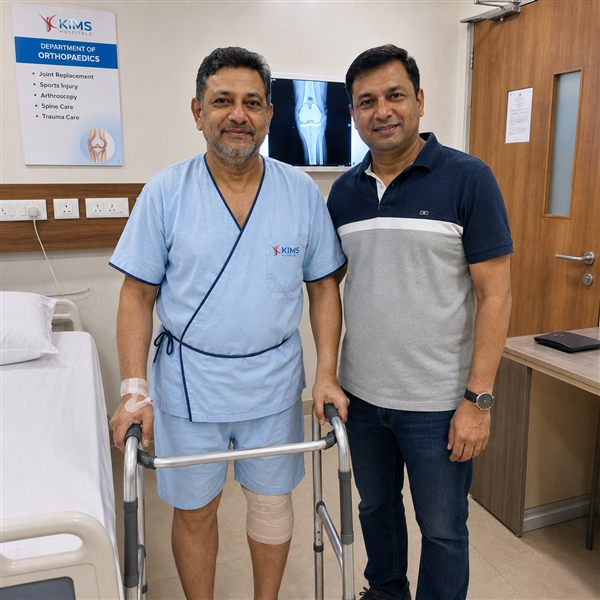
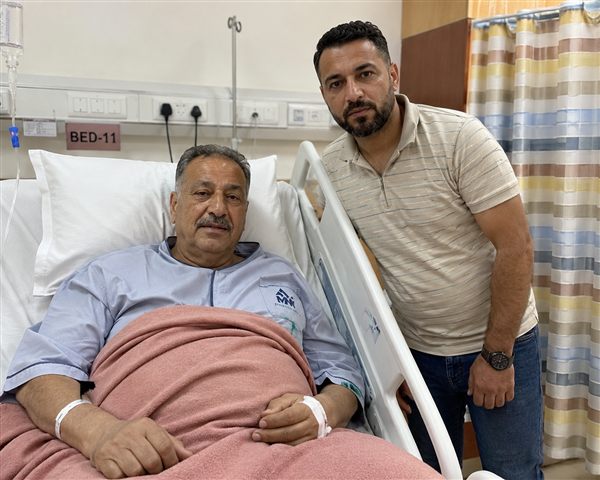
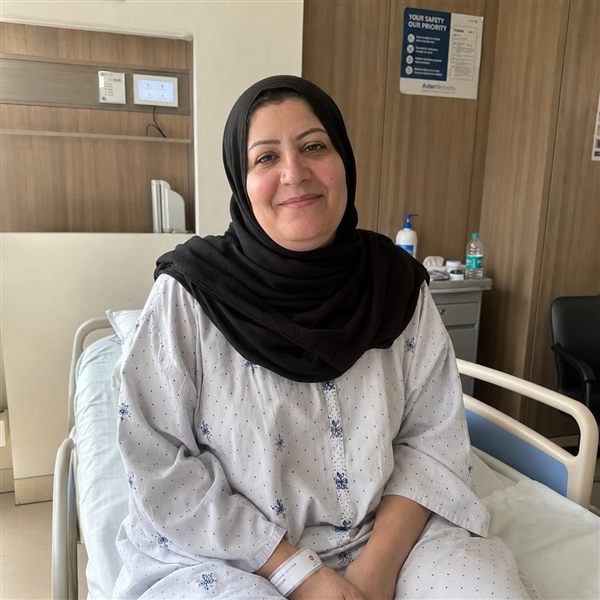
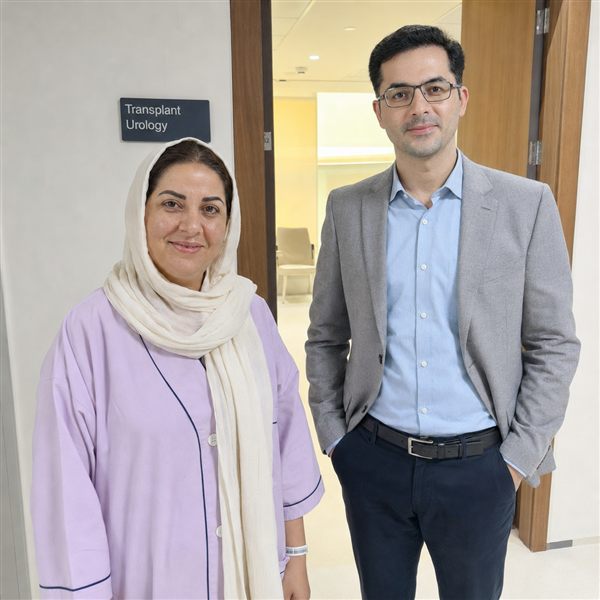
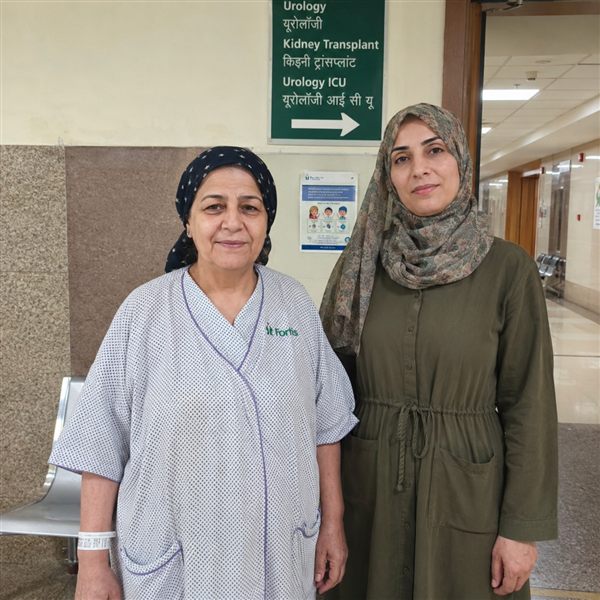
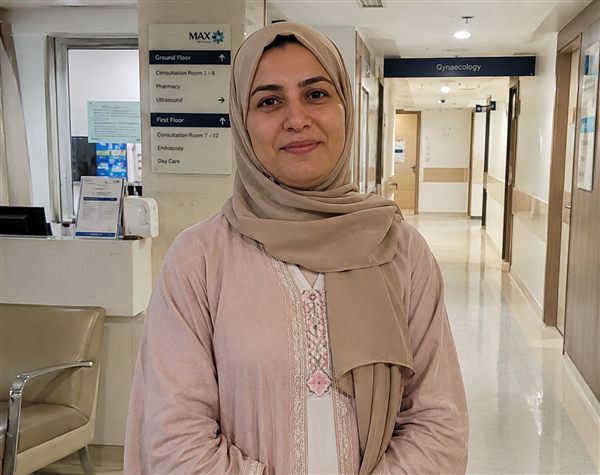
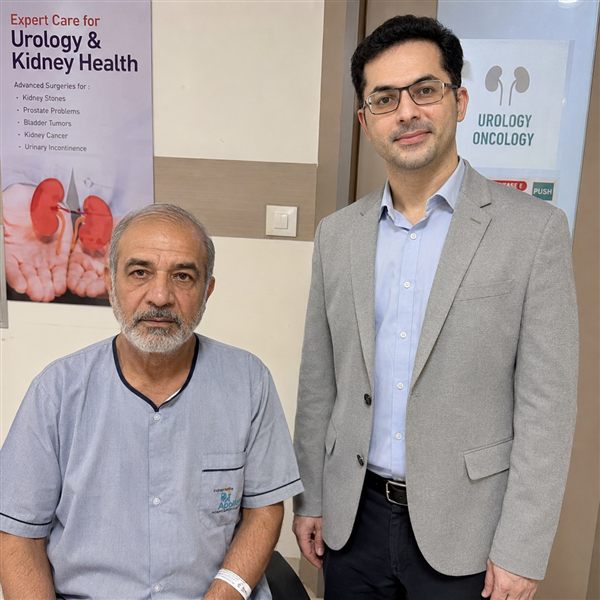
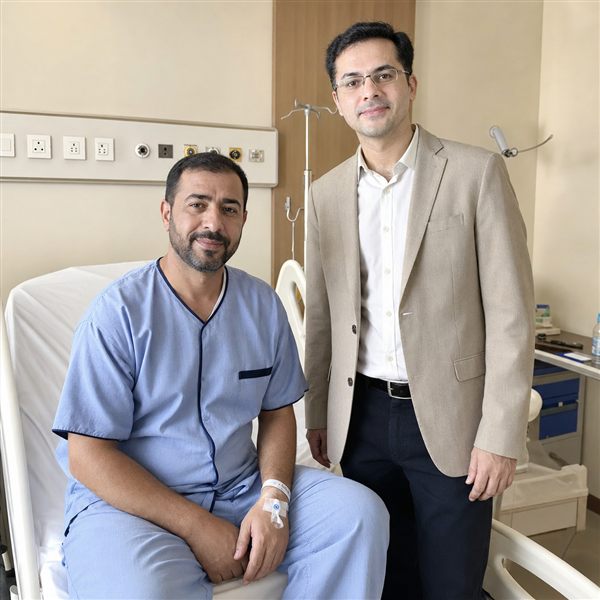
Patient Testimonials from Iraq




Ready to Take the First Step?
Share your Medical Reports with our Healthcare Managers Today and Get a FREE CONSULTATION, a Personalized Treatment Plan, and Complete Support from Arrival to Recovery.
Get Your Free ConsultationAreas We Serve
Indian Health Guru Consultants proudly assists patients from Iraq and surrounding Middle Eastern countries in accessing advanced, affordable and trusted medical treatment in India. Our team provides complete support for medical opinions, hospital selection, treatment planning, visa assistance, travel coordination, accommodation and post-treatment follow-up.
We regularly serve patients from:
- Iraq
- Turkey
- Iran
- Kuwait
- Jordan
- Syria
- Qatar
- Bahrain
- Oman
- Yemen
- Saudi Arabia
- United Arab Emirates
No matter where you are located, our experienced team is committed to making your medical journey to India safe, smooth, transparent and stress-free from the first enquiry to your return home.
From Iraq to India: Your Complete Patient Guide
- Weight Loss and Bariatric Surgery in India for Iraqis: Cost & Guide
- Brain Tumour Surgery in India for Iraqi Patients
- Robotic Cancer Surgery in India for Iraqis
- CyberKnife Treatment in India for Iraqis
- Parkinson's Treatment and DBS Surgery in India for Iraqis
- Paediatric Neurosurgery in India for Iraqis
- Cardiac Surgery in India for Iraqis
- Leukemia, Lymphoma and Blood Cancer Treatment in India for Iraqis
- Neuronavigation and Advanced Brain Surgery in India for Iraqis
- Liver Transplant in India for Iraqis
- Cervical and Lumbar Disc Replacement Surgery in India for Iraqis
- Neurosurgery in India for Iraqis
- Cardiac Pacemaker Treatment in India for Iraqi Patients
- Bone Marrow Transplant in India for Iraqi Patients
- Cosmetic and Aesthetic Surgery in India for Iraqis
- Colorectal Cancer Treatment and Surgery in India for Iraqis
- Penile Implant Surgery in India for Iraqis
- Scoliosis Correction Surgery in India for Iraqis