

CyberKnife Treatment in India for Iraqis: What You Need to Know Before You Travel
A doctor’s honest guide for Iraqi families weighing CyberKnife robotic radiosurgery abroad — costs, hospitals, the real treatment journey, and the questions worth asking before you book anything.
For an Iraqi patient whose tumour is in a location that makes conventional surgery risky, close to the spinal cord, deep in the lung, or wrapped around blood vessels near the liver, CyberKnife treatment offers something genuinely different from either surgery or standard radiotherapy: it delivers highly focused radiation from many angles, tracking the tumour’s exact position in real time, without a single incision and without the metal head frame older radiosurgery techniques required. For the right patient, this can mean treating a tumour that would otherwise be called inoperable. I have spent 24 years guiding patients from across the Middle East, Africa, and South Asia through exactly this decision, and Iraqi families are an increasingly regular part of that work. What I tell every family calling from Baghdad, Basra, Erbil, or Sulaimani is the same thing I would tell my own relative: CyberKnife is not simply “radiation,” it is a specific robotic system that treats tumours anywhere in the body, not only the brain, and the hospital’s experience with your specific tumour location is what determines whether it is the right tool for your case. For a growing number of Iraqi families, once the options are compared honestly, that experience is found in India.
Healing Journeys of Iraqi Patients
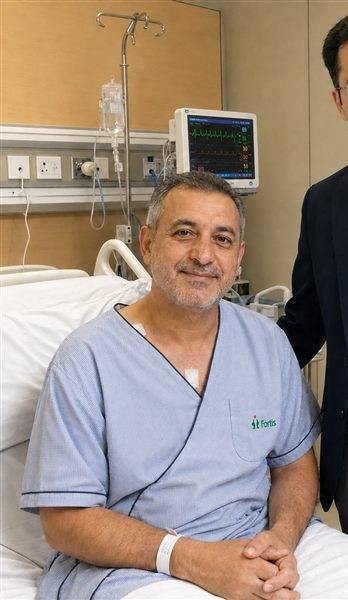
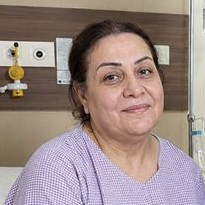
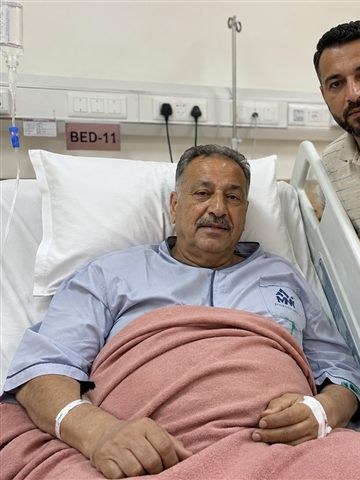
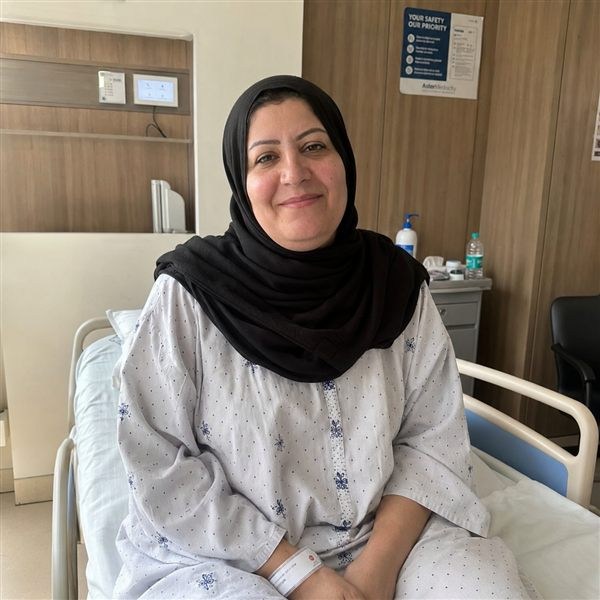

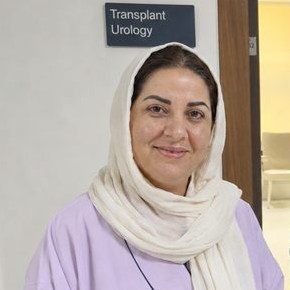
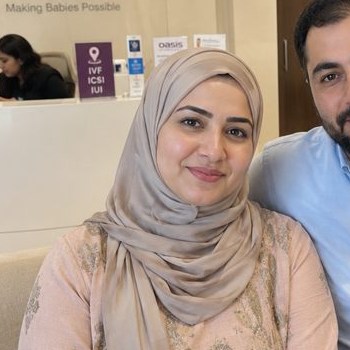
Key Takeaways
- CyberKnife is a robotic radiosurgery system that delivers highly focused radiation from multiple angles while tracking the tumour's position in real time. The source distinguishes it from conventional surgery and older frame-based radiosurgery, noting that it can be used for tumours in locations such as the spine, lung, liver, pancreas, prostate, and brain. For the right patient, this approach may provide an option when conventional surgery is considered risky or difficult.
- Iraq has already developed meaningful radiosurgery capacity, including Gamma Knife treatment for brain lesions. The guide notes that Neuroscience Hospital has treated more than 1,000 patients with Gamma Knife, while a CyberKnife centre at Warith International Cancer Institute in Karbala is under construction. However, the source states that the CyberKnife project is still being built and that existing Gamma Knife treatment is focused on brain lesions rather than the broader extracranial tumour locations that CyberKnife can address.
- India is highlighted for established, high-volume CyberKnife experience across multiple tumour types. Leading centres have radiation oncology and medical physics teams experienced with brain, spine, lung, liver, pancreatic, and prostate tumours. The source also emphasises integration with surgical oncology, medical oncology, and conventional radiotherapy, allowing a tumour board to compare CyberKnife with surgery or standard radiation rather than automatically selecting one technology.
- International-patient infrastructure is another factor. Indian CyberKnife centres may provide Arabic-speaking coordinators and case managers who can review existing imaging remotely before travel. The guide also highlights NABH or JCI accreditation at many leading cancer hospitals, internationally trained radiation oncologists, and India's dedicated medical visa category for foreign patients and one attendant.
- The cost chart on page 2 gives an illustrative all-inclusive range of approximately USD 4,000–8,000 for a full CyberKnife treatment course in India. The comparison ranges shown are approximately USD 19,000–32,000 in the United Kingdom, USD 16,000–24,000 in Germany, and USD 35,000–70,000 in the United States. The Indian estimate includes planning imaging, robotic radiosurgery sessions, and routine follow-up, although the final cost varies according to tumour location and the number of sessions required.
- The treatment journey illustrated on page 3 shows remote consultation and imaging review on Day 0, arrival and planning scans on Days 1–2, CyberKnife sessions during approximately Days 3–7, a final review around Day 8, and return home during Week 2. The source describes one to five treatment sessions over one to two weeks, with no overnight hospital stay required between sessions. Remote follow-up and imaging continue after returning home.
- The page 3 checklist identifies six important considerations: genuine candidacy confirmation, hospital accreditation, integration with the full cancer-care system, the exact number of sessions included, Arabic-language coordination, and a long-term follow-up plan. CyberKnife should ideally be selected through tumour-board discussion rather than a single specialist's recommendation, and existing imaging should be personally reviewed by a radiation oncologist before travel.
- The source also advises Iraqi families to confirm the number of treatment sessions in writing and ask what happens if additional sessions become necessary. This is important because treatment requirements vary according to tumour type and size. The overall message is that CyberKnife should be chosen because it genuinely fits the patient's tumour, not simply because the technology is available or the quoted price is attractive.
Quick Facts
- Treatment
- CyberKnife robotic radiosurgery
- Primary Patients
- Iraqi patients with tumours being evaluated for highly focused radiation treatment
- Main Speciality
- Radiation oncology and stereotactic robotic radiosurgery
- Key Specialist
- Radiation oncologist experienced with CyberKnife and the patient's specific tumour location
- Technology
- Robotic, image-guided radiation delivered from multiple angles
- Treatment Characteristic
- Non-incisional and generally outpatient
- Tumour Locations
- Brain, spine, lung, liver, pancreas, prostate, and other selected sites
- Candidacy
- Must be confirmed for the specific tumour and clinical situation
- Decision Process
- Ideally reviewed through a multidisciplinary tumour board
- Treatment Alternatives
- Surgery and conventional radiotherapy should be considered when appropriate
- India Experience
- Leading centres have established CyberKnife experience across multiple tumour types
- Cancer-Care Integration
- Surgical oncology, medical oncology, and conventional radiotherapy may be available within the same cancer-care system
- Medical Physics
- Experienced medical physics teams are an important part of the programme
- Hospital Accreditation
- NABH or JCI accreditation should be considered
- Pre-Travel Review
- Existing imaging should be reviewed personally by a radiation oncologist
- International Support
- Arabic-speaking coordinators and case managers may assist Iraqi patients
- Illustrative India Cost
- USD 4,000–8,000 for a full treatment course
- UK Comparison
- USD 19,000–32,000
- Germany Comparison
- USD 16,000–24,000
- USA Comparison
- USD 35,000–70,000
- Cost Variables
- Tumour location and number of treatment sessions
- Treatment Sessions
- Approximately one to five sessions
- Treatment Duration
- Usually one to two weeks for the treatment sessions
- Hospital Stay
- No overnight stay is required between CyberKnife sessions according to the source
- Total India Stay
- Approximately two weeks
- Follow-Up
- Final review before travel followed by remote imaging and clinical follow-up
- Session Confirmation
- Number of included sessions should be confirmed in writing
- Additional Treatment
- Patients should ask what happens if more sessions are required
- Author
- Dr. Dheeraj Bojwani
- Experience
- 24+ Years
In Brief
For Iraqi patients considering CyberKnife in India, the first question should not be where the machine is located but whether CyberKnife is genuinely the most appropriate treatment for the specific tumour. A radiation oncologist should personally review imaging before travel, ideally within a multidisciplinary tumour-board discussion that can compare CyberKnife with surgery and conventional radiotherapy. The source describes one to five treatment sessions over one to two weeks, with no overnight stay required between sessions and an overall stay of roughly two weeks in India.
Why Iraqi Patients Are Looking Beyond Iraq for CyberKnife Treatment
Iraq has made real investments in radiosurgery. Neuroscience Hospital in Iraq has treated over a thousand patients with Gamma Knife radiosurgery for brain lesions, a genuine and meaningful achievement. A CyberKnife radiotherapy centre is also under active construction in Karbala, part of the Warith International Cancer Institute, built with the explicit goal of bringing this specific technology to Iraqi patients for the first time.
Where the picture stands today, however, is that this CyberKnife project is still being built, not yet treating patients, and Gamma Knife technology already available in Iraq treats brain lesions only, using a fixed head frame, and cannot address tumours in the spine, lung, liver, or prostate the way CyberKnife’s frameless, whole-body system can. Bone marrow, pancreatic, and other extracranial tumours simply fall outside what Iraq’s current radiosurgery capacity was built to treat. For an Iraqi patient with a tumour outside the brain who is a genuine candidate for robotic radiosurgery today, rather than once a future facility opens, this is why a growing number of families now travel for CyberKnife treatment specifically, and India has become one of the most trusted destinations, not simply the cheapest one.
Why India Specifically for CyberKnife Treatment, Not Just Overseas
Iraqi families researching treatment abroad quickly discover several destinations: Turkey, Jordan, UAE, and India are all commonly mentioned in the same breath. It is worth being direct about why India stands apart for CyberKnife treatment specifically.
The first reason is established, high-volume experience. India’s leading CyberKnife centres have been operating for years rather than months, with radiation oncology and medical physics teams experienced across the full range of tumour types this technology treats, brain, spine, lung, liver, pancreas, and prostate, rather than a single tumour location.
The second reason is integration with a full cancer care ecosystem. Leading Indian centres offering CyberKnife also maintain surgical oncology, medical oncology, and conventional radiotherapy on the same campus, so a tumour board can genuinely compare CyberKnife against surgery or standard radiation for a specific case, rather than a family being steered toward whichever single technology a smaller centre happens to own.
The third reason is infrastructure built specifically for international patients, including Arabic-speaking coordinators and case managers who can review existing imaging remotely to confirm candidacy before a family ever travels. Finally, there is regulatory credibility: a large share of India’s leading cancer hospitals hold JCI or NABH accreditation, many radiation oncologists have trained or held fellowships in the UK, US, or Germany, and India’s government has built a dedicated medical visa category for foreign patients and one attendant.
Understanding the Cost Picture of CyberKnife Treatment in India
Cost is rarely the only reason a family chooses India, but it is almost always part of the conversation. The figures below reflect typical all-inclusive ranges for a full CyberKnife treatment course, covering planning imaging, the robotic radiosurgery sessions themselves, and routine follow-up. Costs vary by tumour location and the number of sessions required, so I always urge families to get a written, itemised estimate once imaging has confirmed candidacy.
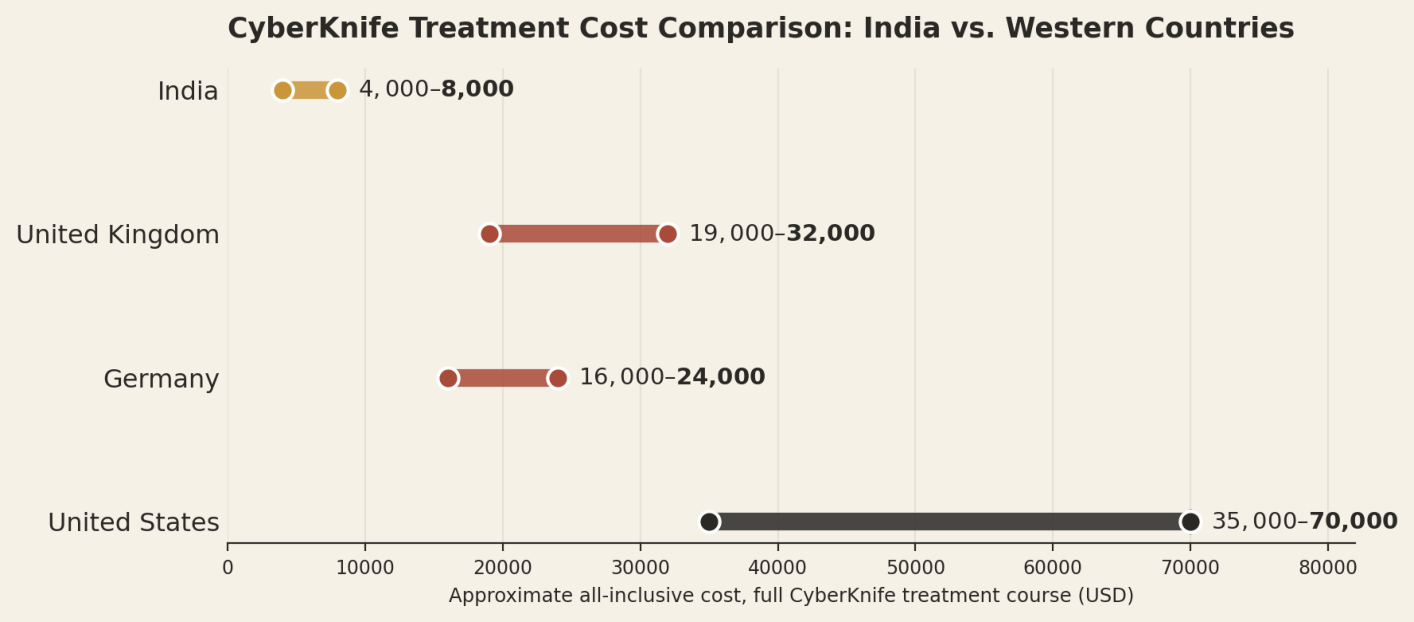
What stands out is not simply that India is cheaper than the United States, the United Kingdom, or Germany. It is that India offers the same robotic radiosurgery platform and internationally trained radiation oncology teams at a fraction of Western prices, with transparent, package-based pricing that contrasts favourably with Western systems where a quoted “treatment cost” often excludes planning imaging or the full number of sessions actually required until the final bill arrives. Many hospitals also accept a partial advance deposit rather than full upfront payment, which is worth raising directly in the first consultation since it can meaningfully ease the financial planning involved in arranging funds from Iraq.
What CyberKnife Treatment in India Typically Looks Like
Patients often worry that any cancer treatment means a long hospital stay, but CyberKnife is largely an outpatient process. Having coordinated this journey for many patients, I find it helps enormously to see the process mapped out plainly before departure.
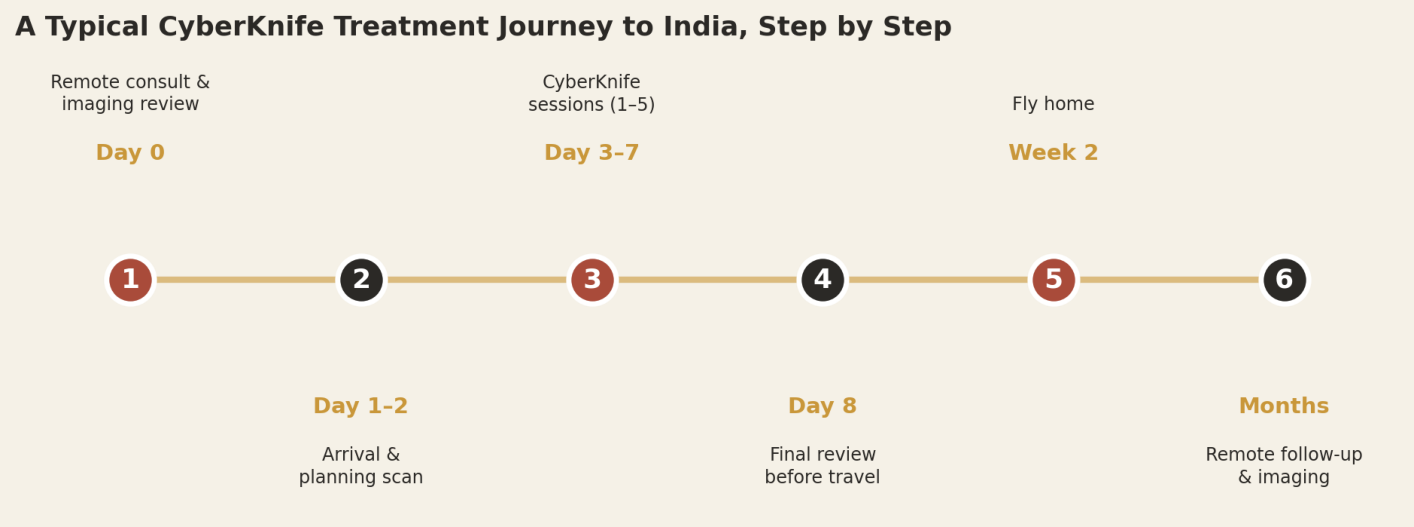
A typical CyberKnife patient can expect one to five treatment sessions delivered over one to two weeks, with no overnight hospital stay required between sessions, and a further short period in India for a final review before flying home, with a structured remote follow-up plan and imaging continuing afterward.
Factors Every Iraqi Patient Should Weigh Before Deciding CyberKnife Treatment in India
Beyond cost and destination, the Iraqi families I have advised over these 24 years tend to make better decisions, and face fewer complications, when they think through the following before booking anything.
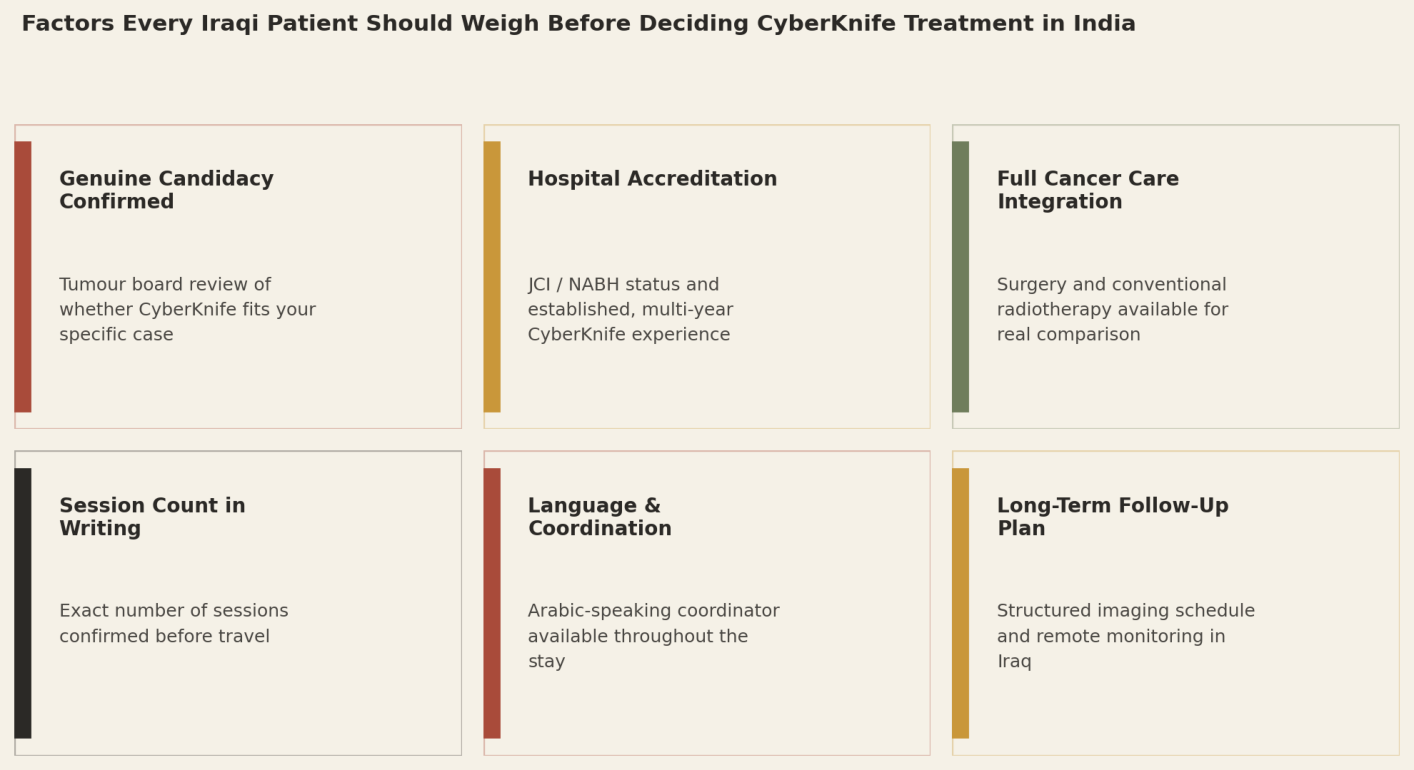
A few of these deserve a specific note. Confirm directly that CyberKnife, rather than surgery or conventional radiotherapy, is genuinely the best option for your specific tumour, ideally through a tumour board discussion rather than a single specialist’s opinion. Existing imaging should be translated and shared digitally before travel, since a radiation oncologist needs to review this personally to confirm candidacy and plan the treatment. Families should also ask, in writing, exactly how many sessions are included in the quoted package, since the number required varies by tumour type and size, and confirm what happens if additional sessions are needed once treatment has begun.
A Closing Thought for Iraqi Families
CyberKnife offers a genuinely different option for tumours that surgery cannot safely reach, and that option deserves to be delivered by a team with real, established experience, not a facility still being built or a marketing brochure promising the lowest quoted price. What the evidence consistently shows is that for Iraqi families weighing where to go, India offers a genuinely rare combination: years of established CyberKnife experience across the full range of tumour locations, integration with complete cancer care, meaningfully lower cost, and hospital systems built to confirm candidacy honestly before a family ever travels. Few destinations available to an Iraqi family today can offer this breadth of established robotic radiosurgery experience at once. My role, and the role of any advisor a family works with, should be to help confirm whether CyberKnife genuinely fits the patient’s specific tumour and make sure the plan in front of them fits their budget and timeline. Iraq’s families deserve the same standard of scrutiny and care in this decision as any family anywhere else in the world.
Sources & Further Reading
- World Health Organization — Iraq Health System Profile (who.int/countries/irq)
- National Institute for Health and Care Excellence (NICE, UK) — Stereotactic Radiosurgery Guidance (nice.org.uk)
- UK Government — List of English-Speaking Doctors and Medical Facilities in Iraq (gov.uk/government/publications/iraq-doctors-and-medical-facilities)
- National Cancer Institute (NCI, US) — Radiation Therapy for Cancer (cancer.gov)
- World Bank — Iraq Health Sector Reports (worldbank.org/en/country/iraq)
Frequently Asked Questions by Iraqi Patients about CyberKnife Treatment in India
What is CyberKnife treatment?
CyberKnife is a robotic radiosurgery system that delivers highly focused radiation from multiple angles while tracking tumour position. It does not require an incision or the rigid head frame used by some older radiosurgery systems.
Which tumours can CyberKnife treat?
The guide discusses CyberKnife experience across brain, spine, lung, liver, pancreas, and prostate tumours. Whether it is suitable depends on the individual tumour's characteristics and location.
Why might Iraqi patients travel to India for CyberKnife?
The source notes that Iraq's existing Gamma Knife capacity primarily treats brain lesions, while its CyberKnife facility in Karbala is still under construction. India has established CyberKnife programmes treating a broader range of tumour locations.
How much does CyberKnife treatment cost in India for Iraqi patients?
The source gives an illustrative all-inclusive range of approximately USD 4,000–8,000 for a full CyberKnife course. The final amount depends mainly on tumour location and the number of sessions required.
How many CyberKnife sessions are usually required?
The guide describes approximately one to five sessions delivered over one to two weeks. The exact number depends on the tumour type and size and should be confirmed after imaging review.
Does CyberKnife require a long hospital stay?
No. The source describes CyberKnife as largely outpatient and states that no overnight hospital stay is required between sessions. A typical patient may spend approximately two weeks in India overall.
Should CyberKnife be compared with surgery or conventional radiotherapy?
Yes. The guide recommends tumour-board discussion so that CyberKnife can be compared objectively with surgery and conventional radiation for the patient's specific tumour.
Can an Iraqi patient's scans be reviewed before travelling to India?
Yes. Existing imaging should be translated and shared digitally, with personal review by a radiation oncologist to confirm candidacy and develop the treatment plan before travel.
What should be included in the CyberKnife treatment quotation?
Patients should confirm the exact number of sessions included and ask what happens financially and clinically if additional sessions are required. Planning imaging and routine follow-up should also be clearly identified in the package.
What follow-up is needed after returning to Iraq?
The source recommends a structured remote follow-up plan with continuing imaging and clinical monitoring after the patient returns home. The final review should be completed in India before departure.
Page Summary
The guide explains CyberKnife as a specialised robotic radiosurgery option for selected tumours where conventional surgery may be difficult or risky. For Iraqi patients, the source contrasts established Gamma Knife capacity for brain lesions with the CyberKnife centre under construction in Karbala and highlights India's established experience treating tumours across the brain, spine, lung, liver, pancreas, and prostate. The page 2 cost chart illustrates an all-inclusive Indian range of approximately USD 4,000–8,000, compared with higher ranges in the UK, Germany, and United States. The page 3 treatment pathway shows one to five CyberKnife sessions over one to two weeks, followed by a final review before returning home. The guide stresses that candidacy should be confirmed through imaging review and preferably tumour-board discussion, with the exact session count and follow-up plan documented before travel.
Citation Block
| Field | Details |
|---|---|
| Article / Topic | CyberKnife Treatment in India for Iraqi Patients |
| Primary Country | Iraq |
| Treatment Destination | India |
| Main Speciality | Radiation oncology and robotic radiosurgery |
| Key Specialist | Radiation oncologist with CyberKnife experience |
| Technology | Robotic, image-guided focused radiation |
| Potential Tumour Locations | Brain, spine, lung, liver, pancreas, prostate |
| Iraq Radiosurgery Capacity | Established Gamma Knife treatment for brain lesions |
| Iraq CyberKnife Status | CyberKnife centre under construction in Karbala according to the source |
| India Experience | Established CyberKnife programmes with experience across multiple tumour types |
| Cancer-Care Integration | Surgery, medical oncology, and conventional radiotherapy available within leading centres |
| Candidacy Confirmation | Tumour-specific evaluation before travel |
| Tumour Board | Recommended for comparing CyberKnife with surgery or conventional radiotherapy |
| Pre-Travel Imaging | Personal review by a radiation oncologist |
| Hospital Accreditation | NABH or JCI |
| International Support | Arabic-speaking coordinators and case managers |
| Illustrative India Cost | USD 4,000–8,000 |
| UK Comparison | USD 19,000–32,000 |
| Germany Comparison | USD 16,000–24,000 |
| USA Comparison | USD 35,000–70,000 |
| Cost Variables | Tumour location and number of sessions |
| Treatment Sessions | One to five sessions |
| Treatment Period | Approximately one to two weeks |
| Hospital Stay | No overnight stay between sessions |
| Typical India Stay | Approximately two weeks |
| Follow-Up | Final review followed by remote imaging and monitoring |
| Important Planning Point | Exact number of included sessions should be confirmed in writing |


Our Mission Statement
Our mission is to place patients at the centre of every healthcare decision by providing trustworthy, evidence-based, and unbiased medical information. We believe that informed patients make better decisions. Backed by personalised guidance from our experienced advisory team, we help patients understand their treatment options, compare them objectively, and confidently choose the path that best suits their medical needs and personal circumstances.
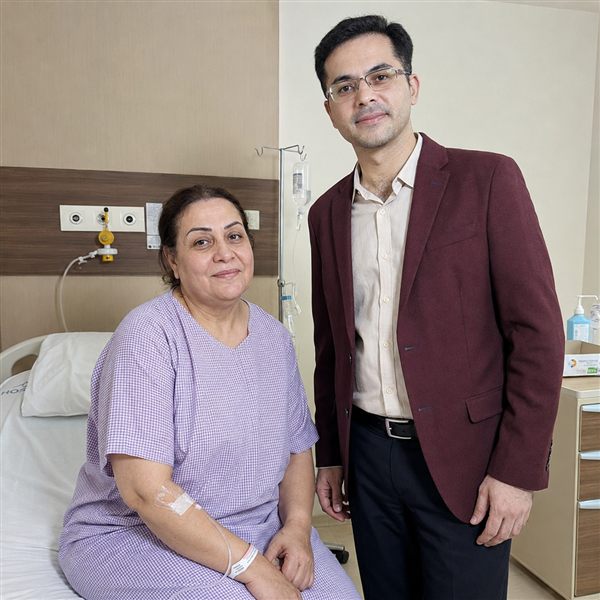
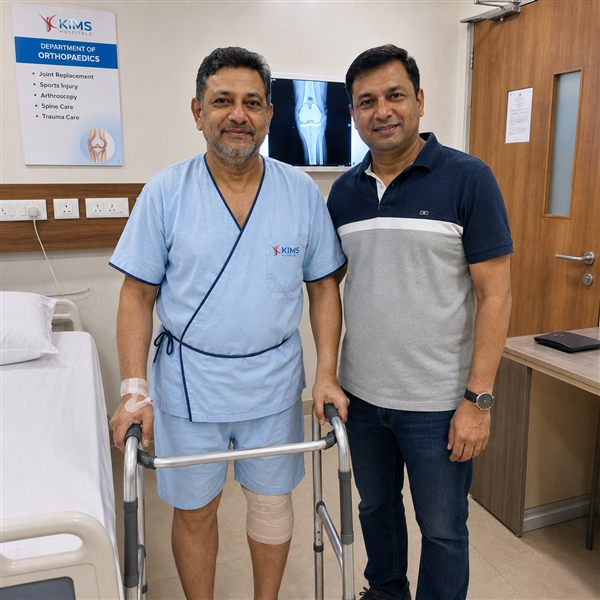
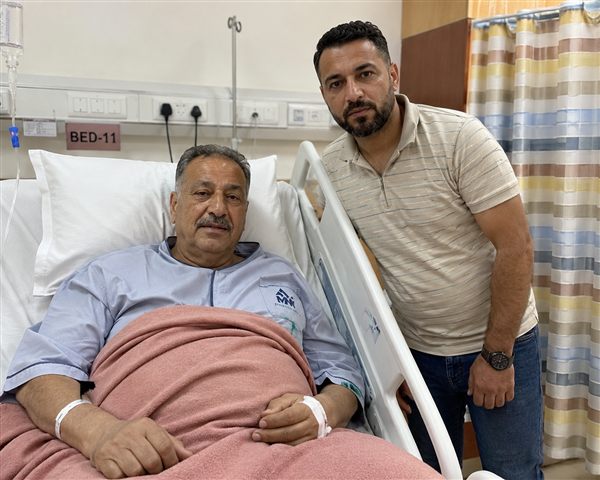
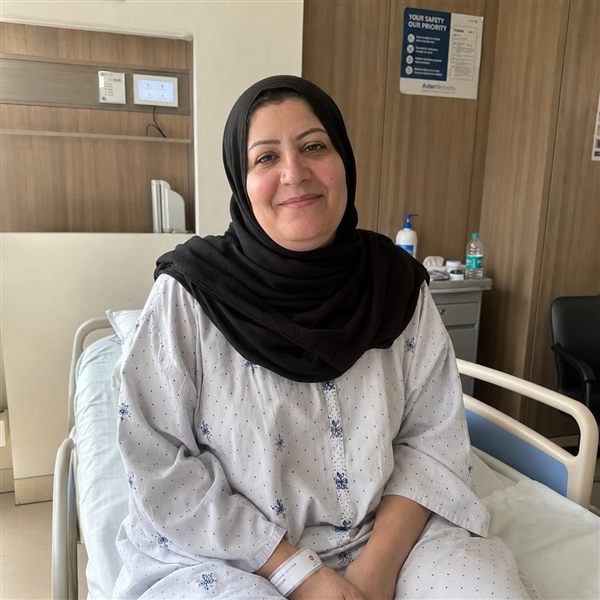
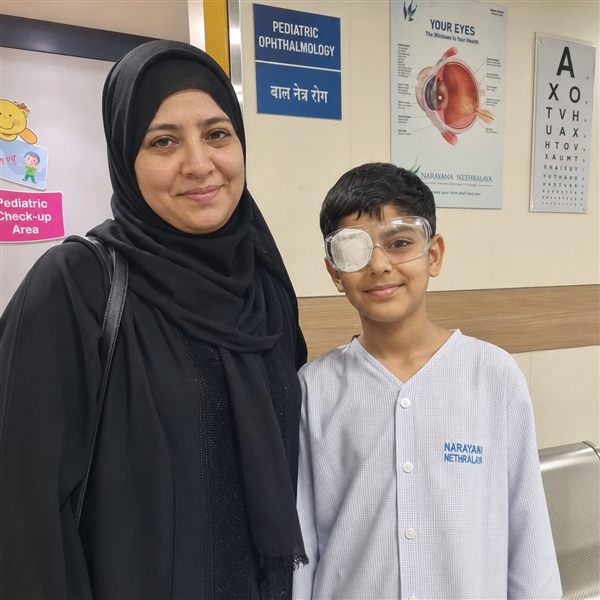
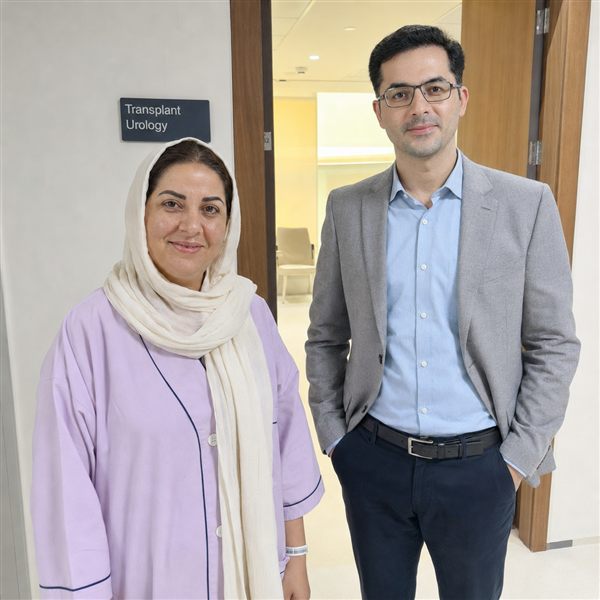
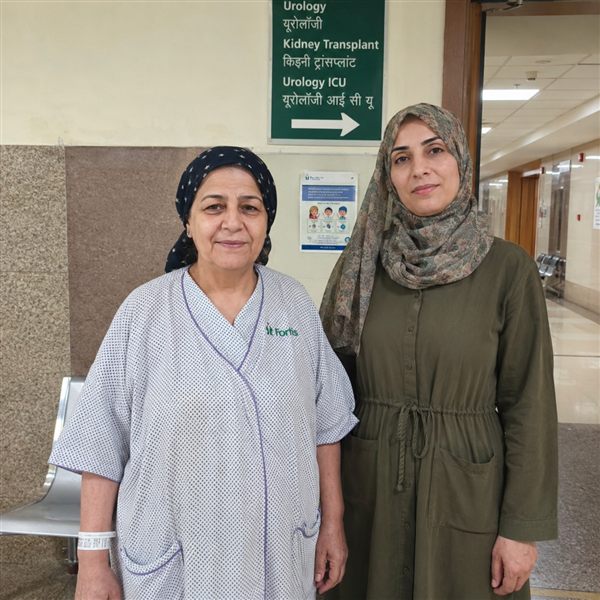
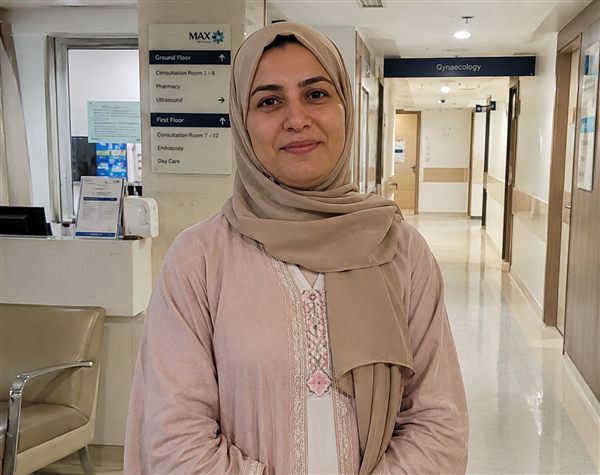
Patient Testimonials from Iraq



Ready to Take the First Step?
Share your Medical Reports with our Healthcare Managers Today and Get a FREE CONSULTATION, a Personalized Treatment Plan, and Complete Support from Arrival to Recovery.
Get Your Free ConsultationAreas We Serve
Indian Health Guru Consultants proudly assists patients from Iraq and surrounding Middle Eastern countries in accessing advanced, affordable and trusted medical treatment in India. Our team provides complete support for medical opinions, hospital selection, treatment planning, visa assistance, travel coordination, accommodation and post-treatment follow-up.
We regularly serve patients from:
- Iraq
- Turkey
- Iran
- Kuwait
- Jordan
- Syria
- Qatar
- Bahrain
- Oman
- Yemen
- Saudi Arabia
- United Arab Emirates
No matter where you are located, our experienced team is committed to making your medical journey to India safe, smooth, transparent and stress-free from the first enquiry to your return home.
From Iraq to India: Your Complete Patient Guide
- Cancer Treatment in India for Iraqi Patients
- Prostate Cancer Treatment and Surgery in India for Iraqis
- Neuronavigation and Advanced Brain Surgery in India for Iraqis
- Penile Implant Surgery in India for Iraqis
- Cornea Transplant and Advanced Eye Surgery in India for Iraqis
- Robotic Cancer Surgery in India for Iraqis
- Paediatric Heart Surgery in India for Iraqis
- Laparoscopic and Robotic Myomectomy in India for Iraqis
- IVF and Fertility Treatment in India for Iraqis
- Shoulder Surgery in India for Iraqis
- Knee Surgery in India for Iraqis
- Brain Tumour Surgery in India for Iraqi Patients
- Complex Joint Revision Surgery in India for Iraqis
- Paediatric Orthopaedic Surgery in India for Iraqis
- HIPEC Cancer Surgery in India for Iraqis
- Cosmetic and Aesthetic Surgery in India for Iraqis
- Neurosurgery in India for Iraqis
- Kidney Transplant in India for Iraqis