

Selecting the Best Paediatric Orthopaedic Surgeons and Hospitals in India — A Congolese Patient's Guide
A practical guide for Congolese parents comparing paediatric orthopaedic specialists and hospitals in India, with emphasis on fellowship training, exact-condition experience, bracing and follow-up.
Few findings in this entire series are as stark as the one behind this guide: a documented DRC study found that children with clubfoot treated by a nurse rather than an orthopaedist had a 74.5 times higher risk of treatment failure. In 24 years of guiding parents through paediatric orthopaedic decisions, I have rarely seen a single factor matter this much. This guide sets out, plainly, how a Congolese parent should verify a specialist's genuine credentials before entrusting a child's treatment to them. Nothing in this guide should be read as blaming any family for a past treatment choice made under difficult circumstances — it is offered so that the next choice can be made with full information.
Healing Journeys of Congolese Patients
Key Takeaways
- The guide explains that choosing the right paediatric orthopaedist can be more important than choosing a hospital based on general reputation. A documented DRC study found that children with clubfoot treated by a nurse rather than an orthopaedist had a 74.5-times higher risk of treatment failure. The guide therefore recommends verifying genuine paediatric orthopaedic expertise before deciding on treatment.
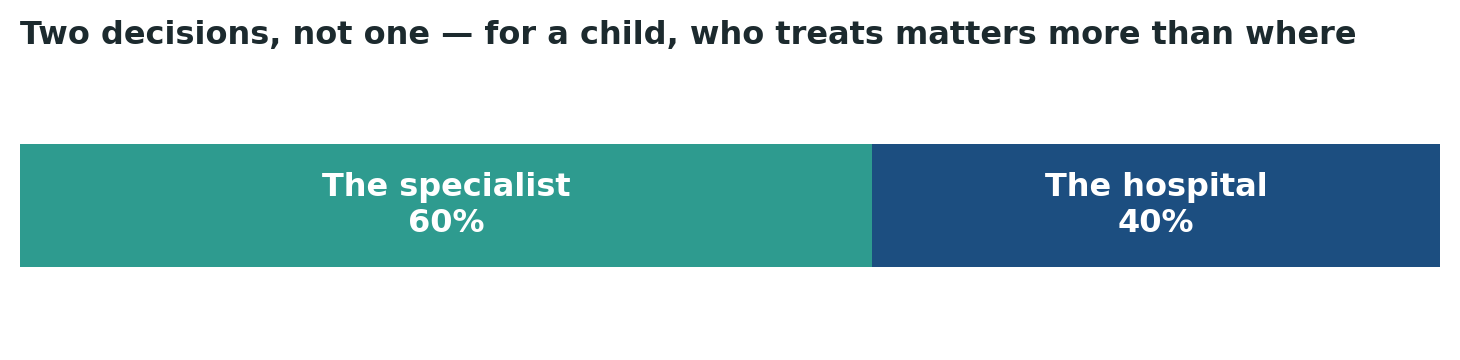
- The page 1 graphic gives 60% weight to the specialist and 40% to the hospital, making specialist selection the dominant factor. Before comparing centres, parents should establish whether the child's condition requires conservative treatment such as casting and bracing or surgery, based on assessment by a genuine paediatric orthopaedist.
- The guide recommends a named paediatric orthopaedist with fellowship-level paediatric orthopaedic training, documented experience in the child's exact condition during the previous 12 months and an honest conservative-versus-surgical assessment. A senior title or general orthopaedic experience alone does not confirm paediatric-specific expertise.
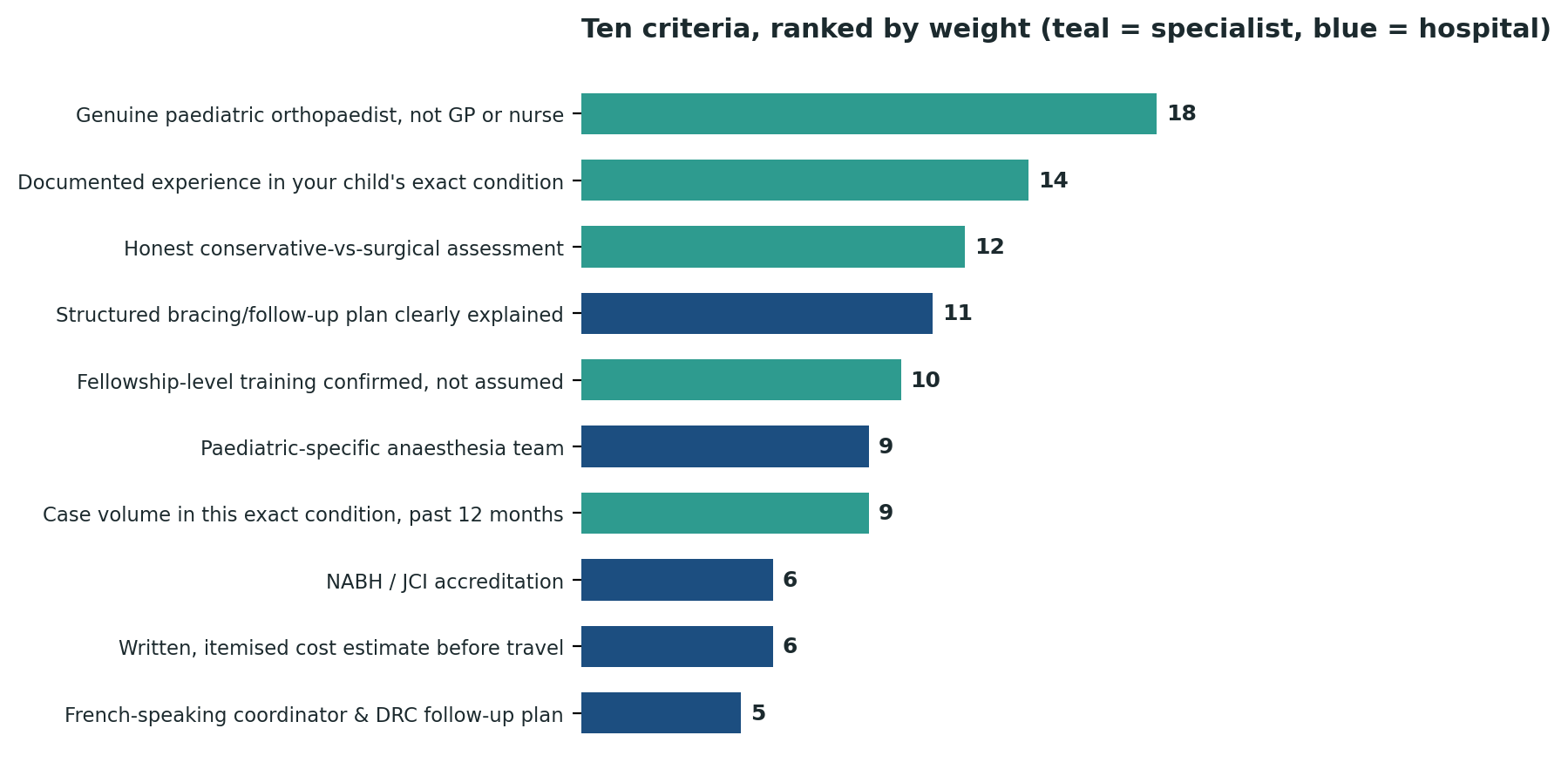
- The page 3 criteria chart ranks having a genuine named paediatric orthopaedist highest at 18 points, followed by exact-condition experience at 14 and honest conservative-versus-surgical assessment at 12. A structured bracing/follow-up plan scores 11, fellowship-level training 10 and paediatric-specific anaesthesia and exact-condition case volume 9 each.
- The hospital should provide a structured bracing and follow-up programme, paediatric-specific anaesthesia, NABH or JCI accreditation and a written itemised quotation. For conservative treatment, parents should specifically confirm whether the quoted cost covers the entire bracing period, which may continue for months, rather than only the initial casting phase.
- For Congolese families, the guide recommends sending photographs and actual scans rather than only descriptions, maintaining a 15–20% financial margin and arranging the paper medical and attendant visas early. Parents should also check yellow-fever requirements for the child's age and plan connecting flights from Kinshasa.
- The page 4 six-step pathway covers sending photographs and reports, obtaining a written treatment opinion and quotation, verifying specialist credentials, arranging visas and flights, completing treatment and returning home with a follow-up plan. The guide identifies four warning signs: no confirmed paediatric orthopaedic fellowship, treatment proposed without reviewing imaging, no structured bracing/follow-up plan and pressure to pay the full balance before a written treatment plan exists.
Quick Facts
- Author
- Dr. Dheeraj Bojwani
- Experience
- 24+ Years
- Treatment
- Paediatric Orthopaedic Care
- Patients
- Congolese Children and Families
- Key Specialist
- Fellowship-Trained Paediatric Orthopaedist
- Decision Weighting
- Specialist 60% / Hospital 40%
- Key Condition
- Clubfoot and other paediatric orthopaedic conditions
- Research Finding
- Nurse-treated clubfoot showed a 74.5-times higher treatment-failure risk in the cited DRC study
- Specialist Check
- Genuine named paediatric orthopaedist
- Case Volume
- Exact condition during the previous 12 months
- Treatment Assessment
- Conservative treatment versus surgery
- Bracing
- Structured bracing and follow-up plan
- Anaesthesia
- Paediatric-specific anaesthesia team
- Accreditation
- NABH or JCI
- Cost Check
- Full treatment course, including bracing where applicable
- Financial Buffer
- 15–20% above written estimate
- Imaging
- Actual photographs and scan files
- Follow-Up
- Named specialist and care plan in the DRC
- Key Warning
- Do not accept treatment recommendations without actual imaging review
- Decision Principle
- Verify the treating paediatric orthopaedist before choosing the hospital.
In Brief
For Congolese children requiring orthopaedic care in India, the guide recommends prioritising a genuine fellowship-trained paediatric orthopaedist with experience in the child's exact condition. Parents should then verify conservative-versus-surgical recommendations, structured bracing and follow-up, paediatric-specific support, transparent costs and a clear plan for continued care in the DRC.
First, Confirm What Your Child's Condition Actually Needs
Before comparing specialists or hospitals, establish clearly what your child's specific condition requires — conservative treatment such as casting and bracing, or surgery, either because the condition demands it or because earlier treatment did not succeed. This distinction should come from a genuine paediatric orthopaedist, not be assumed from limited information.
If your child has already received treatment from a non-specialist provider, this is not a reason for alarm or self-blame — it is simply the starting point for a fresh, specialist assessment of where things currently stand and what options remain open.
Two Decisions, Not One
Choosing well depends on two things: the specialist's own genuine paediatric orthopaedic training, and the hospital's supporting infrastructure. For this category specifically, the documented DRC research points to an unusually lopsided weighting — the identity and training of the treating specialist matters more than almost any other factor in this entire series, though the surrounding hospital infrastructure still matters considerably for recovery and follow-up.
Part One: Verifying the Specialist
These four points matter more than a hospital's overall reputation or general marketing claims.
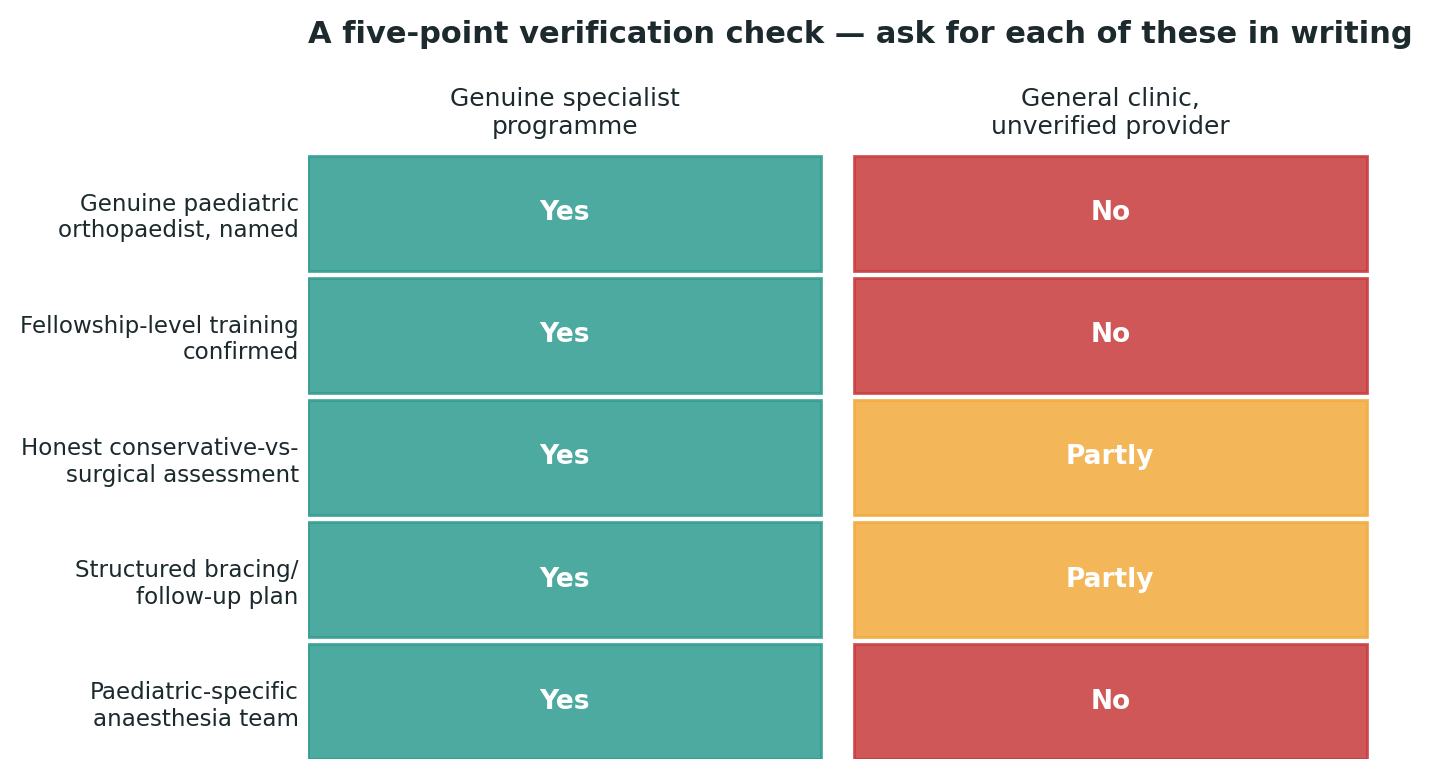
- A genuine paediatric orthopaedist, named specifically — not a general practitioner, general orthopaedic surgeon, or nurse extending their practice. Ask this question directly and expect a clear, verifiable answer.
- Fellowship-level training in paediatric orthopaedics confirmed, not assumed from a senior-sounding title or general reputation.
- Documented experience in your child's exact condition, in the last 12 months, not general paediatric caseload spread across many different conditions.
- An honest conservative-versus-surgical assessment, explaining clearly why one approach suits your child specifically, rather than defaulting to whichever the centre prefers to offer.
| Stage | What it means |
|---|---|
| MBBS | Basic medical degree — the entry point, not evidence of paediatric orthopaedic skill on its own. |
| MS (Orthopaedics) | The base surgical qualification in orthopaedics — three years of foundational training. |
| Fellowship in Paediatric Orthopaedics | An additional one to two years focused specifically on children's orthopaedic conditions — the credential that actually confirms the specialist training the DRC's own research shows makes the critical difference. |
This ladder matters more here than in almost any other topic in this series, given how starkly the DRC's own data shows outcomes diverging by provider type. A title alone does not confirm this training — ask specifically whether the fellowship line applies, and expect a direct answer.
Part Two: Verifying the Hospital
Once the specialist is confirmed, the supporting infrastructure shapes how safely and completely your child's treatment and recovery unfold.
- A structured bracing and follow-up plan, clearly explained, not left vague for "after the procedure."
- A paediatric-specific anaesthesia team, distinct from general or adult anaesthesia staff.
- NABH accreditation in India, or JCI internationally, auditing patient safety and clinical governance in depth.
- A written, itemised cost estimate covering the full treatment course, not just the initial procedure.
- A French-speaking coordinator and a clear plan for handing follow-up care back to a genuine specialist in the DRC.
What the quote doesn't always show
In 24 years of reviewing these estimates for parents, I have found the disputes almost never concern the headline number — they concern what it silently left out: bracing supplies charged separately, or follow-up visits not included in the original plan. Get every line item in writing before paying any deposit, and never pay the full balance before treatment.
For conservative treatment specifically, ask whether the quoted figure covers the entire bracing period, which can run for months, or only the initial casting phase. This is the detail families most often discover has been left out only after treatment is already underway.
What a Congolese Parent Should Weigh in Particular
Beyond verifying the specialist and hospital, a handful of practical realities specific to travelling from the DRC deserve their own attention.
Send photographs and scans, not just a description, to every centre being compared — a real assessment depends on seeing the condition directly, not a summary in words.
Currency and budget. The Congolese franc has weakened considerably against the dollar (roughly CDF 2,300–2,350 per US$1 in mid-2026, and it moves), and Indian hospitals quote and expect payment in dollars. Budget with a 15–20% margin above the written estimate.
Visa timing. DRC passport holders need a paper medical visa, not an e-visa, through the Embassy of India in Kinshasa (Avenue Batetela, Gombe), typically taking around two weeks once the hospital's invitation letter is ready. Apply for the attendant visa for the accompanying parent in the same batch.
Yellow fever certificate, current and dated at least 10 days before travel — check the minimum vaccination age for your child with a paediatrician beforehand.
No direct flight. Ethiopian Airlines via Addis Ababa is the most frequent route from Kinshasa; Kenya Airways, Air France, and Qatar Airways offer workable alternatives.
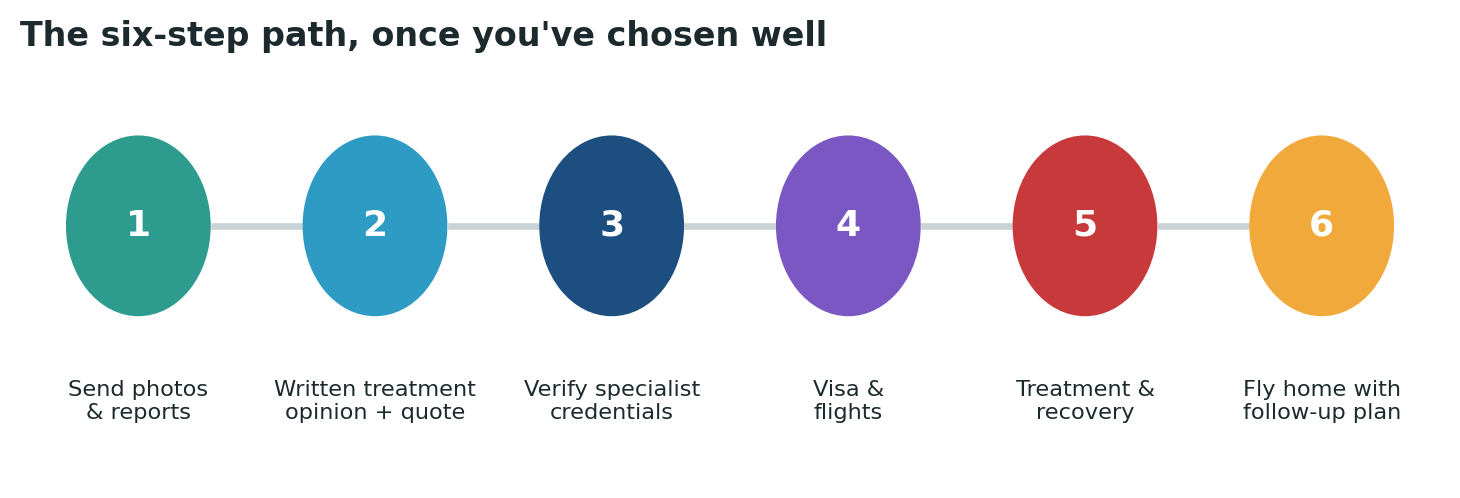
Four signals that should make you pause
- No clear confirmation of genuine paediatric orthopaedic fellowship training.
- Treatment proposed without reviewing your child's actual imaging or photographs.
- No structured bracing or follow-up plan explained.
- Pressure to pay the full balance before a written treatment plan exists.
| Ask the specialist | Ask the hospital |
|---|---|
| Are you fellowship-trained in paediatric orthopaedics? | What does the bracing and follow-up schedule involve? |
| How many cases like my child's have you treated this year? | Is there a paediatric-specific anaesthesia team? |
| Is conservative treatment still possible for my child? | Who coordinates my child's care once we're home? |
A closing word
The DRC's own research makes an unusually clear case: for many paediatric orthopaedic conditions, the treatment itself is not the hard part — ensuring a genuine specialist delivers it is. A named, fellowship-trained paediatric orthopaedist, backed by a structured follow-up plan and paediatric-specific supporting care, is the baseline worth insisting on before any deposit is paid, and no genuine specialist programme will hesitate to confirm this clearly. If you can share photographs or scans of your child's condition, I am glad to review them honestly, including telling you if a proposed specialist's credentials do not hold up to scrutiny, and what a better-verified alternative would look like.
Sources
- 🌐 National Medical Commission of India — verify any surgeon's registration · nmc.org.in
- 🌐 National Accreditation Board for Hospitals & Healthcare Providers (NABH) · nabh.co
- 🌐 Embassy of India, Kinshasa — medical visa requirements · eoikinshasa.gov.in
- 🌐 "Factors associated with failure of Ponseti treatment for congenital Clubfoot...Katanga (DRC)" (2026) · researchgate.net/publication/403676174
- 🌐 World Health Organization — yellow fever vaccination requirements · who.int/health-topics/yellow-fever
Frequently Asked Questions by Congolese Patients about Selecting the Best Paediatric Orthopaedic Surgeons and Hospitals in India
Why is the paediatric orthopaedist so important?
The guide highlights DRC research showing a 74.5-times higher treatment-failure risk for clubfoot treated by a nurse rather than an orthopaedist. It therefore places unusually strong emphasis on verifying the treating specialist's credentials.
How are the specialist and hospital weighted?
The page 1 graphic assigns 60% to the specialist and 40% to the hospital, making specialist expertise the dominant selection factor.
What type of specialist should parents choose?
The guide recommends a named paediatric orthopaedist with fellowship-level training in paediatric orthopaedics, rather than a general practitioner, nurse or general orthopaedic surgeon extending their practice to children.
How should parents assess the specialist's experience?
Ask how many cases involving the child's exact condition were treated during the previous 12 months. General paediatric orthopaedic experience may cover many different conditions.
Should surgery always be the first option?
No. The guide recommends an honest conservative-versus-surgical assessment, including whether casting or bracing remains appropriate before surgery is considered.
Why is the bracing plan important?
Some conditions, particularly clubfoot, can require bracing for months. Parents should confirm exactly how long bracing is expected to continue and what support will be provided after the initial treatment.
What should the hospital provide?
The guide recommends a structured bracing and follow-up plan, paediatric-specific anaesthesia, NABH/JCI accreditation and a clear process for handing care back to a specialist in the DRC.
What should the quotation include?
The written estimate should cover the full treatment course, including bracing supplies and follow-up where applicable, rather than only the initial casting or surgical procedure.
What should Congolese parents send before travelling?
Send photographs and actual scan files, not just a written description of the child's condition. The guide notes that a genuine assessment depends on seeing the condition directly.
What are the main warning signs?
Pause if there is no confirmation of genuine paediatric orthopaedic fellowship training, treatment is proposed without reviewing the child's imaging, no structured bracing/follow-up plan is provided or the family is pressured to pay the full balance before receiving a written treatment plan.
Page Summary
This guide helps Congolese parents select paediatric orthopaedic surgeons and hospitals in India by giving greater weight to the treating specialist. The page 1 graphic assigns 60% to the specialist and 40% to the hospital, while the page 3 chart places the highest weight on genuine paediatric orthopaedic credentials, exact-condition experience and honest conservative-versus-surgical assessment. The page 4 pathway adds practical guidance on imaging, quotations, bracing, visas, travel and follow-up.
Citation Block
| Field | Information |
|---|---|
| Topic | Selecting Paediatric Orthopaedic Surgeons and Hospitals in India for Congolese Patients |
| Treatment | Paediatric Orthopaedic Care |
| Patients | Congolese Children and Families |
| Key Specialist | Fellowship-Trained Paediatric Orthopaedist |
| Decision Weighting | Specialist 60% / Hospital 40% |
| Key Condition | Clubfoot and other paediatric orthopaedic conditions |
| DRC Research Finding | Nurse-treated clubfoot associated with 74.5-times higher treatment-failure risk in the cited study |
| Specialist Criteria | Genuine paediatric orthopaedist, fellowship training and exact-condition experience |
| Case Volume | Exact condition during previous 12 months |
| Treatment Assessment | Conservative versus surgical approach |
| Bracing | Structured bracing and follow-up programme |
| Anaesthesia | Paediatric-specific anaesthesia team |
| Accreditation | NABH or JCI |
| Cost Transparency | Full treatment course and bracing period |
| Imaging | Actual photographs and scan files |
| Financial Planning | 15–20% buffer above written estimate |
| Visa | Paper medical visa and attendant visa |
| Entry Requirement | Yellow-fever documentation |
| Travel | Connecting flights from Kinshasa |
| Follow-Up | Specialist handover and care plan in the DRC |
| Warning Signs | No fellowship confirmation, no imaging review, no bracing/follow-up plan or advance-payment pressure |
| Key Decision | Verify the paediatric specialist first, then assess the supporting hospital infrastructure |


Our Mission Statement
Our mission is to place patients at the centre of every healthcare decision by providing trustworthy, evidence-based, and unbiased medical information. We believe that informed patients make better decisions. Backed by personalised guidance from our experienced advisory team, we help patients understand their treatment options, compare them objectively, and confidently choose the path that best suits their medical needs and personal circumstances.
Patient Testimonials from Congo
Ready to Take the First Step?
Share your medical reports with our healthcare managers today and receive a FREE CONSULTATION, a personalized treatment plan and complete support from your arrival to your recovery.
Get Your Free ConsultationAreas We Serve
At Indian Health Guru Consultants, we proudly assist patients from Congo and neighboring countries across Central, East and Southern Africa who travel to India for advanced medical treatment. Our experienced international patient team provides end-to-end support, including medical opinions, hospital selection, Medical Visa assistance, travel planning, accommodation, interpreter services and post-treatment follow-up.
We regularly serve patients from:
- Gabon
- Cameroon
- Angola
- Uganda
- Rwanda
- Burundi
- Tanzania
- Zambia
- Djibouti
- Comoros
- Madagascar
- Seychelles
- South Sudan
- Central African Republic
- Republic of the Congo
- Democratic Republic of the Congo
No matter where you are located in the region, Indian Health Guru Consultants is committed to making your medical journey to India safe, affordable, seamless and completely patient-focused.
From Congo to India: Your Complete Patient Guide
- Brain Tumor Surgery in India for Congolese Patients
- Best Brain Tumour Surgeons & Hospitals in India for Congo Patients
- Knee Replacement in India for Congolese Patients
- Best Knee Replacement Surgeons & Hospitals in India for Congolese Patients
- Spine Surgery in India for Congolese Patients
- Best Spine Surgeons & Hospitals in India for Congolese Patients
- Liver Transplant in India for Congolese Patients: Cost & Guide
- Best Liver Transplant Centres and Hospitals in India for Congolese Patients
- Cardiac Surgery in India for Congolese Patients: Cost & Guide
- Best Cardiac Surgeons & Hospitals in India for Congolese Patients
- Bone Marrow Transplant in India for Congolese Patients: Cost & Guide
- Best Bone Marrow Transplant Centres and Hospitals in India for Congolese Patients
- Prostate Cancer Treatment in India for Congolese Patients: Cost & Guide
- Best Prostate Cancer Centres and Hospitals in India for Congolese Patients
- HIPEC in India for Congolese Patients: Cost & Treatment Guide
- Best HIPEC Centres and Hospitals in India for Congolese Patients
- Kidney Transplant in India for Congolese Patients: Cost & Guide
- Best Kidney Transplant Centres and Hospitals in India for Congolese Patients