

Scoliosis Correction Surgery in India for Congolese Patients: What It Costs, and How to Decide Well
A practical guide for Congolese families covering late scoliosis diagnosis, curve severity, surgery costs in India, specialist selection and long-term follow-up.
Scoliosis is, in one sense, a very ordinary condition — a curve in the spine, usually appearing during a child's growth years, that in many countries is caught early through routine school screening and managed with a brace long before surgery is ever needed. In 24 years of advising families on this exact diagnosis, I have found that the DRC's story is different, and the difference has real consequences for the surgery a patient eventually needs. This guide sets out plainly why that is, what treatment in India costs against the Western alternatives some families consider, and what to expect. The good news, even for the more complex cases this pattern produces, is that scoliosis remains a treatable condition at nearly every stage.
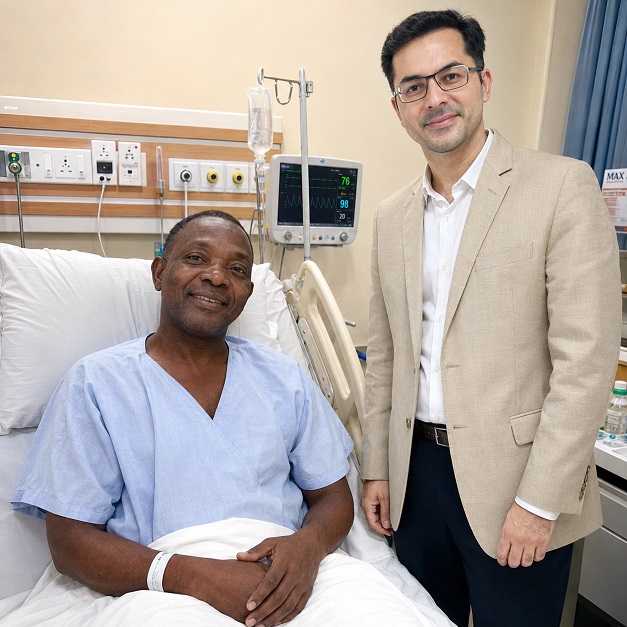
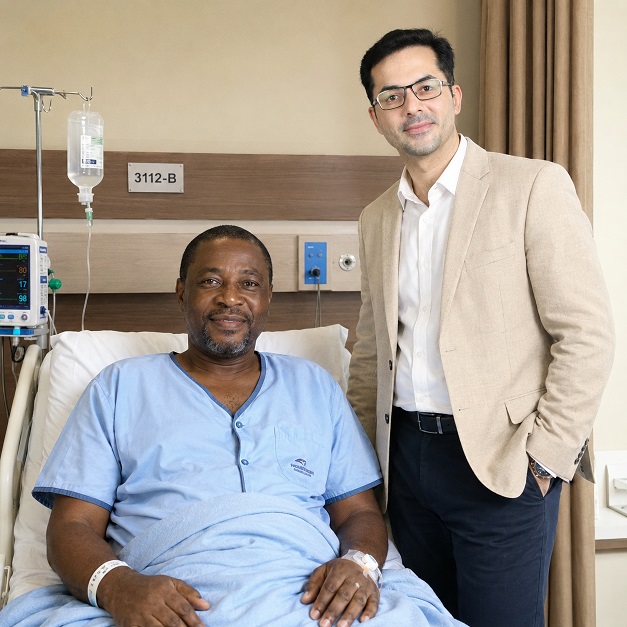
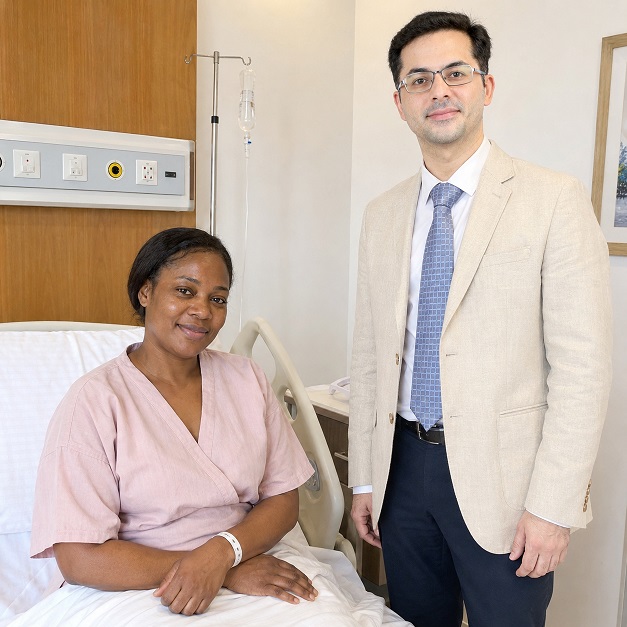
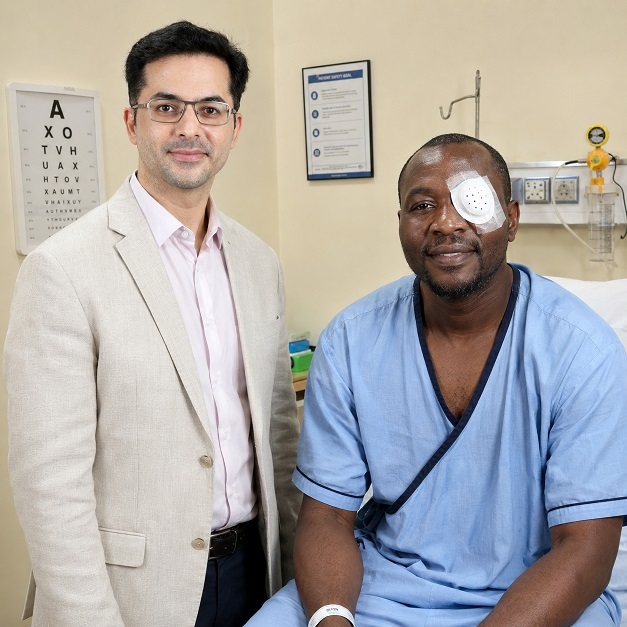
Healing Journeys of Congolese Patients
Key Takeaways
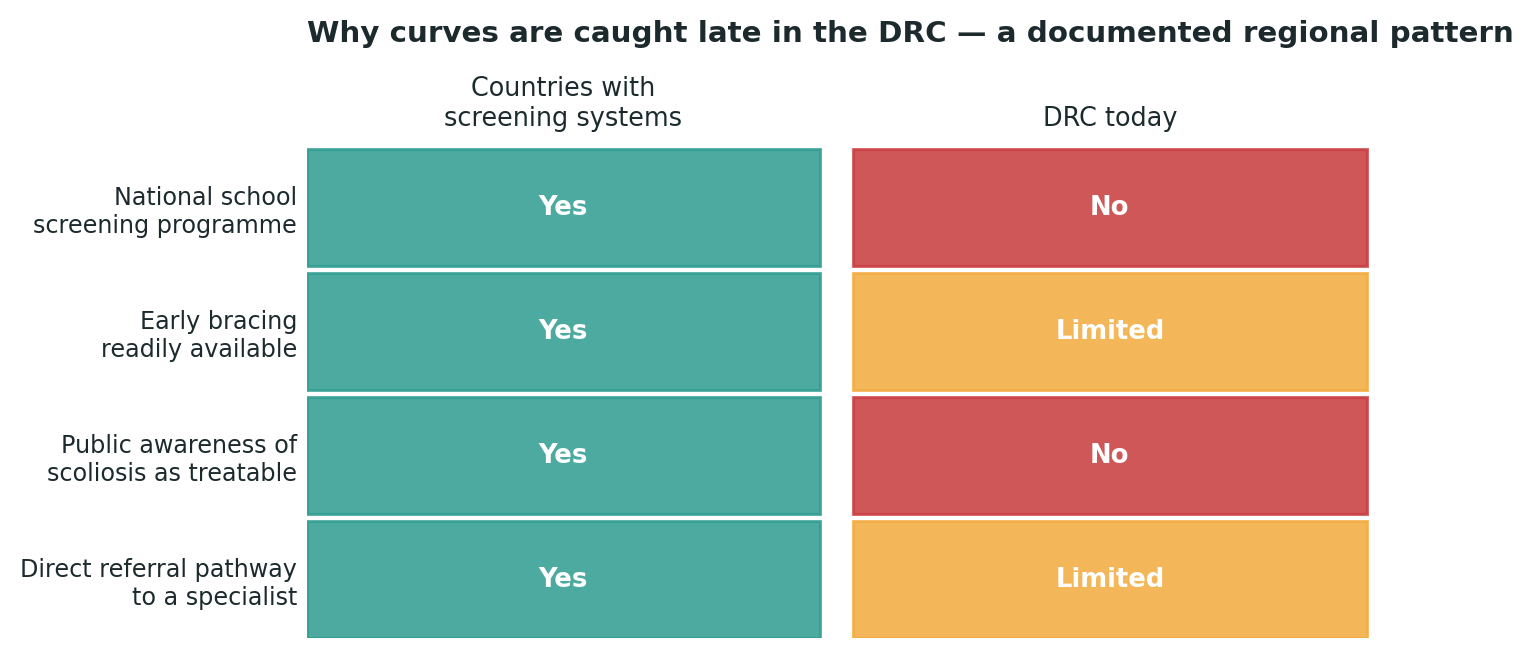
- The guide explains that scoliosis is often detected late in the DRC because there is no national school screening programme, while early bracing and direct referral pathways remain limited. Curves may therefore become severe before specialist assessment, although the guide stresses that this reflects an access gap rather than a lack of concern or medical skill.
- The page 2 chart illustrates how late presentation can affect the operation itself. In the published pattern shown, curves caught late were associated with approximately 11 vertebral levels fused versus 8 when caught early, 6.5 hours of operating time versus 4.5 hours, and blood loss of 700 mL versus 400 mL. The guide uses these figures to demonstrate why early assessment matters even when surgery is not immediately required.
- The guide emphasises that a 25-degree curve and a 90-degree curve are surgically very different problems, even though both are labelled scoliosis. Severe or rigid curves may require additional techniques such as osteotomies, vertebral column procedures or, in some cases, staged surgery. The page 3 illustrative distribution shows 15% mild, 25% moderate, 40% severe and 20% very severe/rigid curves in settings without routine screening.
- The page 4 cost chart gives an indicative scoliosis correction range of US$8,000–17,000 in India, compared with US$30,000–50,000 in France/Belgium, US$50,000–90,000 in the UK private sector and US$100,000–250,000 in the US. The guide stresses that cost depends substantially on curve severity and the number of vertebral levels requiring fusion.
- For Congolese families, the guide recommends seeking an opinion as soon as a curve is noticed, sending actual scan files rather than only written reports, asking how the quotation could change if the case proves more complex and confirming the proposed number of vertebral levels and surgical technique. A written estimate should contain all major cost components, with a 15–20% financial buffer recommended.
- The guide also highlights practical travel considerations, including starting the Indian medical and attendant visa process early, maintaining a current yellow-fever certificate and planning realistic connecting flights from Kinshasa, since there is no direct flight to India. Ethiopian Airlines via Addis Ababa is identified as the most frequent option, with Kenya Airways, Air France and Qatar Airways as alternatives.
- For long-term care, the guide recommends arranging follow-up in the DRC before travelling, because scoliosis correction requires periodic monitoring for years. It also identifies warning signs such as receiving a quote without imaging review, no explanation of how complexity could change the cost, no specific number of levels or technique being proposed, and pressure to pay the full balance before a written surgical plan exists.
Quick Facts
- Author
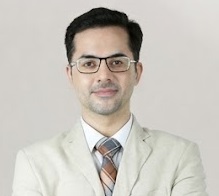
- Dr. Dheeraj Bojwani
- Experience
- 24+ Years
- Treatment
- Scoliosis Correction Surgery
- Patients
- Congolese Patients
- Key Specialist
- Spine Deformity / Scoliosis Surgeon
- Major Challenge
- Late detection due to absence of national school screening
- Early Detection Benefit
- May preserve bracing and other non-surgical options
- Illustrative Curve Distribution
- 15% mild, 25% moderate, 40% severe and 20% very severe/rigid
- Late-Curve Surgery
- More vertebral levels, longer operating time and greater blood loss
- India Cost
- US$8,000–17,000
- France/Belgium
- US$30,000–50,000
- UK Private Sector
- US$50,000–90,000
- US
- US$100,000–250,000
- Cost Driver
- Curve severity and number of vertebral levels fused
- Imaging
- Send actual scan files
- Surgical Check
- Confirm number of levels and proposed technique
- Financial Buffer
- 15–20% above initial estimate
- Visa
- Paper medical visa and attendant visa
- Entry Requirement
- Current yellow-fever certificate
- Flight Planning
- Connecting flights from Kinshasa to India
- Follow-Up
- Long-term monitoring in the DRC
- Key Warning
- Do not accept a quotation without actual imaging review
- Decision Principle
- Choose a centre experienced in the full range of scoliosis severity, particularly severe and rigid curves.
In Brief
For Congolese patients with scoliosis, the guide recommends early specialist assessment even when surgery may not yet be necessary, because identifying the curve earlier can preserve non-surgical options and potentially reduce surgical complexity. For patients requiring correction surgery, the chosen centre should demonstrate experience with severe and rigid curves, provide a clear level-by-level surgical plan and offer structured long-term follow-up.
Why Curves Are Caught Late in the DRC
Unlike many higher-income countries, the DRC has no national school screening programme for scoliosis — a pattern documented across much of Sub-Saharan Africa, including in neighbouring Francophone countries with published data. Without routine screening, a curve typically goes unnoticed until it becomes visible enough for a parent or teacher to see, by which point it is often already severe. In parts of the region, scoliosis is still sometimes viewed through a cultural or mystical-religious lens rather than as a straightforward, treatable medical condition, which can delay a family's decision to seek care even further.
None of this reflects a lack of concern from families. A curve that develops gradually, without pain in its early stages, is genuinely easy to miss without a structured screening system looking for it — the same reason many high-income countries built school screening programmes in the first place.
Why "Caught Late" Changes the Surgery Itself
This matters beyond timing. An international study comparing adolescent scoliosis surgery across countries with differing levels of access to care found that patients from lower-access settings presented with significantly larger curves — and that larger curves required more vertebral levels fused, longer operating time, and greater blood loss during surgery.
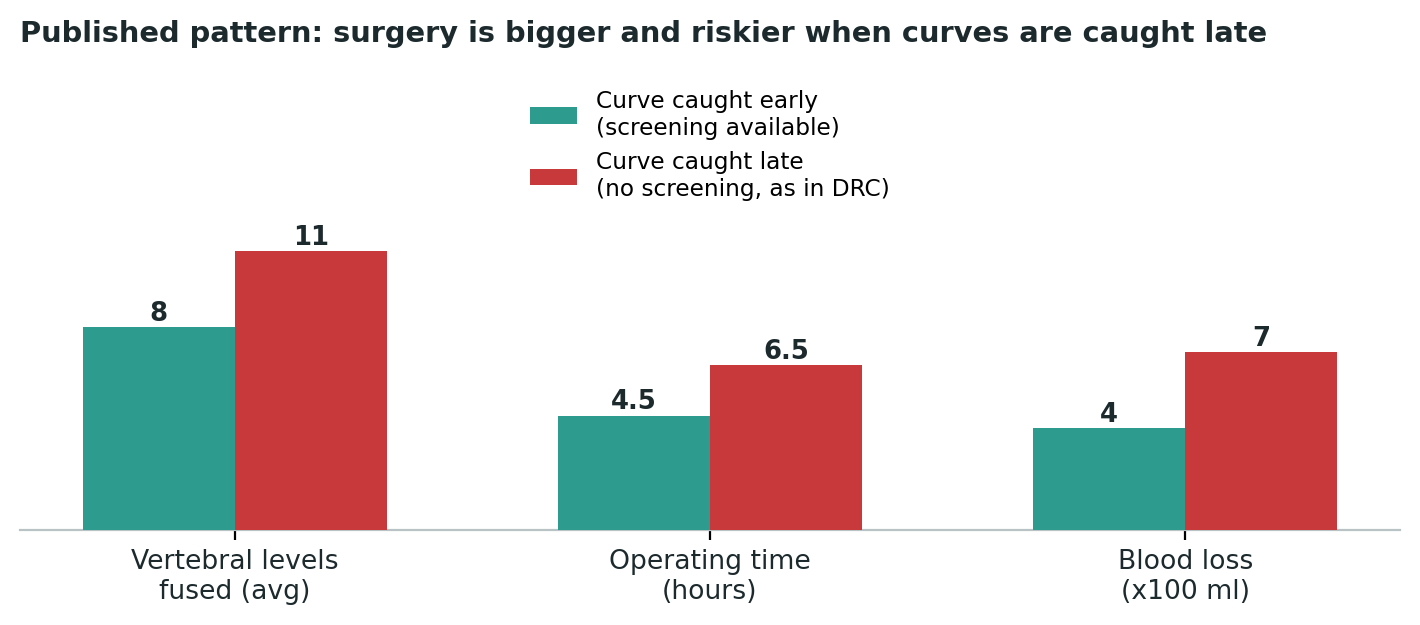
It is worth being direct about what this means in practice. Two patients can carry the identical diagnosis of adolescent idiopathic scoliosis, yet require very different operations, very different recovery times, and very different levels of surgical experience from their chosen team — simply because one curve was caught at 25 degrees and the other at 95. None of this is the patient's fault, or a family's fault; it is the direct, measurable consequence of a missing screening system, and understanding it changes what questions are worth asking a prospective surgeon.
The one fact worth remembering
A curve caught at 25 degrees and a curve caught at 90 degrees are, in surgical terms, very different problems, even though both are called "scoliosis." The second may need additional techniques — osteotomies, vertebral column procedures, sometimes staged surgery — that the first never requires. This is why an early opinion, even if surgery is not yet needed, is worth seeking as soon as a curve is noticed.
What Curve Severity Typically Looks Like Without Screening
In settings without routine screening, a much larger share of patients present with severe or rigid curves than would be expected in a screened population.
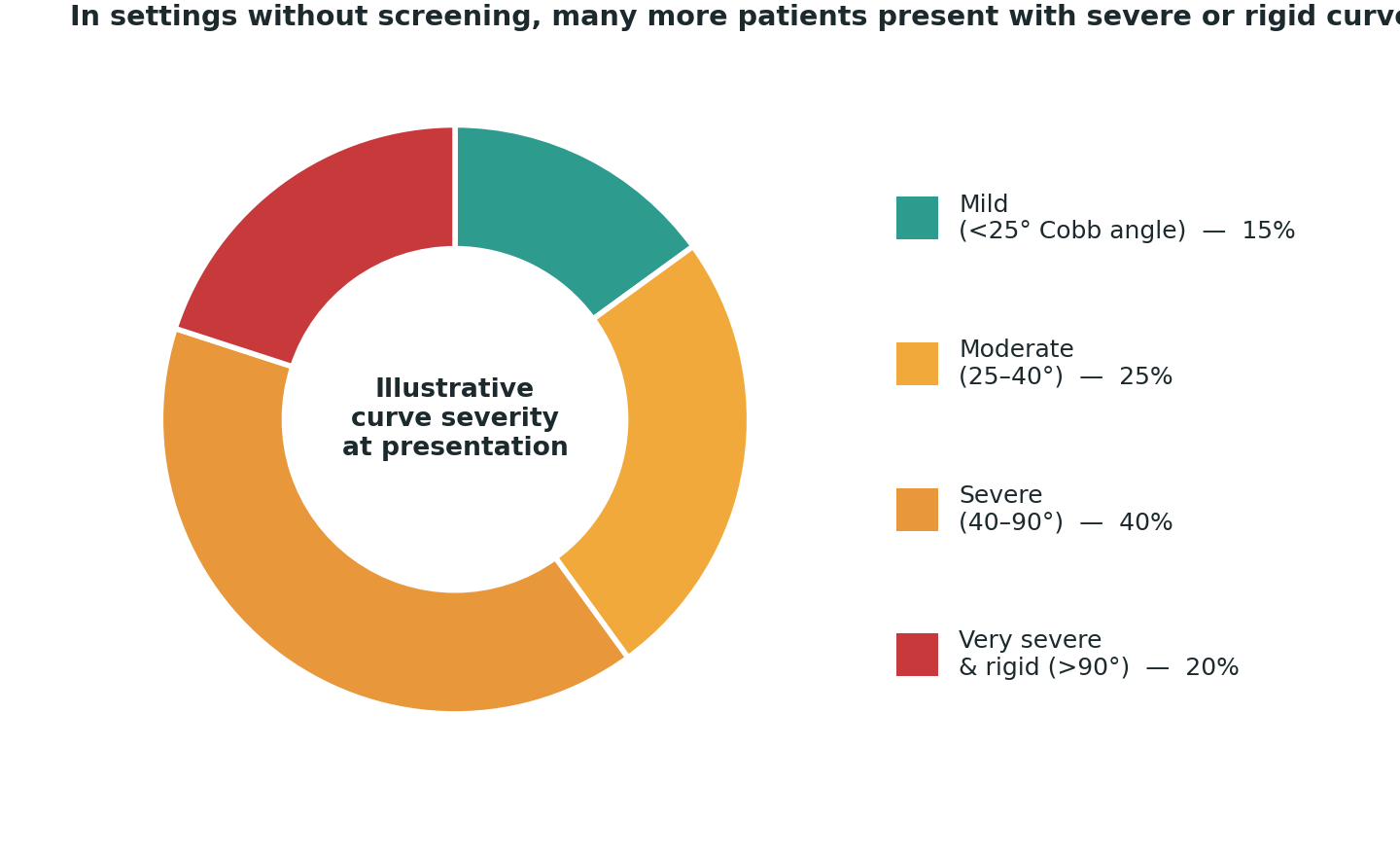
This distribution shapes almost everything about treatment planning. A programme accustomed to mostly mild-to-moderate cases, where bracing or a single straightforward fusion is the norm, may simply not carry the routine caseload of severe deformity work that Congolese patients are statistically more likely to need. This is not a criticism of such programmes — it is a mismatch worth checking for directly, well before travel is booked.
What This Surgery Costs: DRC Reality vs India vs the West
Cost varies enormously with curve severity and the number of vertebral levels involved, which is exactly why catching a curve early, wherever that happens, matters financially as well as medically.
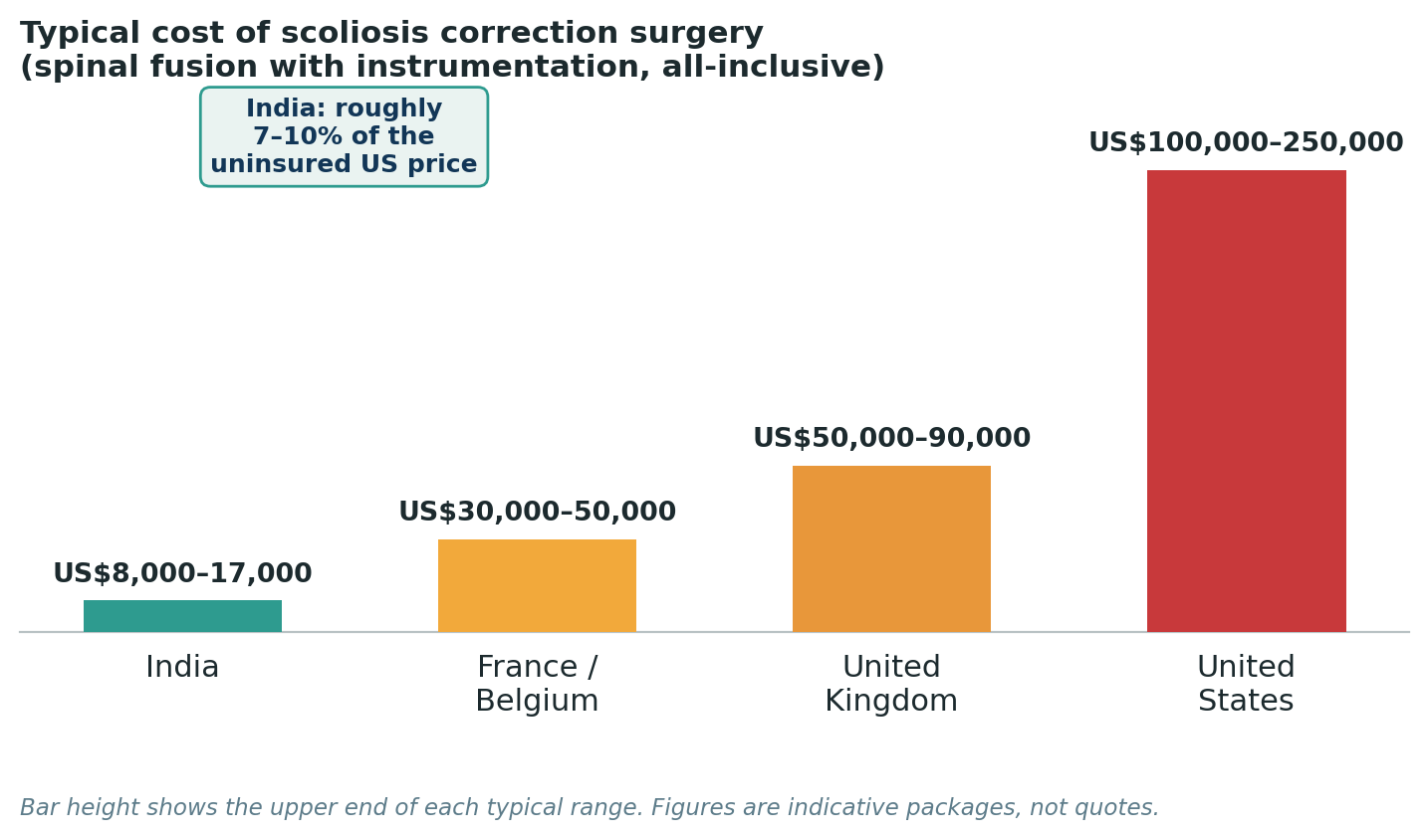
In India, scoliosis correction surgery typically costs US$8,000 to US$17,000, depending on curve severity and the number of levels fused. In France or Belgium, private-sector costs typically run US$30,000 to US$50,000. In the UK's private sector, costs range roughly US$50,000 to US$90,000. In the US, the same surgery commonly costs US$100,000 to US$250,000. India's typical price sits at roughly a tenth of the uninsured US figure.
What the number on the quote does not always show
A written estimate should specify the assumed number of vertebral levels and whether it would change if your case turns out more complex than initial scans suggest — a real risk with severe, neglected curves. In 24 years of reviewing these quotes, I have found disputes almost never concern the headline figure — they concern what it silently left out. Get every line item in writing, and never pay the full balance before surgery.
What a Congolese Family Should Weigh, Specifically
Beyond the medical facts already covered, a handful of practical steps make a real difference to how smoothly treatment goes from the DRC.
- Seek an opinion as soon as a curve is noticed, even if surgery seems far off — early evaluation keeps non-surgical options genuinely open.
- Send the actual scan files, not just the typed report, since surgical planning depends on precise curve measurement.
- Ask how the quote might change if the case is more complex than expected, given how often severe curves are only fully understood once imaging is complete.
- Budget in US dollars, with margin. The Congolese franc has weakened considerably against the dollar (roughly CDF 2,300–2,350 per US$1 in mid-2026, and it moves); build in a 15–20% buffer above the initial estimate.
- Start the visa process early. DRC passport holders need a paper medical visa through the Embassy of India in Kinshasa (Avenue Batetela, Gombe), typically around two weeks once the hospital's invitation letter is ready; apply for an attendant visa at the same time.
- Confirm your yellow fever certificate is current — mandatory for entry into India, at least 10 days before travel.
- Plan the route realistically. There is no direct flight from Kinshasa to India; Ethiopian Airlines via Addis Ababa is the most frequent option, with Kenya Airways, Air France, and Qatar Airways as alternatives.
- Arrange follow-up care in the DRC before you fly — scoliosis correction needs periodic monitoring for years afterward, and identifying a doctor at home matters as much as the operation itself.
Four signals that should make you pause
- A quote given before anyone has reviewed your actual imaging.
- No explanation of how the estimate might change with case complexity.
- No mention of a specific number of levels or surgical technique proposed.
- Pressure to pay the full balance before a written surgical plan exists.
Why India Specifically for Scoliosis Correction Surgery for Congolese Patients?
India operates high-volume scoliosis centres with genuine experience across the full range of curve severity, including the complex, neglected cases more common in settings without screening — not just the milder curves typically seen where early detection is routine. Combined with English-language consultation throughout and hospital accreditation (NABH domestically, JCI internationally) that mirrors the standards used to evaluate hospitals in the US and Europe, India offers a combination of depth of experience and lower cost that matters especially for the more complex cases many Congolese patients present with, where a centre's comfort with severe curves is not something every programme can genuinely claim. This depth is precisely what a family facing a severe or rigid curve needs to look for, rather than settling for the first available offer.
A closing word
A scoliosis diagnosis, especially a severe one discovered late, can feel overwhelming, but it remains a treatable condition at almost any stage. What matters most is an accurate assessment of your specific curve and an honest surgical plan built around it. If you are able to share your scans, I am glad to look them over and give a direct, honest view on what your case would involve.
Sources
- 🌐 National Medical Commission of India — verify any surgeon's registration · nmc.org.in
- 🌐 National Accreditation Board for Hospitals & Healthcare Providers (NABH) · nabh.co
- 🌐 Embassy of India, Kinshasa — medical visa requirements · eoikinshasa.gov.in
- 🌐 "Epidemiological and Diagnostic Characteristics of Scoliosis in Children...Abidjan," African Journal of Paediatric Surgery (2022) · doi.org/10.4103/ajps.AJPS_62_21
- 🌐 "The Adolescent Idiopathic Scoliosis International Disease Severity Study," Spine Deformity · sciencedirect.com/science/article/abs/pii/S2212134X19300668
- 🌐 World Health Organization — yellow fever vaccination requirements · who.int/health-topics/yellow-fever
Frequently Asked Questions by Congolese Patients about Scoliosis Correction Surgery in India
Why is scoliosis often diagnosed late in the DRC?
The guide explains that the DRC has no national school screening programme, while early bracing and direct specialist referral remain limited. This can allow curves to become more severe before diagnosis.
Why does late diagnosis affect scoliosis surgery?
Larger curves may require more vertebral levels to be fused, longer operating times and greater blood loss than curves identified earlier.
Can scoliosis be treated without surgery?
Yes. Early assessment can keep non-surgical options such as bracing open for appropriate patients. The treatment depends on the curve's severity, age and progression.
What happens with very severe or rigid scoliosis?
The guide explains that severe curves may require additional techniques, including osteotomies, vertebral column procedures and sometimes staged surgery.
How much does scoliosis surgery cost in India?
The guide gives an indicative range of US$8,000–17,000, depending mainly on curve severity and the number of vertebral levels fused.
Should I send actual scans before requesting a quotation?
Yes. The guide specifically recommends sending actual scan files rather than only the typed report, because precise curve measurement is essential for surgical planning.
What should the quotation specify?
The written estimate should identify the assumed number of vertebral levels and explain how the cost could change if the case proves more complex than initially expected.
How much financial buffer should Congolese families keep?
The guide recommends budgeting in US dollars and maintaining a 15–20% buffer above the initial estimate to accommodate potential changes.
What travel documents are required?
Congolese patients should start the Indian medical and attendant visa process early and ensure their yellow-fever certificate is current, as it is mandatory for entry into India.
Why is follow-up in the DRC important?
Scoliosis correction requires periodic monitoring for years after surgery. The guide therefore recommends identifying a doctor in the DRC who can provide ongoing follow-up before travelling to India.
Page Summary
This guide helps Congolese families understand scoliosis correction surgery in India, particularly why late diagnosis in the DRC can result in larger curves and more complex surgery. The page 2 chart demonstrates the differences in fused levels, operating time and blood loss between early-and late-detected curves, while the page 3 graphic illustrates the greater proportion of severe and very severe curves in settings without screening. The page 4 cost comparison and page 5 travel and follow-up guidance focus on transparent planning, specialist experience and long-term care.
Citation Block
| Field | Information |
|---|---|
| Topic | Scoliosis Correction Surgery in India for Congolese Patients |
| Treatment | Scoliosis Correction Surgery / Spinal Fusion |
| Patients | Congolese Patients |
| Key Specialist | Spine Deformity / Scoliosis Surgeon |
| Major Access Issue | No national school screening programme in the DRC |
| Curve Distribution | 15% mild, 25% moderate, 40% severe, 20% very severe/rigid |
| Early vs Late Fusion | 8 vs 11 vertebral levels |
| Operating Time | 4.5 vs 6.5 hours |
| Blood Loss | 400 vs 700 mL |
| India Cost | US$8,000–17,000 |
| Cost Driver | Curve severity and number of levels fused |
| Surgical Planning | Confirm levels, technique and complexity |
| Imaging | Actual scan files |
| Second Opinion | Recommended before major corrective surgery |
| Financial Planning | 15–20% buffer above initial estimate |
| Visa | Medical visa and attendant visa |
| Entry Requirement | Yellow-fever certificate |
| Travel Route | Connecting flights from Kinshasa to India |
| Follow-Up | Periodic monitoring in the DRC |
| Warning Signs | Quote without imaging, unclear levels or technique, no complexity explanation or advance-payment pressure |
| Key Decision | Select a centre experienced in severe and rigid scoliosis as well as routine cases |

Our Mission Statement
Our mission is to place patients at the centre of every healthcare decision by providing trustworthy, evidence-based, and unbiased medical information. We believe that informed patients make better decisions. Backed by personalised guidance from our experienced advisory team, we help patients understand their treatment options, compare them objectively, and confidently choose the path that best suits their medical needs and personal circumstances.
Patient Testimonials from Congo
Ready to Take the First Step?
Share your medical reports with our healthcare managers today and receive a FREE CONSULTATION, a personalized treatment plan and complete support from your arrival to your recovery.
Get Your Free ConsultationAreas We Serve
At Indian Health Guru Consultants, we proudly assist patients from Congo and neighboring countries across Central, East and Southern Africa who travel to India for advanced medical treatment. Our experienced international patient team provides end-to-end support, including medical opinions, hospital selection, Medical Visa assistance, travel planning, accommodation, interpreter services and post-treatment follow-up.
We regularly serve patients from:
- Gabon
- Cameroon
- Angola
- Uganda
- Rwanda
- Burundi
- Tanzania
- Zambia
- Djibouti
- Comoros
- Madagascar
- Seychelles
- South Sudan
- Central African Republic
- Republic of the Congo
- Democratic Republic of the Congo
No matter where you are located in the region, Indian Health Guru Consultants is committed to making your medical journey to India safe, affordable, seamless and completely patient-focused.
From Congo to India: Your Complete Patient Guide
- Brain Tumor Surgery in India for Congolese Patients
- Best Brain Tumour Surgeons & Hospitals in India for Congo Patients
- Knee Replacement in India for Congolese Patients
- Best Knee Replacement Surgeons & Hospitals in India for Congolese Patients
- Spine Surgery in India for Congolese Patients
- Best Spine Surgeons & Hospitals in India for Congolese Patients
- Liver Transplant in India for Congolese Patients: Cost & Guide
- Best Liver Transplant Centres and Hospitals in India for Congolese Patients
- Cardiac Surgery in India for Congolese Patients: Cost & Guide
- Best Cardiac Surgeons & Hospitals in India for Congolese Patients
- Bone Marrow Transplant in India for Congolese Patients: Cost & Guide
- Best Bone Marrow Transplant Centres and Hospitals in India for Congolese Patients
- Prostate Cancer Treatment in India for Congolese Patients: Cost & Guide
- Best Prostate Cancer Centres and Hospitals in India for Congolese Patients
- HIPEC in India for Congolese Patients: Cost & Treatment Guide
- Best HIPEC Centres and Hospitals in India for Congolese Patients
- Kidney Transplant in India for Congolese Patients: Cost & Guide
- Best Kidney Transplant Centres and Hospitals in India for Congolese Patients