

Cancer Treatment and Surgery in India for Congolese Patients: What It Costs, and How to Decide Well
A practical guide for Congolese patients understanding complete cancer treatment in India, including surgery, chemotherapy, radiotherapy, costs and treatment planning.
Acancer diagnosis anywhere in the world sets off the same basic question: what combination of surgery, chemotherapy, and radiotherapy gives the best chance of beating it? In 24 years of advising cancer patients, I have found that in the DRC specifically, this question is often answered incompletely — not because doctors do not know the right combination, but because two of the three tools are frequently unavailable. This guide sets out plainly what that gap looks like in practice, what complete cancer treatment in India costs against the Western alternatives some families consider, and what to weigh before deciding. None of this reflects a lack of medical knowledge in the DRC — it reflects a genuine, documented gap in equipment and infrastructure, worth understanding clearly before deciding how to proceed.
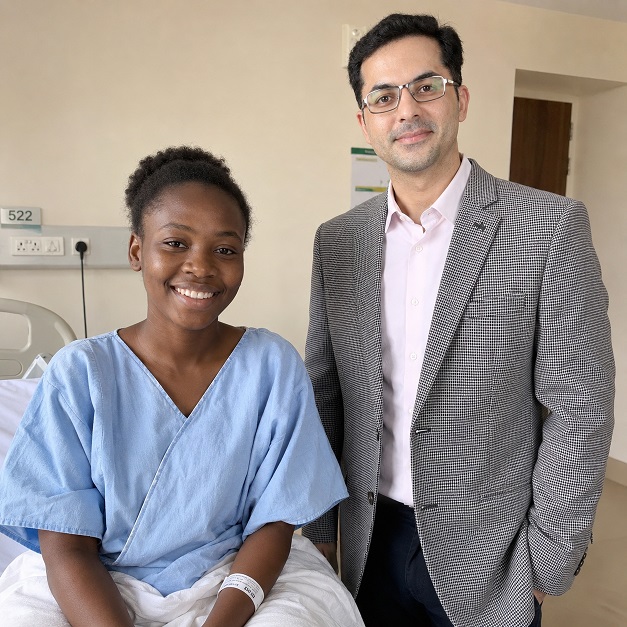
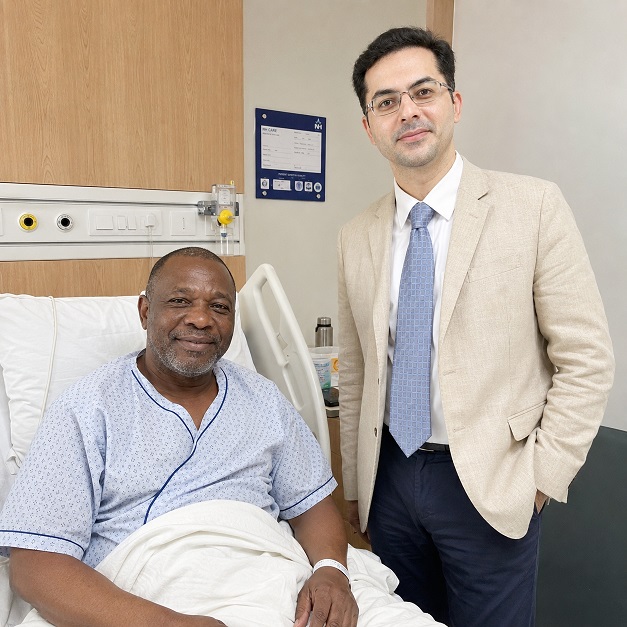
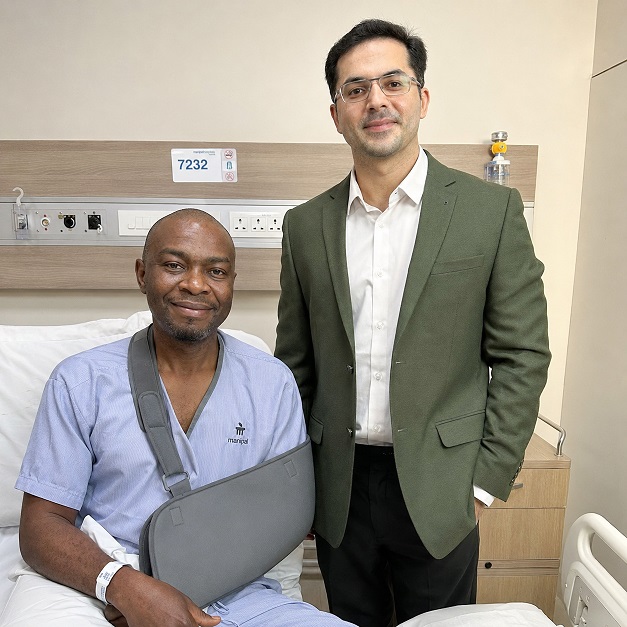
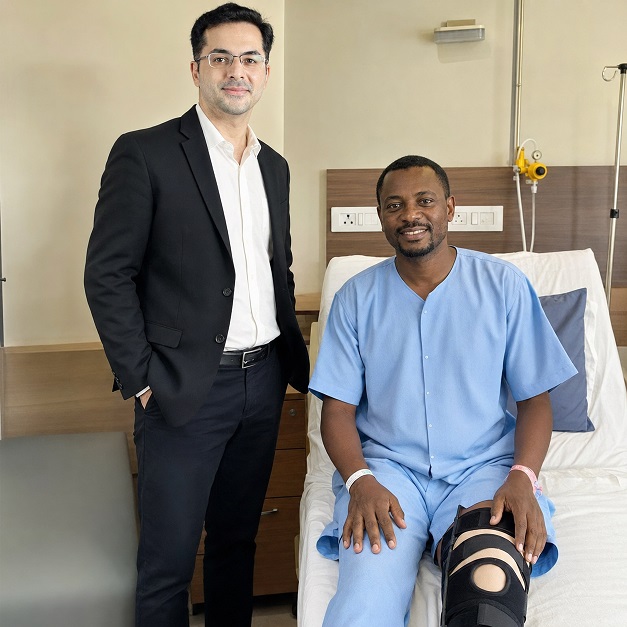
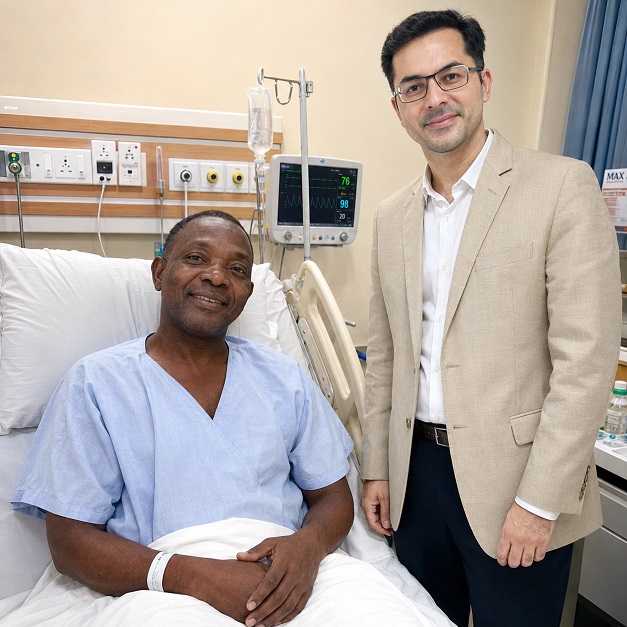
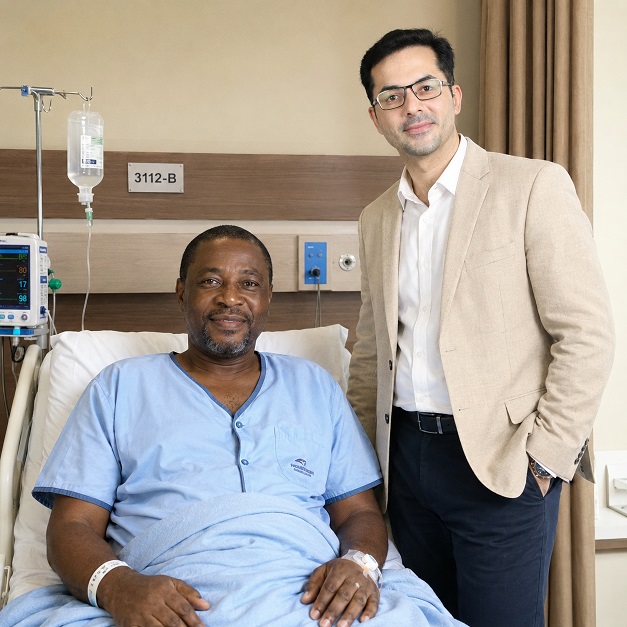
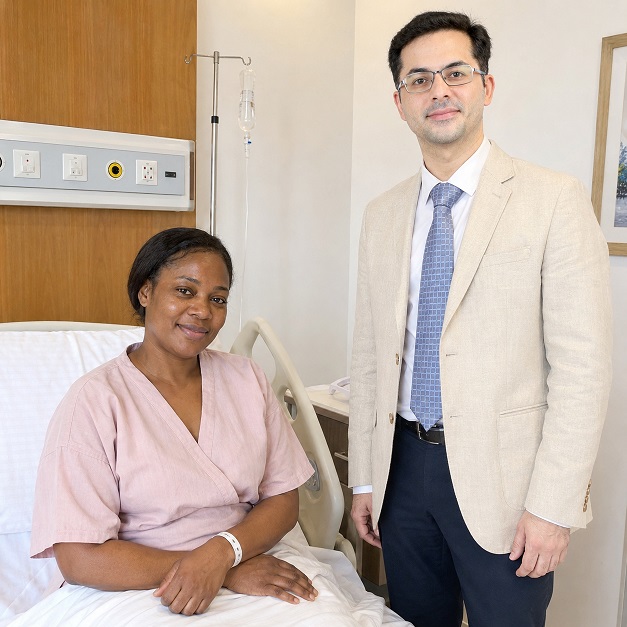
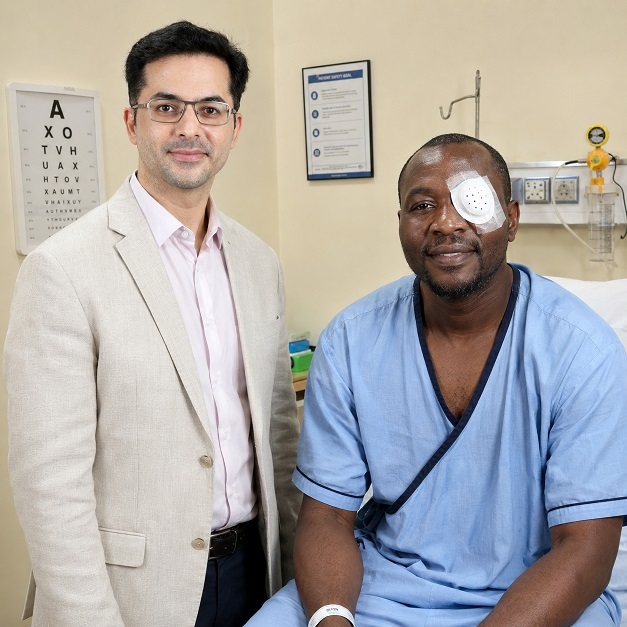
Healing Journeys of Congolese Patients
Key Takeaways
- The guide explains that modern cancer treatment is rarely limited to surgery alone. Depending on the cancer type and stage, surgery, chemotherapy and radiotherapy may need to work together. The guide highlights that limited availability of chemotherapy and radiotherapy in the DRC can leave some patients receiving only part of the treatment pathway.
- The page 2 treatment-pathway graphic contrasts a typical DRC pathway, where radiotherapy may be unavailable, with a complete pathway such as that available in India, where surgery, chemotherapy and radiotherapy can be coordinated. The DRC Ministry of Health estimate cited in the guide states that more than 25,000 patients require radiotherapy annually, while the country's sole private radiotherapy facility has capacity for about 500 patients per year.
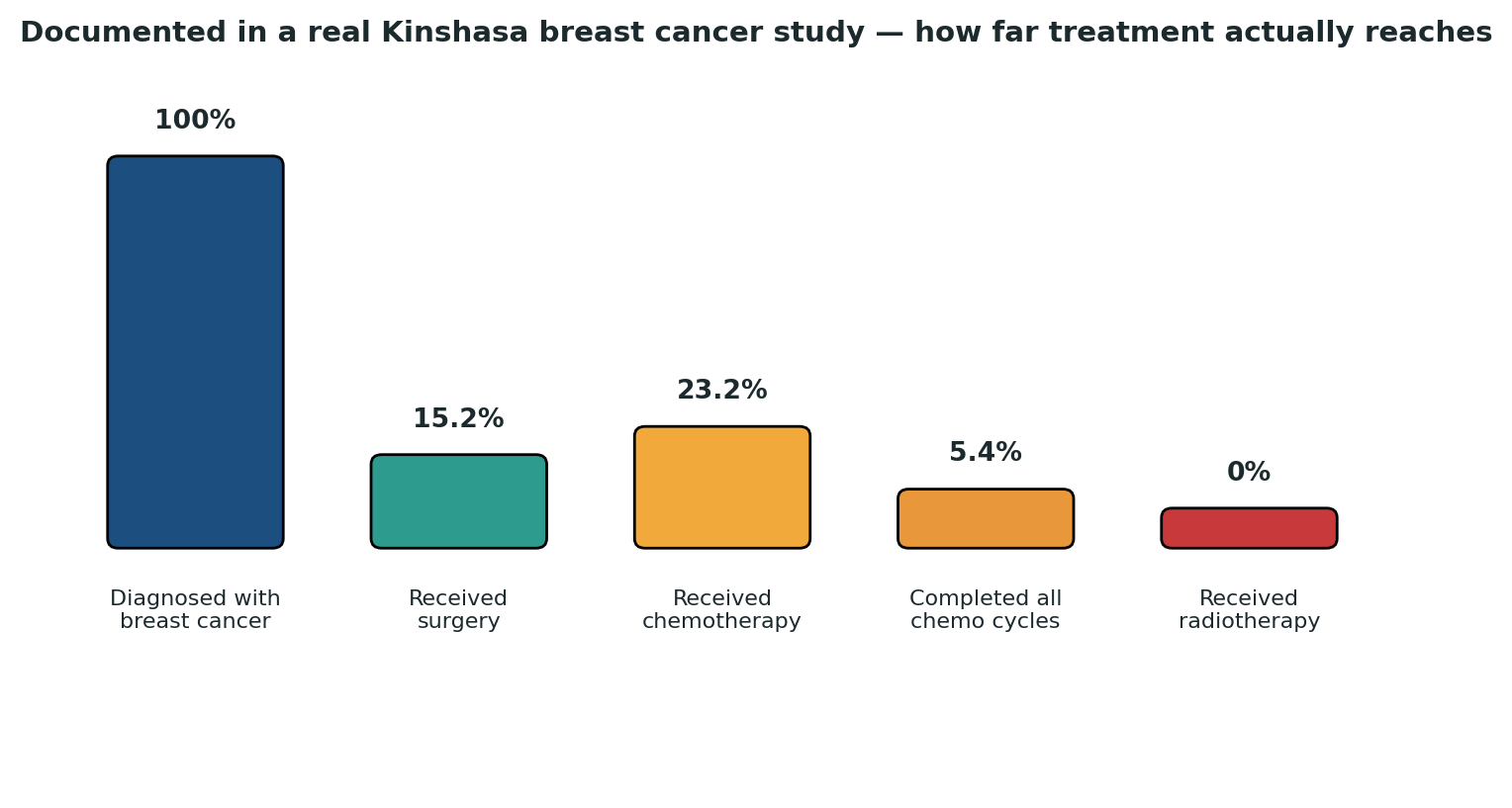
- The page 4 chart from a documented Kinshasa breast cancer study shows the treatment gap clearly: 15.2% underwent surgery, 23.2% received chemotherapy, only 5.4% completed all chemotherapy cycles and 0% received radiotherapy in the cited study. The guide uses this evidence to encourage patients to ask whether their complete guideline-based treatment should include additional modalities.
- The guide recommends confirming that the treating surgeon has genuine oncology-specific training, rather than relying only on general surgical experience. Patients should send their actual pathology and imaging, confirm the full treatment sequence and ask explicitly whether chemotherapy or radiotherapy should accompany surgery and in what order.
- The page 5 cost comparison shows an indicative complete cancer treatment pathway in India at US$4,000–15,000, compared with approximately US$22,000–50,000 in France/Belgium, US$25,000–70,000 in the UK private sector and US$50,000–150,000 in the US. The guide stresses that these are indicative package ranges and actual costs depend on cancer type, stage and treatment requirements.
- For Congolese patients, the guide recommends independent review of pathology and imaging, a written treatment plan and complete itemised quotation, together with a 15–20% financial buffer. It also advises starting the paper medical and attendant visa process early and ensuring a current yellow-fever certificate before travel.
Quick Facts
- Author
- Dr. Dheeraj Bojwani
- Experience
- 24+ Years
- Treatment
- Cancer Treatment & Surgery
- Patients
- Congolese Patients
- Key Specialist
- Oncology-Trained Cancer Surgeon
- Treatment Approach
- Surgery, chemotherapy and radiotherapy as clinically appropriate
- First Step
- Confirm the complete treatment pathway
- Surgeon Check
- Genuine oncology-specific training
- Assessment
- Actual pathology and imaging
- Treatment Sequence
- Confirm timing between surgery, chemotherapy and radiotherapy
- Cost Range
- India US$4,000–15,000 indicative complete pathway
- Second Opinion
- Recommended before treatment
- Financial Buffer
- 15–20% above the initial estimate
- Visa
- Paper medical visa and attendant visa
- Entry Requirement
- Current yellow-fever certificate
- Follow-Up
- Planned after returning to the DRC
- Key Warning
- Do not accept surgery alone without asking whether additional treatment is medically required
- Decision Principle
- Choose the complete cancer treatment pathway, not simply the treatment currently available locally.
In Brief
For Congolese patients seeking cancer treatment in India, the guide recommends understanding the complete treatment pathway rather than accepting surgery alone as the final plan. Patients should verify oncology-specific expertise, staging, the need for chemotherapy and radiotherapy, treatment sequencing, complete costs, visa requirements and follow-up before travelling.
Why Cancer Surgery Often Stands Alone in the DRC
International health authorities reviewing cancer care in the DRC have found that cancer is often treated through surgery specifically because radiotherapy and chemotherapy services are not sufficiently developed, and diagnostic services remain limited. Cancer surgery itself is frequently performed by general surgeons and other specialists without dedicated oncology training, rather than by surgeons trained specifically in cancer care.
This distinction between a general surgeon and an oncology-trained surgeon matters more than it might first appear. Cancer surgery often requires specific technique to ensure clear margins around a tumour, careful handling to avoid spreading cancerous cells during the operation, and judgement about when a tumour needs to shrink with chemotherapy before surgery is even attempted. These are skills built through dedicated oncology training, not automatically present in general surgical experience, however extensive.
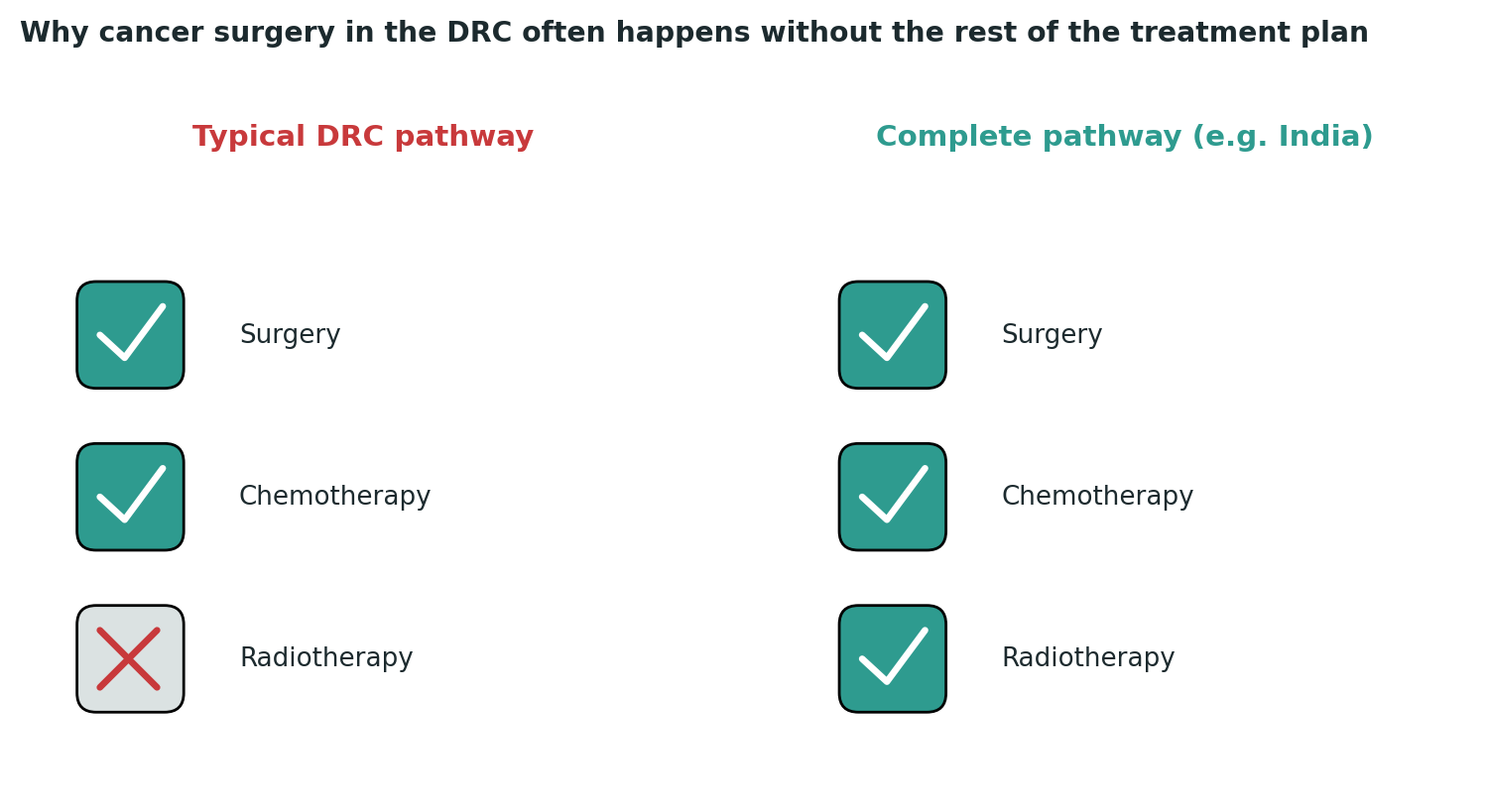
This matters because modern cancer treatment is rarely a single intervention. Surgery removes the visible tumour, but chemotherapy and radiotherapy are frequently what address microscopic disease left behind, or shrink a tumour enough to make surgery possible in the first place. Surgery alone, without the modalities that international guidelines recommend alongside it, is treating part of the problem rather than the whole of it.
A Radiotherapy Gap Measured in Tens of Thousands of Patients
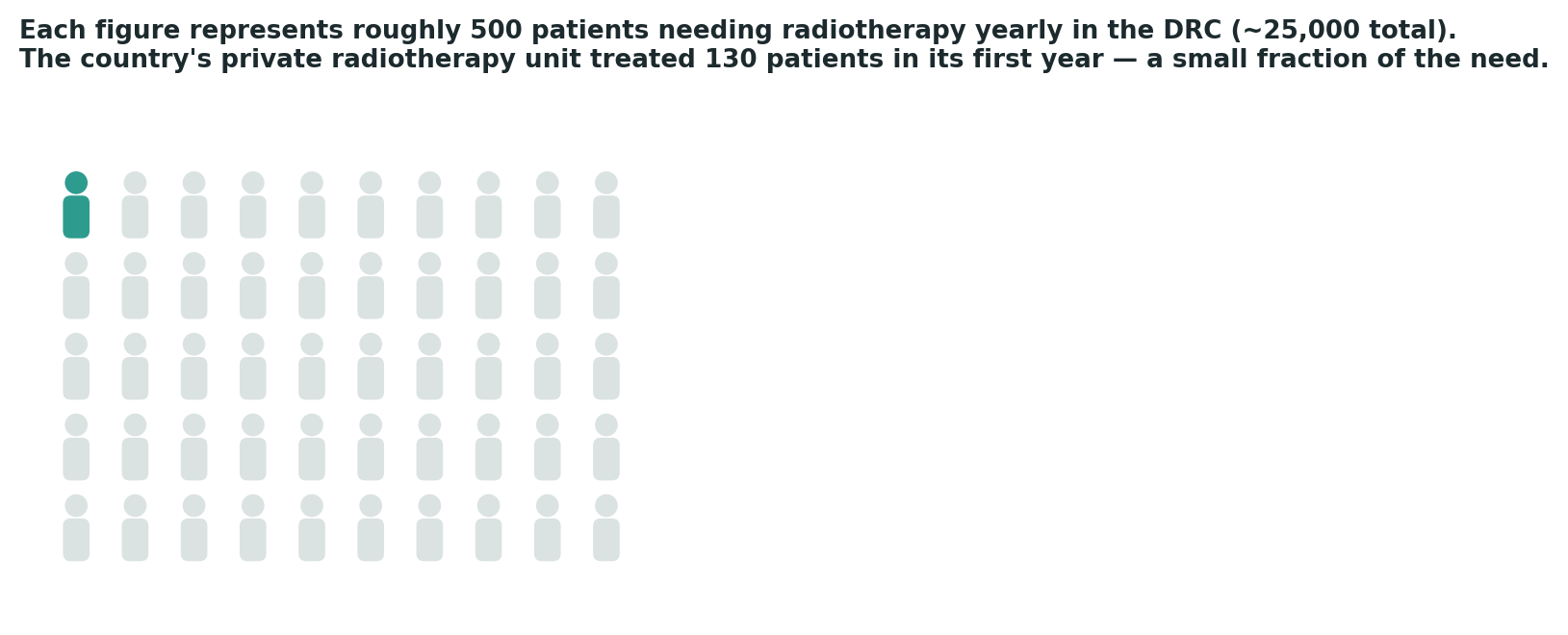
The DRC's own health ministry estimates that more than 25,000 patients require radiotherapy treatment each year nationally. The country's sole private radiotherapy facility, established in 2020, has the capacity to treat 500 patients annually — and treated just 130 patients in its first year of operation.
Even at full capacity, this single facility could meet only around 2% of estimated national need. This is not a criticism of the facility itself, which represents genuine, hard-won progress — it is a reflection of how large the underlying gap remains, and why so many patients whose cancer would benefit from radiotherapy simply never receive it.
The one fact worth remembering
If your treatment plan in the DRC involves surgery only, this does not necessarily mean surgery is all your case needs — it may simply reflect what is currently available locally. It is always worth asking explicitly whether chemotherapy or radiotherapy would normally be recommended alongside your surgery, and if so, why they are not part of your current plan.
What This Looks Like in a Real, Documented Case
A study of breast cancer patients at a major Kinshasa hospital gives a precise, sobering picture of how far treatment actually reaches in practice. Among patients diagnosed, only 15.2% ultimately underwent surgery. Just under a quarter received any chemotherapy at all, and of those, only a small fraction completed the full recommended course of six cycles. Not a single patient in the study received radiotherapy, because, as the researchers stated plainly, there was no capacity to provide it.
The DRC's two most common cancers, prostate cancer in men and cervical cancer in women, together account for tens of thousands of new diagnoses each year nationally. Both are cancers where the combination of surgery with chemotherapy or radiotherapy, delivered in the right sequence, meaningfully changes outcomes — making this treatment gap a matter of real, ongoing consequence for a very large number of Congolese patients.
What a Complete Treatment Pathway Costs: DRC Reality vs India vs the West
Cost depends heavily on cancer type, stage, and which combination of surgery, chemotherapy, and radiotherapy your specific case requires, but the relative gap between India and Western options holds fairly consistently.
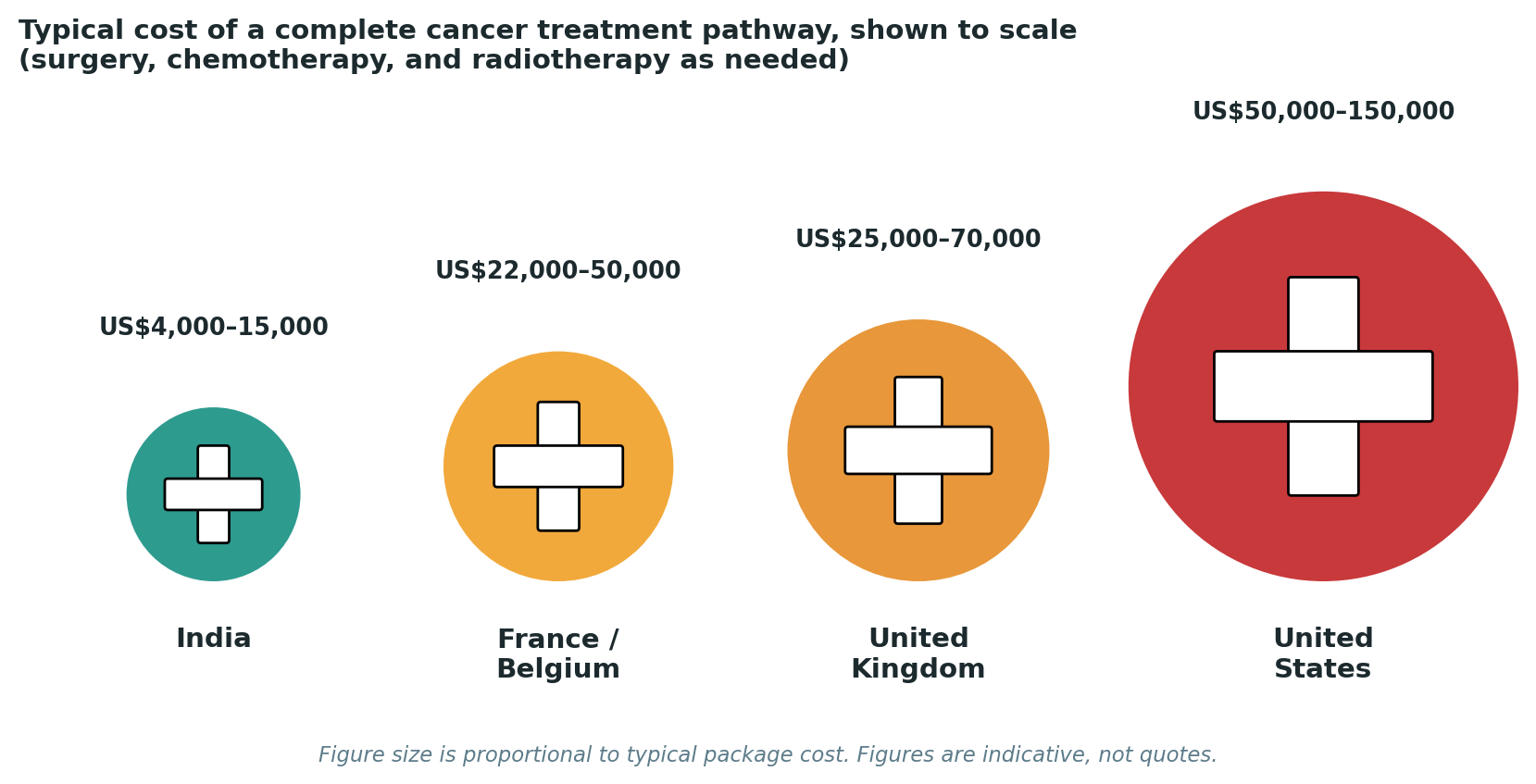
In India, a complete cancer treatment pathway typically costs US$4,000 to US$15,000, depending on cancer type and stage. In France or Belgium, private-sector costs typically run US$22,000 to US$50,000. In the UK's private sector, costs range roughly US$25,000 to US$70,000. In the US, the same combination of treatments commonly costs US$50,000 to US$150,000. India's typical price sits at roughly a tenth of the uninsured US figure.
What the number on the quote does not always show
A written estimate should specify exactly which combination of surgery, chemotherapy, and radiotherapy is included, and in what sequence, since cancer treatment plans often unfold over months rather than a single visit. In 24 years of reviewing these quotes, I have found disputes almost never concern the headline figure — they concern what it silently left out. Get every line item in writing, and never pay the full balance before treatment begins.
What a Congolese Patient Should Weigh, Specifically
- Ask explicitly whether your case would normally need chemotherapy or radiotherapy alongside surgery, even if your current local plan is surgery alone.
- Confirm the surgeon treating you has genuine oncology-specific training, not only general surgical experience.
- Send the actual pathology and imaging results, not just a description of your diagnosis, since treatment planning depends on precise staging.
- Ask how the full treatment sequence would be planned and delivered, including timing between surgery, chemotherapy, and radiotherapy.
- Budget in US dollars, with margin. The Congolese franc has weakened considerably against the dollar (roughly CDF 2,300–2,350 per US$1 in mid-2026, and it moves); build in a 15–20% buffer above the initial estimate.
- Start the visa process early. DRC passport holders need a paper medical visa through the Embassy of India in Kinshasa (Avenue Batetela, Gombe), typically around two weeks once the hospital's invitation letter is ready; apply for an attendant visa at the same time.
- Confirm your yellow fever certificate is current — mandatory for entry into India, at least 10 days before travel.
- Plan for a longer stay than a single procedure — a complete cancer treatment pathway often spans weeks or months, not days.
Four signals that should make you pause
- Surgery proposed without discussing whether chemotherapy or radiotherapy should accompany it.
- No confirmation of the treating surgeon's specific oncology training.
- No clear staging or pathology results behind the treatment plan.
- Pressure to pay the full balance before a written, complete treatment plan exists.
Why India Specifically for Cancer Treatment and Surgery for Congolese Patients?
India operates dedicated, high-volume cancer centres offering the complete combination of surgery, chemotherapy, and radiotherapy under one coordinated treatment plan — addressing directly the gap that leaves so many Congolese patients with surgery alone. Combined with oncology-trained surgeons, English-language consultation throughout, and hospital accreditation (NABH domestically, JCI internationally) that mirrors the standards used to evaluate hospitals in the US and Europe, India offers both the full range of treatment modalities and the affordability that make complete, guideline-based cancer care realistically achievable, for exactly the kind of cancers most commonly diagnosed among Congolese patients.
A closing word
Surgery alone, when the medical guidelines call for more, is not a complete answer to a cancer diagnosis — it is a partial one, shaped by what is currently available rather than what your specific case actually needs. What matters most is understanding your full, correct treatment pathway, and finding a way to access all of it, not just the piece that happens to be available locally. If you are able to share your pathology and imaging results, I am glad to give a direct, honest view on what complete treatment would involve.
Sources
- 🌐 National Medical Commission of India — verify any surgeon's registration · nmc.org.in
- 🌐 National Accreditation Board for Hospitals & Healthcare Providers (NABH) · nabh.co
- 🌐 Embassy of India, Kinshasa — medical visa requirements · eoikinshasa.gov.in
- 🌐 IAEA, "Strengthening Cancer Care in Democratic Republic of the Congo" (2025) · iaea.org/newscenter/news
- 🌐 Baleka et al., "Challenges in the management of breast cancer in Kinshasa," Journal of Clinical Oncology (2022) · ascopubs.org
- 🌐 World Health Organization — yellow fever vaccination requirements · who.int/health-topics/yellow-fever
Frequently Asked Questions by Congolese Patients about Cancer Treatment and Surgery in India
Is surgery alone always sufficient for cancer treatment?
No. Depending on the cancer type and stage, chemotherapy and radiotherapy may also be required alongside surgery.
Why can cancer treatment be incomplete in the DRC?
The guide highlights limited availability of radiotherapy, chemotherapy and diagnostic infrastructure, which can restrict access to the complete treatment pathway.
How many patients require radiotherapy in the DRC?
The guide cites the DRC Ministry of Health estimate of more than 25,000 patients requiring radiotherapy each year, compared with capacity of about 500 patients annually at the cited private facility.
What should Congolese patients ask their surgeon?
Patients should ask whether the surgeon has specific oncology training, whether additional chemotherapy or radiotherapy is needed and how the complete treatment will be sequenced.
Why should actual pathology and imaging be sent?
Cancer treatment depends on accurate diagnosis and staging, so treatment planning should be based on the patient's actual reports and imaging rather than only a description of the diagnosis.
What does complete cancer treatment cost in India?
The guide gives an indicative range of US$4,000–15,000 for a complete pathway involving surgery, chemotherapy and radiotherapy where clinically appropriate.
How does India's indicative cost compare with Western countries?
The guide cites approximately US$22,000–50,000 in France/Belgium, US$25,000–70,000 in the UK private sector and US$50,000–150,000 in the US.
Should patients obtain a second opinion?
Yes. A second opinion can help confirm the diagnosis, staging and whether chemotherapy or radiotherapy should accompany surgery before international travel is arranged.
What financial preparation is recommended?
The guide recommends budgeting in US dollars and maintaining a 15–20% financial buffer above the initial treatment estimate because treatment requirements and costs can change.
What should Congolese patients arrange before travelling?
Patients should arrange the paper medical and attendant visas, current yellow-fever documentation, complete medical records and a treatment plan, while preparing for a stay that may extend over weeks or months.
Page Summary
This guide explains why complete cancer treatment may require surgery, chemotherapy and radiotherapy together and why treatment availability can be a major challenge for Congolese patients. The page 2 graphic contrasts incomplete and complete treatment pathways, while the page 4 study chart demonstrates the treatment gap documented in Kinshasa. Page 5 compares indicative treatment costs internationally and provides practical guidance on treatment planning, financial preparation and visas.
Citation Block
| Field | Information |
|---|---|
| Topic | Cancer Treatment and Surgery in India for Congolese Patients |
| Treatment | Surgery, Chemotherapy & Radiotherapy |
| Patients | Congolese Patients |
| Key Specialist | Oncology-Trained Cancer Surgeon |
| Treatment Approach | Complete, coordinated treatment pathway |
| Key Assessment | Pathology, imaging and cancer stage |
| Surgeon Criteria | Genuine oncology-specific training |
| Treatment Sequence | Confirm timing between surgery, chemotherapy and radiotherapy |
| Indicative India Cost | US$4,000–15,000 |
| Second Opinion | Recommended before treatment |
| Cost Transparency | Complete itemised treatment estimate |
| Financial Buffer | 15–20% |
| Visa | Paper medical and attendant visas |
| Entry Requirement | Current yellow-fever certificate |
| Follow-Up | Planned care after returning to the DRC |
| Warning Signs | Surgery proposed without discussing chemotherapy or radiotherapy |
| Key Decision | Determine the complete treatment pathway before choosing where to receive care |


Our Mission Statement
Our mission is to place patients at the centre of every healthcare decision by providing trustworthy, evidence-based, and unbiased medical information. We believe that informed patients make better decisions. Backed by personalised guidance from our experienced advisory team, we help patients understand their treatment options, compare them objectively, and confidently choose the path that best suits their medical needs and personal circumstances.
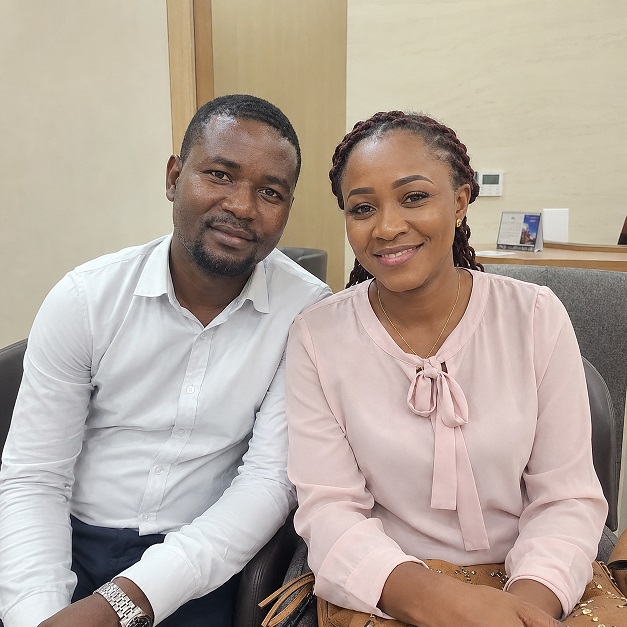
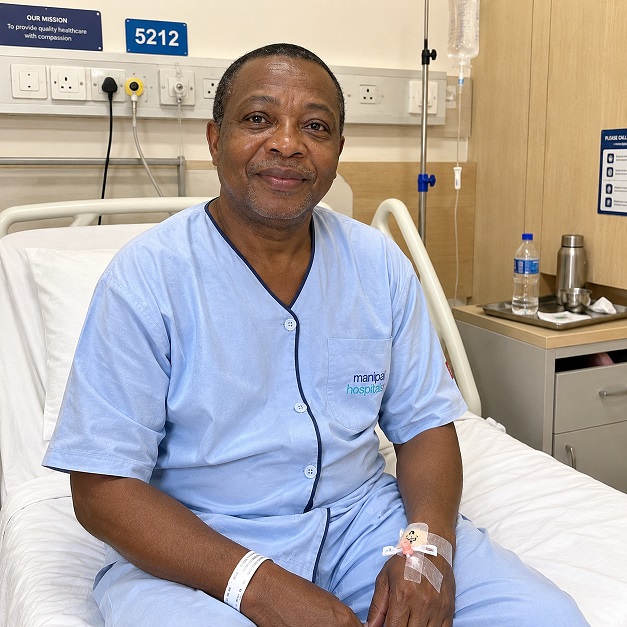
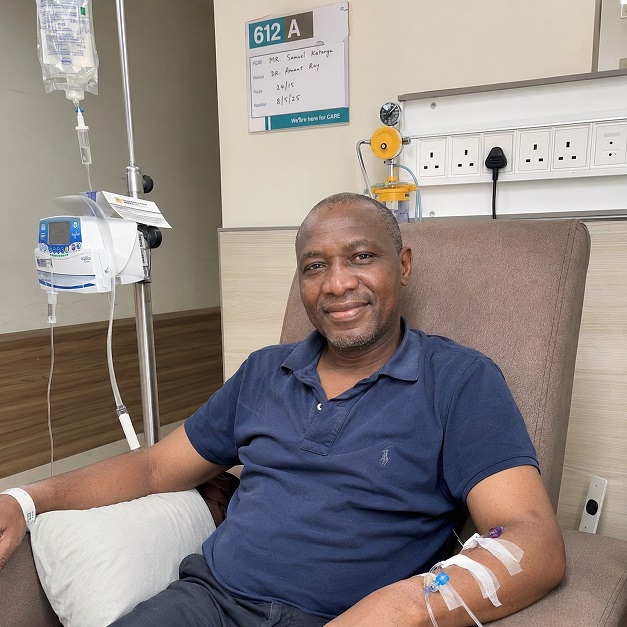
Patient Testimonials from Congo
Ready to Take the First Step?
Share your medical reports with our healthcare managers today and receive a FREE CONSULTATION, a personalized treatment plan and complete support from your arrival to your recovery.
Get Your Free ConsultationAreas We Serve
At Indian Health Guru Consultants, we proudly assist patients from Congo and neighboring countries across Central, East and Southern Africa who travel to India for advanced medical treatment. Our experienced international patient team provides end-to-end support, including medical opinions, hospital selection, Medical Visa assistance, travel planning, accommodation, interpreter services and post-treatment follow-up.
We regularly serve patients from:
- Gabon
- Cameroon
- Angola
- Uganda
- Rwanda
- Burundi
- Tanzania
- Zambia
- Djibouti
- Comoros
- Madagascar
- Seychelles
- South Sudan
- Central African Republic
- Republic of the Congo
- Democratic Republic of the Congo
No matter where you are located in the region, Indian Health Guru Consultants is committed to making your medical journey to India safe, affordable, seamless and completely patient-focused.
From Congo to India: Your Complete Patient Guide
- Brain Tumor Surgery in India for Congolese Patients
- Best Brain Tumour Surgeons & Hospitals in India for Congo Patients
- Knee Replacement in India for Congolese Patients
- Best Knee Replacement Surgeons & Hospitals in India for Congolese Patients
- Spine Surgery in India for Congolese Patients
- Best Spine Surgeons & Hospitals in India for Congolese Patients
- Liver Transplant in India for Congolese Patients: Cost & Guide
- Best Liver Transplant Centres and Hospitals in India for Congolese Patients
- Cardiac Surgery in India for Congolese Patients: Cost & Guide
- Best Cardiac Surgeons & Hospitals in India for Congolese Patients
- Bone Marrow Transplant in India for Congolese Patients: Cost & Guide
- Best Bone Marrow Transplant Centres and Hospitals in India for Congolese Patients
- Prostate Cancer Treatment in India for Congolese Patients: Cost & Guide
- Best Prostate Cancer Centres and Hospitals in India for Congolese Patients
- HIPEC in India for Congolese Patients: Cost & Treatment Guide
- Best HIPEC Centres and Hospitals in India for Congolese Patients
- Kidney Transplant in India for Congolese Patients: Cost & Guide
- Best Kidney Transplant Centres and Hospitals in India for Congolese Patients