

Selecting the Best Liver Transplant Surgeons and Hospitals in India: A Guide for Patients from Iraq
A doctor’s honest, question-by-question guide for patients from Iraq on vetting a liver transplant hospital in India — MELD-specific outcomes, accreditation, donor-type expertise, and the exact questions worth asking before you book anything.
Over the years, I have found that liver transplant is one of the areas where Iraqi families most need to understand a specific distinction: the difference between living donor and deceased donor transplantation, and how a patient’s specific MELD score, the standardised measure of how advanced liver disease has become, changes what outcome is realistic. In my experience of 24 years advising families through exactly this decision, a hospital’s single quoted survival percentage rarely tells you which of these categories it actually describes, and that distinction matters enormously for setting honest expectations.
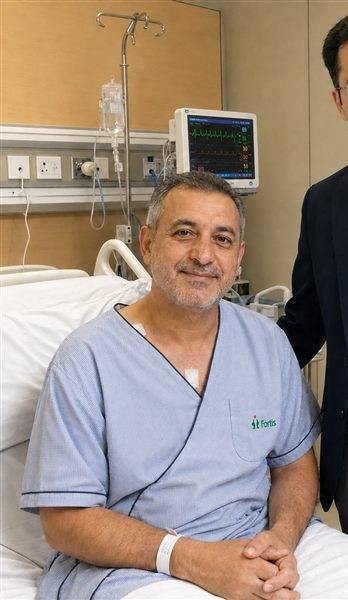
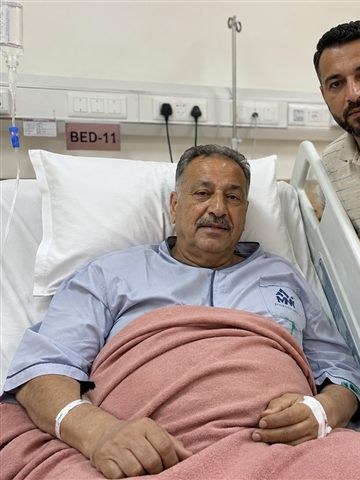
Healing Journeys of Iraqi Patients
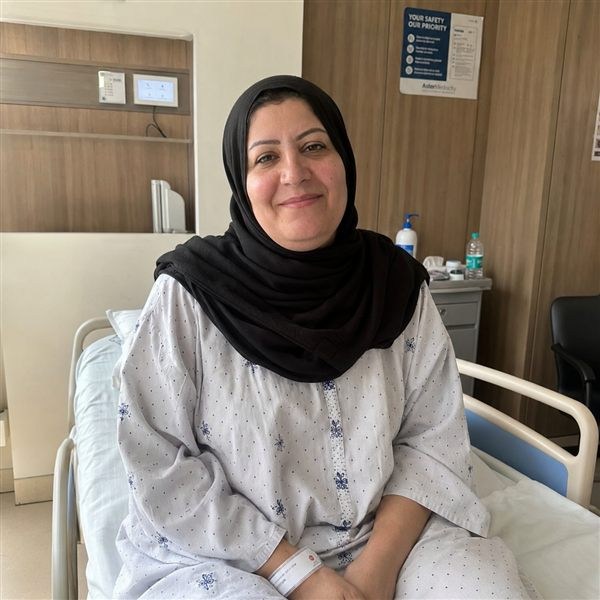

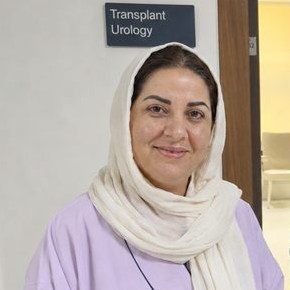
Key Takeaways
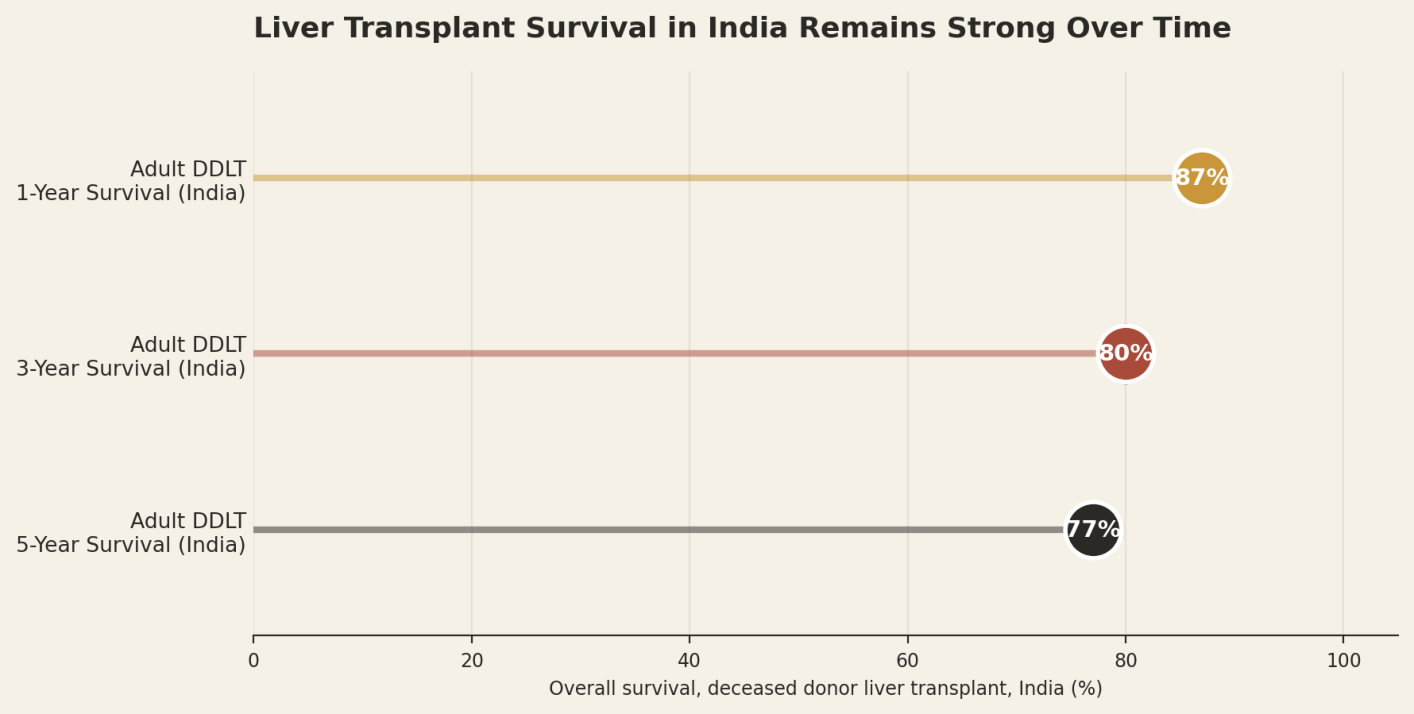
- Liver transplant outcomes should be assessed according to the patient's MELD score, donor type and blood-group compatibility, rather than through one generalized hospital survival percentage. The source explains that more than 80% of liver transplants in India have historically involved living donors because deceased organ donation has been limited. At the same time, Indian deceased donor programmes have reported encouraging long-term results. A multicentre study covering 362 patients across 11 Indian centres reported one-, three- and five-year adult survival of 87.2%, 80.4% and 76.6%, respectively, with 80.6% survival at each interval reported for children.
- The page 2 survival chart presents these deceased donor liver transplant results visually, showing approximately 87% one-year survival, 80% three-year survival and 77% five-year survival. The guide uses these figures to demonstrate that strong outcomes can continue several years after transplantation, but also stresses that published survival numbers must be interpreted according to donor type and patient characteristics.
- Hospital accreditation is an important initial quality filter, but it should not replace procedure-specific questions. The guide recommends verifying recognized accreditation such as JCI and NABH and then asking whether the centre has genuine, tracked experience with both living and deceased donor liver transplantation, since living donor transplantation remains the dominant pathway in India.
- The guide places particular emphasis on MELD-specific outcome data. Families should ask for the patient's current MELD score and request outcome information from the centre for patients within a similar MELD range and undergoing the same donor type. For families considering a living donor who is blood-type incompatible, the hospital should also demonstrate genuine experience with ABO-incompatible liver transplantation.
- ABO-incompatible transplantation can be an important option when the only willing living donor has a different blood type. The source notes that experienced Indian centres use protocols involving plasmapheresis and specific immunosuppression, with outcomes approaching those of standard blood-type-matched transplantation in experienced programmes.
- A strong liver transplant programme should involve a complete multidisciplinary team rather than depend on one surgeon. The source identifies the transplant hepatologist, transplant surgeon experienced in both living and deceased donor procedures, transplant anaesthesiologist, dedicated living donor evaluation team, hepatobiliary radiologist and infectious disease specialist as important members.
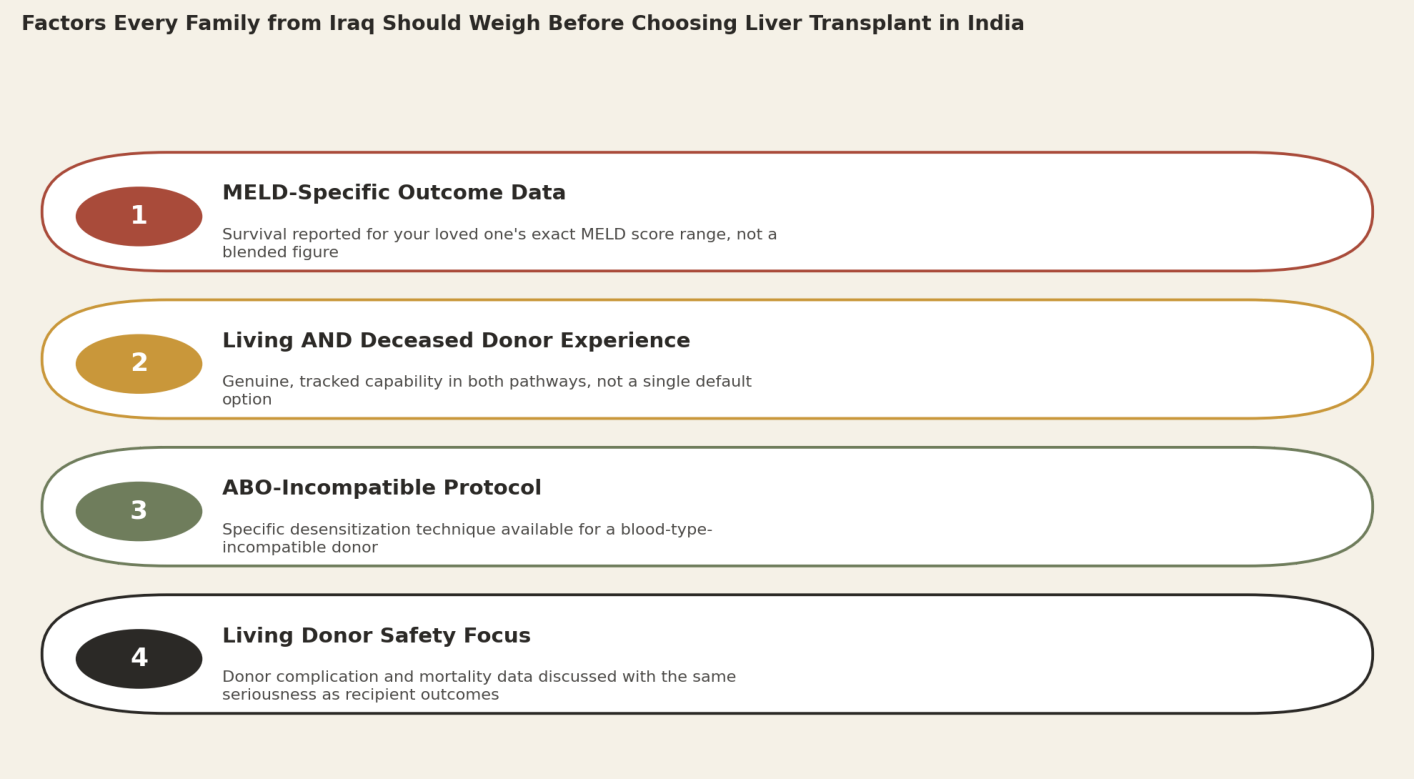
- The source identifies clear warning signs: centres that provide only a single survival percentage, cannot explain their ABO-incompatible protocol, do not discuss living donor complications, or cannot provide separate living and deceased donor volumes. The page 4 checklist highlights MELD-specific outcome data, living and deceased donor experience, ABO-incompatible protocol availability and living donor safety focus.
Quick Facts
- Treatment
- Liver transplantation
- Primary Patients
- Iraqi patients requiring liver transplant evaluation in India
- Main Speciality
- Liver transplant and hepatobiliary surgery
- Key Specialist
- Transplant surgeon experienced in living and deceased donor transplantation
- Major Donor Types
- Living donor and deceased donor
- Important Selection Factor
- Patient's MELD score at the time of transplantation
- Indian Deceased Donor Data
- 87.2% one-year, 80.4% three-year and 76.6% five-year adult survival in the cited 362-patient study
- Living Donor Experience
- More than 80% of Indian liver transplants have historically involved living donors
- ABO-Incompatible Transplant
- Available at experienced Indian centres using specialized protocols
- ABO Protocol
- May include plasmapheresis and specific immunosuppression
- Accreditation
- JCI and/or NABH should be verified
- Outcome Data
- Prefer MELD-specific and donor-type-specific results
- Donor Safety
- Ask for living donor complication and mortality rates
- Core Team
- Transplant hepatologist, transplant surgeon, anaesthesiologist, donor evaluation team, radiologist and infectious disease specialist
- Imaging
- Detailed volumetric imaging should be used for living donor graft planning
- Laboratory
- On-site immunological testing is important for ABO-incompatible transplantation
- Blood Support
- Strong intraoperative blood-product support should be available
- Documentation
- Preserve transplant, donor, operative and follow-up records
- Follow-Up
- Post-transplant monitoring should be planned before returning to Iraq
- Author
- Dr. Dheeraj Bojwani
- Experience
- 24+ Years
In Brief
For Iraqi patients considering liver transplantation in India, the most meaningful hospital comparison should be based on MELD-specific outcomes, donor type and blood-group compatibility rather than a single advertised survival percentage. The source highlights strong Indian deceased donor results from a 362-patient, 11-centre study, while also emphasizing the country’s extensive living donor experience and the development of ABO-incompatible transplantation protocols. Families should verify accreditation, ask for outcomes matching the patient’s MELD range and donor type, assess living donor safety data, confirm the availability of a multidisciplinary transplant team and check the centre’s laboratory, imaging, blood-product and intraoperative capabilities.
Why the Choice of Liver Transplant Team in India Matters as Much as the Choice of Hospital
Based on my interactions with international patients, India’s own published data on this exact question is genuinely encouraging and worth understanding in detail. Because deceased organ donation has historically been limited in India, over 80 percent of Indian liver transplants have been performed using living donors, but a growing number of deceased donor programmes have now published genuinely strong results. The first detailed multi-centre report of Indian deceased donor liver transplant outcomes, covering 362 patients across eleven centres with a median MELD score of 16, found one-, three-, and five-year survival of 87.2 percent, 80.4 percent, and 76.6 percent in adults, and a remarkably stable 80.6 percent at all three intervals in children. Separately, for patients whose only realistic living donor turns out to be blood-type incompatible, Indian centres have developed ABO-incompatible liver transplant protocols using plasmapheresis and specific immunosuppression, with outcomes at experienced centres now approaching those of standard blood-type-matched transplants. What connects all of this is the same lesson: your specific MELD score at the time of transplant, whether your donor is living or deceased, and whether ABO compatibility is a factor all shape what outcome is realistic, far more than a single blended percentage from a hospital’s marketing page.
How Patients from Iraq Can Verify a Liver Transplant Hospital’s Accreditation in India
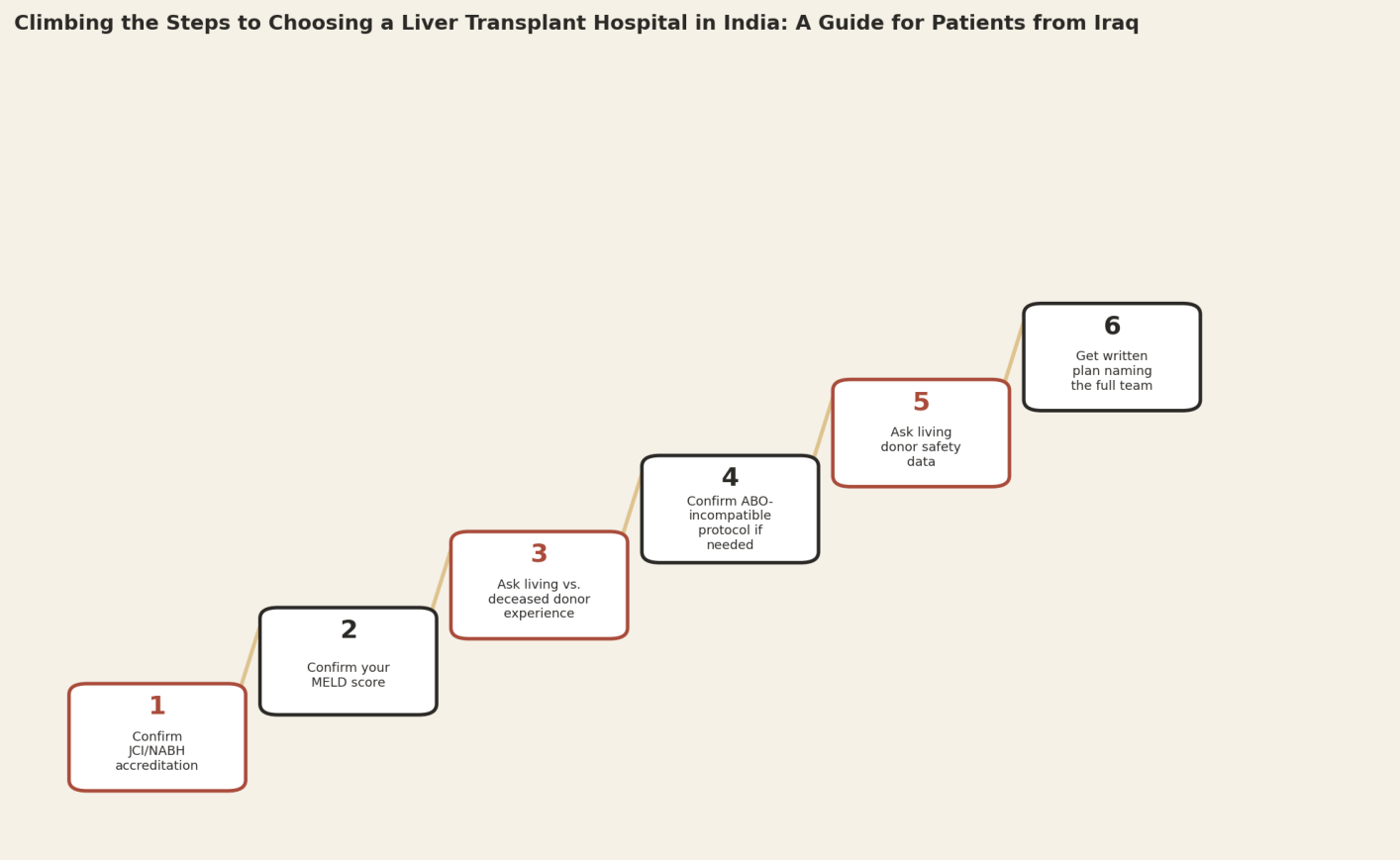
The fastest filter I recommend to every Iraqi family calling about liver transplant is verifiable accreditation, not marketing language. Joint Commission International, JCI, audits a hospital’s overall clinical safety systems against the same standard used across the United States and Europe. The National Accreditation Board for Hospitals and Healthcare Providers, NABH, is India’s own domestic equivalent, and in my experience of 24 years advising families on this exact decision, a centre holding both marks together is a meaningfully stronger signal than either alone. For liver transplant specifically, ask one further, very direct question: does this hospital have genuine, tracked experience with both living and deceased donor transplantation, and can it explain specifically which pathway is realistic for your loved one’s situation, given that most Indian liver transplants are still performed using living donors.
Liver Transplant Volume and MELD-Specific Criteria That Predict Outcomes in India
Based on my interactions with dozens of liver transplant programmes over the years, a centre’s specific outcome data by MELD score range and donor type, not a single transplant success percentage, is one of the clearest signs of a trustworthy, evidence-based programme. A centre’s overall transplant volume still provides useful context, but it does not substitute for MELD-specific and donor-type-specific data, since a centre’s blended average can obscure meaningfully different outcomes across these categories. Ask directly, in writing:
- What is my loved one's current MELD score, and what does this specific centre's own data show for patients in that score range, for the donor type being considered?
- If my loved one's only willing living donor is blood-type incompatible, does this centre have genuine, tracked experience with ABO-incompatible liver transplant, and what is their own outcome data for this specific technique?
- What is the centre's own living donor complication and mortality rate, since donor safety is a distinct and equally important consideration in this specific procedure?
- How many liver transplants of each type, living donor and deceased donor, has this centre performed in the past year, and how does that compare with other centres you are considering?
A centre confident in its own outcomes will answer these specifically. A centre that offers only a single general success percentage without engaging with MELD score or donor type deserves a second opinion before you commit.
Climbing the Steps to Choosing a Liver Transplant Hospital in India: A Guide for Patients from Iraq
Questions Patients from Iraq Should Ask About the Liver Transplant Team in India
Liver transplant is never genuinely the work of one surgeon alone. In my experience of 24 years watching these programmes operate, the strongest units bring together a transplant hepatologist to manage pre- and post-transplant medical care, a transplant surgeon experienced specifically in both living and deceased donor technique, an anaesthesiologist experienced in the specific physiological demands of liver transplant surgery, and a dedicated living donor evaluation team separate from the recipient’s care team, protecting the donor’s own interests throughout the process. A hepatobiliary radiologist for detailed pre-operative imaging, and an infectious disease specialist for the significant post-transplant immunosuppression period, round out the strongest programmes. Ask specifically who fills each of these roles for your case, and confirm that both donor and recipient have been fully evaluated by this complete team before a final surgical plan is set.
Liver Transplant Technology Standards in India That Patients from Iraq Should Check
The specific technology and laboratory capability available change what a centre can safely offer. Ask whether the hospital’s laboratory can perform the immunological testing ABO-incompatible transplant requires on-site, rather than relying on outside facilities. Ask what specific intraoperative monitoring and blood product support capabilities the centre has, given how significant blood loss can be during liver transplant surgery. Ask also whether the hospital uses detailed volumetric imaging to plan the exact size of liver graft needed for a living donor procedure, since accurately matching graft size to recipient body size is a specific factor affecting both donor safety and recipient outcome. Ask directly which of these specific capabilities apply to your case, not simply whether the hospital performs liver transplants in general terms.
Red Flags Patients from Iraq Should Watch For When Choosing a Liver Transplant Hospital in India
Over the years, certain patterns have become reliable warning signs for me. A hospital that quotes a single survival percentage without asking about your loved one’s specific MELD score or donor situation has not engaged with the factors that most determine outcome. A centre that cannot describe a specific ABO-incompatible protocol, despite a genuine blood-type mismatch in your family’s situation, may be steering you toward a longer deceased-donor wait rather than acknowledging a real living-donor option exists. A centre that does not discuss living donor safety and complication rates with the same seriousness as recipient outcomes has not given the donor’s wellbeing the attention it deserves. And a centre that cannot state its own specific volume across both living and deceased donor procedures has not given you the full picture of its actual experience.
Factors Every Family from Iraq Should Weigh Before Choosing Liver Transplant in India
A Closing Thought for Iraqi Families
Liver transplant offers a family genuine, life-saving hope, and the specific outcome realistically achievable depends on your loved one’s MELD score, donor type, and blood-group compatibility, not a single optimistic percentage detached from these specifics. Based on my interactions with international patients over more than two decades, the families who ask about MELD-specific outcomes, donor-type-specific data, and ABO-incompatible experience consistently make better-informed decisions than those who accept a general survival rate alone. My role, and the role of any advisor a family works with, should be to help you ask these exact questions and confirm honestly that the specific team and specific hospital in front of you are the right fit for your family’s exact situation. Iraq’s families deserve the same standard of scrutiny in this decision as any family anywhere else in the world.
Sources & Further Reading
- Joint Commission International (JCI) — Accredited Organizations Directory (jointcommissioninternational.org)
- National Accreditation Board for Hospitals & Healthcare Providers (NABH), India (nabh.co)
- PubMed — Deceased Donor Liver Transplantation in India: First Report of 5-Year Outcomes (pubmed.ncbi.nlm.nih.gov)
- PubMed Central — Value of Preoperative MELD Score in Predicting Postoperative Outcome in LDLT (ncbi.nlm.nih.gov/pmc)
- National Organ and Tissue Transplant Organisation (NOTTO), India (notto.mohfw.gov.in)
Frequently Asked Questions by Iraqi Patients about Selecting a Liver Transplant Surgeon and Hospital in India
Can Iraqi patients undergo liver transplantation in India?
Yes. The source specifically provides guidance for Iraqi patients evaluating liver transplant hospitals and teams in India, including living donor and deceased donor transplantation pathways.
What is the difference between living donor and deceased donor liver transplantation in India?
Living donor transplantation uses a suitable portion of liver from a living donor, while deceased donor transplantation uses a liver from an eligible deceased donor. The source notes that more than 80% of Indian liver transplants have historically involved living donors.
How does the MELD score affect liver transplant planning for Iraqi patients?
The MELD score reflects the severity of liver disease and is an important factor when assessing realistic transplant outcomes. The guide recommends asking the hospital for outcomes among patients with a MELD score range similar to the patient's own.
What are the reported outcomes of deceased donor liver transplantation in India?
The cited multicentre Indian study of 362 patients reported adult survival of 87.2% at one year, 80.4% at three years and 76.6% at five years.
Can an Iraqi patient have a living donor liver transplant if the donor has a different blood group?
The source explains that experienced Indian centres have developed ABO-incompatible liver transplant protocols for selected blood-group mismatches. These may involve plasmapheresis and specific immunosuppression.
What should Iraqi patients ask about ABO-incompatible liver transplantation in India?
They should ask whether the centre has genuine experience with ABO-incompatible transplantation, how many such procedures it performs and what its own outcomes are for the technique.
How important is living donor safety during liver transplantation?
Living donor safety is a separate and essential consideration. The guide recommends asking for the centre's own living donor complication and mortality rates rather than focusing only on recipient survival.
Which specialists should be involved in liver transplantation for Iraqi patients in India?
The source recommends a transplant hepatologist, transplant surgeon, transplant anaesthesiologist, dedicated living donor evaluation team, hepatobiliary radiologist and infectious disease specialist.
What technology should Iraqi patients check before choosing a liver transplant hospital in India?
Families should ask about on-site immunological testing for ABO-incompatible transplantation, intraoperative monitoring, blood-product support and detailed volumetric imaging for living donor graft planning.
When should an Iraqi family seek a second opinion before liver transplantation in India?
A second opinion is advisable when a hospital gives only one general survival percentage, cannot provide MELD- or donor-specific outcomes, lacks a clear ABO-incompatible protocol when needed, does not adequately discuss living donor safety or cannot provide separate living and deceased donor transplant volumes.
Page Summary
The guide explains how Iraqi families can evaluate liver transplant surgeons and hospitals in India using patient-specific rather than marketing-based criteria. The patient's MELD score, donor type and blood-group compatibility are presented as major factors influencing realistic outcomes. Indian deceased donor transplantation has reported strong one-, three- and five-year survival in the cited multicentre study, while living donor transplantation remains the predominant pathway in India.
Families should verify hospital accreditation and assess experience with both living and deceased donor transplantation, including ABO-incompatible procedures when required. They should also review living donor safety data, multidisciplinary expertise, immunological testing, volumetric imaging, blood-product support and the overall transplant infrastructure before selecting a centre.
Citation Block
| Field | Details |
|---|---|
| Article / Topic | Selecting the Best Liver Transplant Surgeons and Hospitals in India |
| Primary Patients | Patients from Iraq |
| Treatment | Liver transplantation |
| Main Donor Types | Living donor and deceased donor |
| Key Selection Factor | MELD-specific outcome assessment |
| Indian Deceased Donor Study | 362 patients across 11 Indian centres |
| Adult 1-Year Survival | 87.2% |
| Adult 3-Year Survival | 80.4% |
| Adult 5-Year Survival | 76.6% |
| Child Survival | 80.6% at one, three and five years in the cited study |
| Living Donor Pattern | More than 80% of Indian liver transplants have historically used living donors |
| ABO-Incompatible Option | Available at experienced centres using plasmapheresis and specific immunosuppression |
| Outcome Comparison | MELD-specific and donor-type-specific data preferred |
| Accreditation | JCI and NABH should be verified |
| Living Donor Assessment | Donor complication and mortality data should be requested |
| Core Specialist | Transplant hepatologist |
| Surgical Expertise | Experience with both living and deceased donor transplantation |
| Donor Protection | Dedicated living donor evaluation team |
| Imaging | Hepatobiliary radiology and detailed volumetric graft planning |
| Laboratory | On-site immunological testing for ABO-incompatible transplantation |
| Intraoperative Support | Monitoring and blood-product support |


Our Mission Statement
Our mission is to place patients at the centre of every healthcare decision by providing trustworthy, evidence-based, and unbiased medical information. We believe that informed patients make better decisions. Backed by personalised guidance from our experienced advisory team, we help patients understand their treatment options, compare them objectively, and confidently choose the path that best suits their medical needs and personal circumstances.
Patient Testimonials from Iraq

Ready to Take the First Step?
Share your Medical Reports with our Healthcare Managers Today and Get a FREE CONSULTATION, a Personalized Treatment Plan, and Complete Support from Arrival to Recovery.
Get Your Free ConsultationAreas We Serve
Indian Health Guru Consultants proudly assists patients from Iraq and surrounding Middle Eastern countries in accessing advanced, affordable and trusted medical treatment in India. Our team provides complete support for medical opinions, hospital selection, treatment planning, visa assistance, travel coordination, accommodation and post-treatment follow-up.
We regularly serve patients from:
- Iraq
- Turkey
- Iran
- Kuwait
- Jordan
- Syria
- Qatar
- Bahrain
- Oman
- Yemen
- Saudi Arabia
- United Arab Emirates
No matter where you are located, our experienced team is committed to making your medical journey to India safe, smooth, transparent and stress-free from the first enquiry to your return home.
From Iraq to India: Your Complete Patient Guide
- Radiotherapy and Modern Cancer Treatment in India for Iraqis
- Prostate Cancer Treatment and Surgery in India for Iraqis
- Liver Transplant in India for Iraqis
- Urosurgery and Reconstructive Urology in India for Iraqis
- Scoliosis Correction Surgery in India for Iraqis
- Cervical and Lumbar Disc Replacement Surgery in India for Iraqis
- CyberKnife Treatment in India for Iraqis
- Paediatric Neurosurgery in India for Iraqis
- Penile Implant Surgery in India for Iraqis
- Colorectal Cancer Treatment and Surgery in India for Iraqis
- Gamma Knife Treatment in India for Iraqis
- Pancreatic Cancer Surgery in India for Iraqis
- Neurosurgery in India for Iraqis
- IVF and Fertility Treatment in India for Iraqis
- Paediatric Orthopaedic Surgery in India for Iraqis
- Hip Surgery in India for Iraqis
- Joint Arthroscopy and Sports Medicine in India for Iraqis
- Knee Surgery in India for Iraqis