

Selecting the Best Knee Replacement Surgeons and Hospitals in India: A Guide for Patients from Iraq
A doctor’s honest, question-by-question guide for patients from Iraq on vetting a knee replacement hospital in India — robotic vs conventional evidence, accreditation, and the exact questions worth asking before you book anything.
Over the years, I have noticed that robotic knee replacement is marketed to Iraqi patients as an automatic, across-the-board upgrade, and in my experience of 24 years advising patients through exactly this decision, the actual published evidence tells a more specific and more interesting story: robotic assistance appears to make a genuinely dramatic difference for some knee procedures and a much smaller, statistically insignificant difference for others, and knowing which category your specific procedure falls into matters far more than the word “robotic” on a hospital’s brochure.
Healing Journeys of Iraqi Patients






Key Takeaways
- Robotic knee replacement should not automatically be considered superior to conventional surgery for every Iraqi patient. The source explains that published evidence shows the benefit of robotic assistance depends strongly on the specific procedure. For standard total knee replacement, a systematic review of 20 comparative studies involving more than 5,400 patients found 10-year implant survivorship of 96.9% with conventional surgery compared with 97.8% with robotic-assisted surgery, with no statistically significant difference across the follow-up periods studied.
- The situation is different for partial or unicompartmental knee replacement. The source cites one comparative study reporting an 87% success rate with robotic assistance compared with 28% using the conventional technique. This substantial difference was associated with the greater precision required for partial knee replacement. The key point for Iraqi patients is therefore not simply whether a hospital owns robotic equipment, but whether the technology provides a meaningful evidence-supported advantage for their particular type of knee replacement.
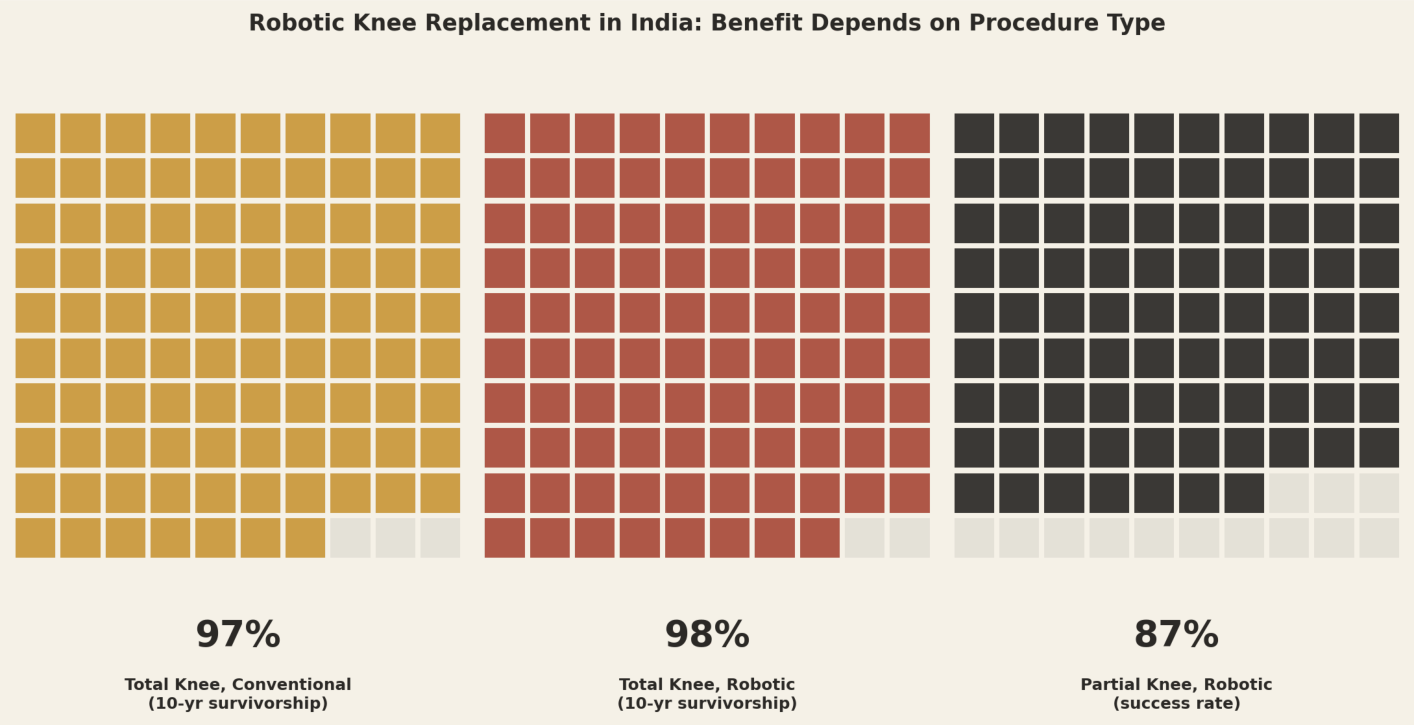
- The comparison graphic on page 2 reinforces this procedure-specific distinction, showing approximately 97% 10-year survivorship for conventional total knee replacement, 98% for robotic-assisted total knee replacement and 87% success for robotic partial knee replacement. These are illustrative figures from published comparative literature, not individual patient guarantees. Patients should therefore request the hospital's own implant-survivorship data separated by conventional and robotic techniques.
- Accreditation is an important initial filter when Iraqi patients compare knee replacement hospitals in India. The guide recommends verifying JCI and NABH accreditation and then asking whether the evidence actually supports robotic assistance for the patient's specific procedure. Patients should also compare the additional cost of robotic surgery with the expected clinical benefit instead of assuming that a technology premium automatically represents better long-term results.
- A trustworthy knee surgeon should be willing to explain why robotic assistance is or is not appropriate for a particular case. The source recommends asking about the hospital's 10-year implant survivorship by technique, the specific advantage expected from robotic assistance, such as alignment precision or bone preservation, and the difference in price between conventional and robotic surgery.
- Knee replacement outcomes also depend on the treatment team and rehabilitation programme. The guide recommends a surgeon with fellowship training in joint arthroplasty, an anaesthesiologist experienced in regional anaesthesia, a structured physiotherapy team and a dedicated pain-management plan. A clear day-by-day rehabilitation programme should be prepared before surgery because the source emphasises that surgical technique alone does not determine the final outcome.
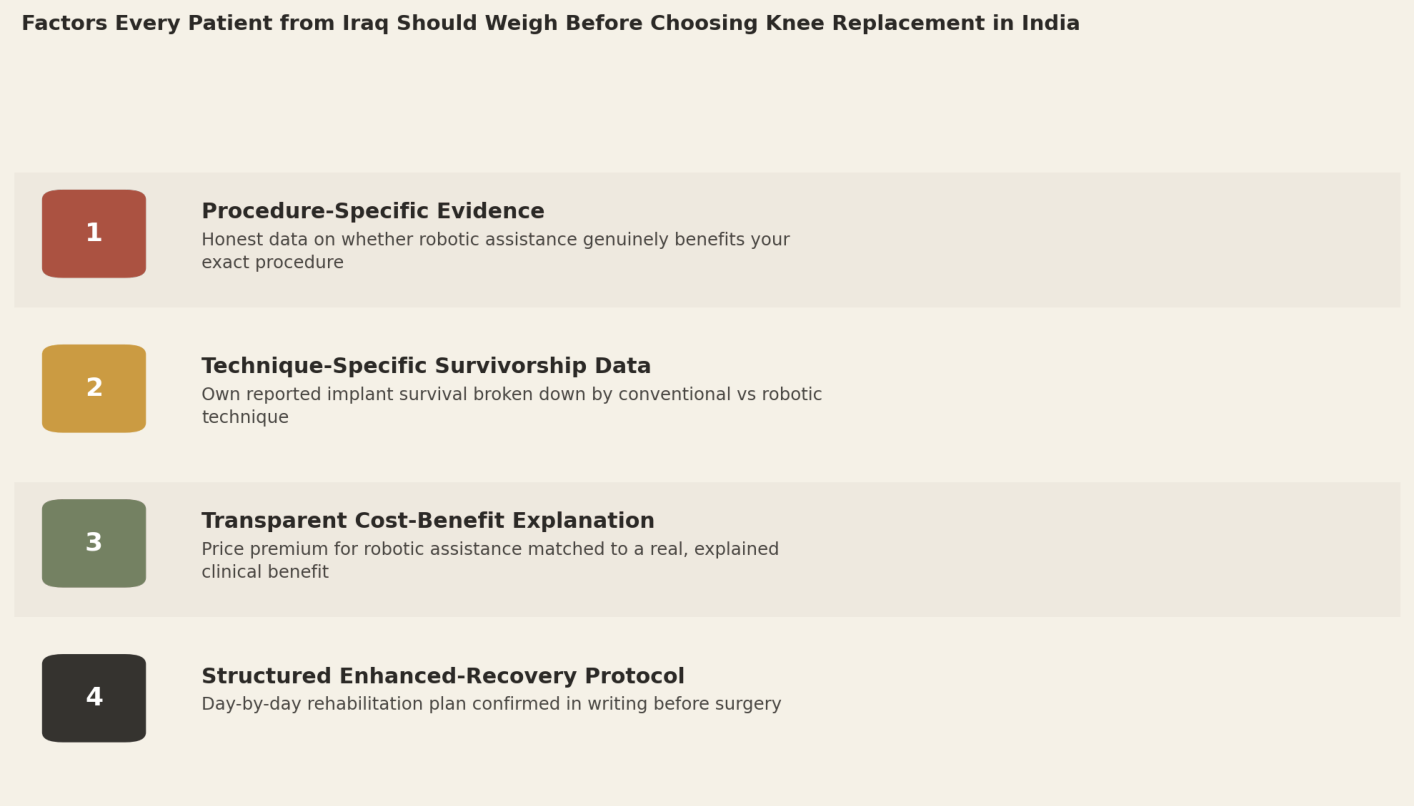
- Technology should be matched to the procedure rather than selected simply because it is available. The page 4 checklist highlights four factors: procedure-specific evidence, technique-specific implant-survivorship data, transparent cost-benefit reasoning and a structured enhanced-recovery programme, reinforcing that robotic surgery should be selected because it offers a meaningful benefit for the specific procedure, not simply because it is marketed as more advanced.
Quick Facts
- Treatment
- Knee replacement surgery
- Primary Patients
- Iraqi patients seeking knee treatment in India
- Main Speciality
- Joint replacement and arthroplasty
- Key Specialist
- Fellowship-trained joint arthroplasty surgeon
- Main Procedures
- Total and partial knee replacement
- Robotic Benefit
- Depends on the specific knee procedure
- Total Knee Survivorship
- 96.9% conventional versus 97.8% robotic at 10 years in cited meta-analysis
- Statistical Difference
- No significant survivorship difference for total knee replacement in the cited analysis
- Partial Knee Evidence
- One cited study reported 87% robotic versus 28% conventional success
- Implant Data
- Ask for technique-specific 10-year survivorship
- Robotic Technology
- Confirm the exact platform and its procedure-specific benefit
- Bone Preservation
- Ask whether bone-preserving techniques are used
- Pain Management
- Regional nerve blocks and multimodal medication may support early mobilisation
- Rehabilitation
- Day-by-day enhanced-recovery plan should be prepared
- Physiotherapy
- Structured postoperative physiotherapy is important
- Accreditation
- Verify JCI and NABH
- Cost
- Compare the robotic premium with the expected clinical benefit
- Procedure Selection
- Robotic versus conventional surgery should be based on the specific case
- Follow-Up
- Rehabilitation and orthopaedic follow-up should be arranged after returning to Iraq
- Author
- Dr. Dheeraj Bojwani
- Experience
- 24+ Years
In Brief
For Iraqi patients choosing knee replacement in India, the most important selection criteria are procedure-specific evidence, technique-specific implant-survivorship data, transparent cost-benefit reasoning and a structured enhanced-recovery programme. The page 4 checklist highlights these four factors and reinforces that robotic surgery should be selected because it offers a meaningful benefit for the specific procedure, not simply because it is marketed as more advanced.
Why the Choice of Knee Surgeon in India Matters as Much as the Choice of Technology
Based on my interactions with international patients, a rigorous systematic review and meta-analysis pooling twenty comparative studies and over 5,400 patients found something genuinely important: for standard total knee replacement, pooled implant survivorship at ten years was 96.9 percent for conventional surgery compared with 97.8 percent for robotic-assisted surgery, a difference the researchers found was not statistically significant at any follow-up point studied, from two years through ten years. The same analysis concluded that conventional total knee replacement is non-inferior to the robotic approach for implant survival, though robotic assistance did show subtle improvements in certain functional outcome measures. For partial, or unicompartmental, knee replacement specifically, the picture changes dramatically: one comparative study found a success rate of 87 percent with robotic assistance compared with just 28 percent using the conventional technique, a substantial and statistically significant difference tied to the greater precision partial knee replacement requires. This tells a family something important: whether robotic technology makes a meaningful difference depends heavily on which specific knee procedure you actually need, not simply whether the word “robotic” appears in the hospital’s marketing.
How Patients from Iraq Can Verify a Knee Replacement Hospital’s Accreditation in India
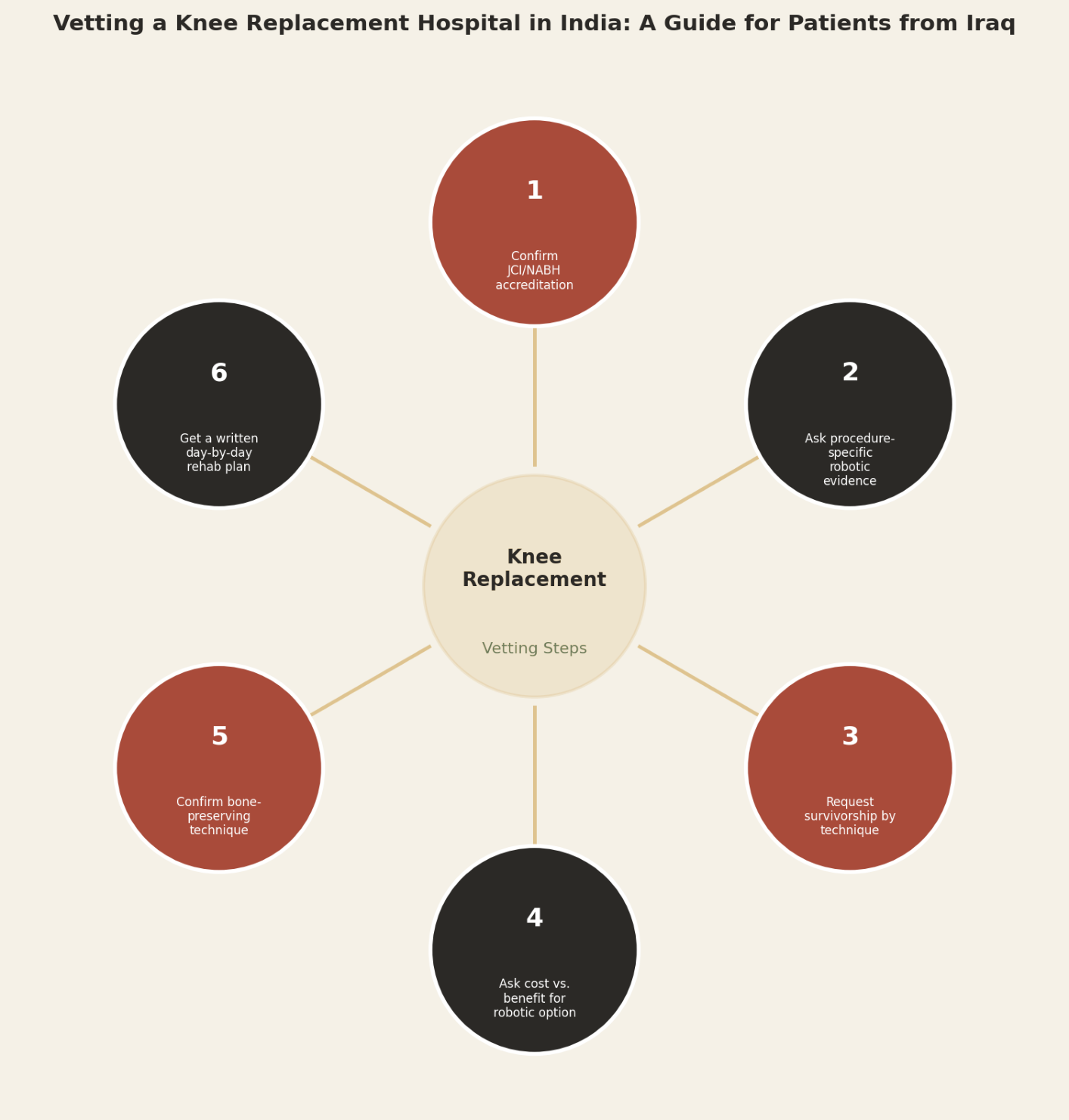
The fastest filter I recommend to every Iraqi patient calling about knee replacement is verifiable accreditation, not marketing language. Joint Commission International, JCI, audits a hospital’s overall clinical safety systems against the same standard used across the United States and Europe. The National Accreditation Board for Hospitals and Healthcare Providers, NABH, is India’s own domestic equivalent, and in my experience of 24 years advising patients on this exact decision, a centre holding both marks together is a meaningfully stronger signal than either alone. For knee replacement specifically, ask one further, very direct question: for my specific procedure, total or partial knee replacement, does the published evidence actually support a meaningful advantage from robotic assistance, or is the hospital charging a premium for technology that, for my specific case, the research does not clearly justify.
Knee Replacement Volume and Procedure-Specific Criteria That Predict Outcomes in India
Based on my interactions with dozens of orthopaedic programmes over the years, a surgeon’s honest, procedure-specific reasoning about whether robotic assistance genuinely benefits your case, not simply their enthusiasm for the technology in general, is one of the clearest signs of a trustworthy recommendation. In my experience of 24 years watching how this technology is marketed across different countries, the surgeons most worth trusting are the ones willing to say plainly when a premium technology offers limited additional benefit for a specific case. Ask directly, in writing:
- For my specific procedure, total or partial knee replacement, what does the published evidence say about the actual benefit of robotic assistance, and does the surgeon's own experience support or differ from that evidence?
- What is this hospital's own implant survivorship data at ten years, broken down by conventional versus robotic-assisted technique, not a single blended figure?
- If robotic assistance is being recommended, what specific advantage does the surgeon expect for my case, alignment precision, bone preservation, or another factor, and how does this translate into a real-world benefit?
- What is the price difference between conventional and robotic-assisted surgery at this hospital, and does that difference match the genuine evidence-based benefit for my specific procedure?
A surgeon confident in their own reasoning will answer these specifically and honestly, including acknowledging when robotic assistance offers limited additional benefit for a specific case. A surgeon who insists robotic technology is essential for every knee procedure regardless of type deserves a second opinion.
Vetting a Knee Replacement Hospital in India: A Guide for Patients from Iraq
Questions Patients from Iraq Should Ask About the Knee Replacement Team in India
Knee replacement outcomes depend on more than the surgeon and the technology alone. In my experience of 24 years watching these programmes operate, the strongest units include a surgeon with specific fellowship training in joint arthroplasty, an anaesthesiologist experienced in regional anaesthesia techniques that support faster early mobilisation, and a structured physiotherapy team guiding a specific, enhanced-recovery rehabilitation protocol. A dedicated pain management plan, combining regional nerve blocks with multimodal medication rather than relying primarily on opioids, is a further detail worth confirming, since effective early pain control directly supports the faster mobilisation that speeds overall recovery regardless of which surgical technique was used. Ask specifically who fills each of these roles for your case, and confirm that a clear, day-by-day rehabilitation plan has been outlined before your surgery, since the meta-analysis findings above make clear that surgical technique alone, robotic or otherwise, does not determine your final outcome without consistent, well-managed rehabilitation.
Knee Replacement Technology Standards in India That Patients from Iraq Should Check
The specific technology and technique available change what precision a surgeon can achieve, and for which procedures that precision genuinely matters. Ask which specific robotic or computer-assisted navigation platform the hospital uses, and ask the surgeon directly to explain the specific accuracy improvement it offers for your exact procedure type. Ask whether bone-preserving technique is used, since removing only diseased bone rather than a broader margin has been associated with longer implant life in modern surgical approaches. For partial knee replacement candidates specifically, confirm that robotic or computer-assisted navigation is genuinely available, given how much larger the published benefit appears to be for this specific procedure, and ask whether the surgeon has specific case volume performing partial replacement with this technology, distinct from their total knee replacement experience. Ask directly which of these specific capabilities apply to your case, not simply whether the hospital owns advanced equipment in general terms.
Red Flags Patients from Iraq Should Watch For When Choosing a Knee Replacement Hospital in India
Over the years, certain patterns have become reliable warning signs for me. A hospital that recommends robotic assistance for every knee procedure regardless of type, without acknowledging that the evidence for total knee replacement specifically shows no significant survivorship difference, is not giving you an honest, evidence-based recommendation. A hospital that cannot provide its own implant survivorship data broken down by technique has not given you information specific enough to justify a price difference. A hospital charging a substantial premium for robotic assistance without a clear, procedure-specific explanation of the actual expected benefit deserves closer questioning before you agree to the additional cost. And a hospital without a clear, structured rehabilitation plan in place before surgery is underselling the part of your recovery that matters just as much as the surgical technique chosen.
Factors Every Patient from Iraq Should Weigh Before Choosing Knee Replacement in India
A Closing Thought for Iraqi Families
Knee replacement is a genuinely reliable, well-established procedure, and the decision between conventional and robotic-assisted technique deserves to be grounded in the specific evidence for your exact procedure type, not marketing language that treats every knee surgery the same. Based on my interactions with international patients over more than two decades, the patients who ask for procedure-specific evidence, honest technique recommendations, and transparent survivorship data consistently make better-informed, more cost-effective decisions than those who accept a general enthusiasm for robotic technology alone. My role, and the role of any advisor a patient works with, should be to help you ask these exact questions and confirm honestly that the specific technique and specific hospital in front of you are the right fit for your exact case. Iraq’s patients deserve the same standard of scrutiny in this decision as any patient anywhere else in the world.
Sources & Further Reading
- Joint Commission International (JCI) — Accredited Organizations Directory (jointcommissioninternational.org)
- National Accreditation Board for Hospitals & Healthcare Providers (NABH), India (nabh.co)
- PubMed Central — Survivorship in Robotic Total Knee Arthroplasty Compared with Conventional TKA: A Systematic Review and Meta-Analysis (pmc.ncbi.nlm.nih.gov)
- PubMed Central — Robotic-Assisted vs. Conventional Surgery in Medial Unicompartmental Knee Arthroplasty (ncbi.nlm.nih.gov/pmc)
- American Academy of Orthopaedic Surgeons (AAOS) — Knee Replacement Patient Information (aaos.org)
Frequently Asked Questions by Iraqi Patients about Selecting a Knee Replacement Surgeon and Hospital in India
Can Iraqi patients undergo knee replacement surgery in India?
Yes. The source specifically provides guidance for patients from Iraq choosing knee replacement surgeons and hospitals in India, including total and partial knee replacement.
Is robotic knee replacement better than conventional knee replacement for Iraqi patients?
Not automatically. The cited evidence found no statistically significant implant-survival advantage for robotic total knee replacement, while partial knee replacement may show a substantially greater benefit from robotic assistance.
What is the 10-year implant survival rate for robotic and conventional total knee replacement?
The cited meta-analysis reported 96.9% survivorship for conventional surgery and 97.8% for robotic-assisted surgery at 10 years, with no statistically significant difference.
Is robotic surgery particularly useful for partial knee replacement?
The source indicates that the evidence may be more favourable for partial knee replacement. One cited study reported 87% success with robotic assistance compared with 28% using the conventional technique.
Should Iraqi patients ask for a surgeon's robotic knee replacement experience?
Yes. Patients should ask specifically about the surgeon's experience with their exact procedure, particularly partial knee replacement, rather than relying only on the surgeon's overall knee replacement volume.
What implant-survival information should Iraqi patients request?
Patients should ask for the hospital's own 10-year implant-survivorship data and request that it be separated between conventional and robotic-assisted procedures rather than presented as one combined figure.
How should Iraqi patients evaluate the extra cost of robotic knee replacement?
They should ask what specific clinical advantage the robotic system is expected to provide and whether that benefit justifies the additional cost for their procedure. A technology premium should not be accepted solely because robotic surgery is marketed as more advanced.
What rehabilitation support should Iraqi patients expect after knee replacement?
The source recommends a structured physiotherapy programme and a clear day-by-day enhanced-recovery plan. Pain management and early mobilisation are also important components of the recovery pathway.
What technology should Iraqi patients check before partial knee replacement in India?
Patients should confirm which robotic or computer-assisted navigation platform is available and whether the surgeon has specific experience using it for partial knee replacement. The relevant technology should be matched to the patient's actual procedure.
What should Iraqi patients check before choosing a knee replacement hospital in India?
They should verify JCI and NABH accreditation, request procedure-specific evidence, review technique-specific implant survivorship, understand the cost-benefit of robotic assistance and confirm that a structured rehabilitation programme is in place.
Page Summary
Knee replacement is an established procedure, but the choice between conventional and robotic-assisted surgery should be based on the patient's specific procedure rather than general marketing claims. The source shows that robotic assistance has not demonstrated a statistically significant 10-year implant-survival advantage for standard total knee replacement in the cited meta-analysis, while the evidence for partial knee replacement suggests a potentially much larger benefit.
For Iraqi patients travelling to India, the appropriate hospital should combine accredited clinical systems with procedure-specific surgical expertise, transparent implant-survivorship data, appropriate technology and structured rehabilitation. Patients should also receive a clear explanation of any additional robotic cost and the actual benefit expected in their individual case.
Citation Block
| Field | Details |
|---|---|
| Article / Topic | Selecting the Best Knee Replacement Surgeons and Hospitals in India |
| Primary Patients | Patients from Iraq |
| Treatment Area | Knee replacement |
| Main Procedures | Total and partial knee replacement |
| Robotic vs Conventional | Benefit depends on procedure type |
| Comparative Studies | 20 studies with more than 5,400 patients cited |
| Conventional TKR 10-Year Survivorship | 96.9% |
| Robotic TKR 10-Year Survivorship | 97.8% |
| Statistical Finding | No significant survivorship difference for TKR in cited analysis |
| Robotic Partial Replacement | 87% success in cited comparative study |
| Conventional Partial Replacement | 28% success in cited comparative study |
| Accreditation | JCI and NABH |
| Survivorship Data | Should be separated by surgical technique |
| Robotic Platform | Exact system should be identified |
| Technology Benefit | Alignment precision, bone preservation or another case-specific advantage |
| Bone Preservation | Should be discussed where relevant |
| Surgical Team | Fellowship-trained arthroplasty surgeon |
| Anaesthesia | Regional anaesthesia expertise |
| Pain Management | Regional blocks and multimodal medication |
| Rehabilitation | Structured enhanced-recovery protocol |
| Cost Evaluation | Robotic premium should be compared with expected benefit |
| Preoperative Planning | Procedure-specific evidence should guide technique selection |


Our Mission Statement
Our mission is to place patients at the centre of every healthcare decision by providing trustworthy, evidence-based, and unbiased medical information. We believe that informed patients make better decisions. Backed by personalised guidance from our experienced advisory team, we help patients understand their treatment options, compare them objectively, and confidently choose the path that best suits their medical needs and personal circumstances.
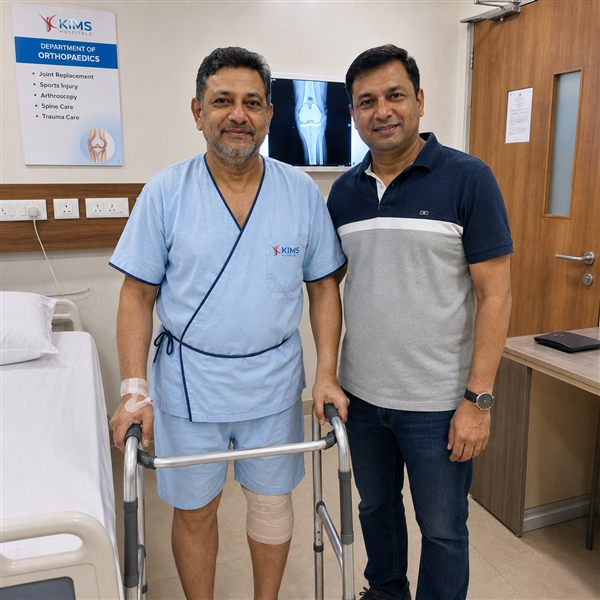
Patient Testimonials from Iraq








Ready to Take the First Step?
Share your Medical Reports with our Healthcare Managers Today and Get a FREE CONSULTATION, a Personalized Treatment Plan, and Complete Support from Arrival to Recovery.
Get Your Free ConsultationAreas We Serve
Indian Health Guru Consultants proudly assists patients from Iraq and surrounding Middle Eastern countries in accessing advanced, affordable and trusted medical treatment in India. Our team provides complete support for medical opinions, hospital selection, treatment planning, visa assistance, travel coordination, accommodation and post-treatment follow-up.
We regularly serve patients from:
- Iraq
- Turkey
- Iran
- Kuwait
- Jordan
- Syria
- Qatar
- Bahrain
- Oman
- Yemen
- Saudi Arabia
- United Arab Emirates
No matter where you are located, our experienced team is committed to making your medical journey to India safe, smooth, transparent and stress-free from the first enquiry to your return home.
From Iraq to India: Your Complete Patient Guide
- Parkinson's Treatment and DBS Surgery in India for Iraqis
- Dental Implants and Smile Makeover in India for Iraqis
- Laparoscopic and Robotic Myomectomy in India for Iraqis
- Cardiac Pacemaker Treatment in India for Iraqi Patients
- Paediatric Neurosurgery in India for Iraqis
- Knee Surgery in India for Iraqis
- CyberKnife Treatment in India for Iraqis
- Cervical and Lumbar Disc Replacement Surgery in India for Iraqis
- Penile Implant Surgery in India for Iraqis
- Spine Surgery in India for Iraqis
- Radiotherapy and Modern Cancer Treatment in India for Iraqis
- Hip Surgery in India for Iraqis
- Prostate Cancer Treatment and Surgery in India for Iraqis
- Neuronavigation and Advanced Brain Surgery in India for Iraqis
- Scoliosis Correction Surgery in India for Iraqis
- Pancreatic Cancer Surgery in India for Iraqis
- Proton Therapy in India for Iraqis
- Cosmetic and Aesthetic Surgery in India for Iraqis