

Selecting the Best Hip Replacement Surgeons and Hospitals in India: A Guide for Patients from Iraq
A doctor’s honest, question-by-question guide for patients from Iraq on vetting a hip replacement hospital in India — implant selection, accreditation, registry data, and the exact questions worth asking before you book anything.
Over the years, I have found that hip replacement is often treated as the most routine, interchangeable surgery in this entire series, and for a well-selected patient with a well-selected implant, that reputation is largely earned. In my experience of 24 years advising patients through exactly this decision, the specific detail that separates a hip replacement lasting fifteen years from one lasting thirty is the match between the implant type, cemented, uncemented, or hybrid, and bearing surface chosen and your own specific age, bone quality, and activity level, a decision that deserves far more individual attention than it usually receives.
Healing Journeys of Iraqi Patients








Key Takeaways
- Hip replacement is a well-established orthopaedic procedure, but the guide stresses that it should not be treated as a completely interchangeable operation. The implant type, fixation method and bearing surface need to be matched to the patient's age, bone quality and activity level. Cemented, uncemented and hybrid fixation can have different applications, while the selected bearing surface can influence long-term wear and implant performance.
- Published outcomes cited in the guide are generally reassuring for primary hip replacement, with survival commonly reported at approximately 90–95% at 10 years and 80–85% at 20 years. The source also cites early Indian registry data showing approximately 92% five-year survival for metal-on-polyethylene bearings, with ceramic bearings performing somewhat better in appropriately selected patients. For revision surgery, a cited study of cemented revision stems reported 98.1% five-year implant survival and 83.9% at 12 years.
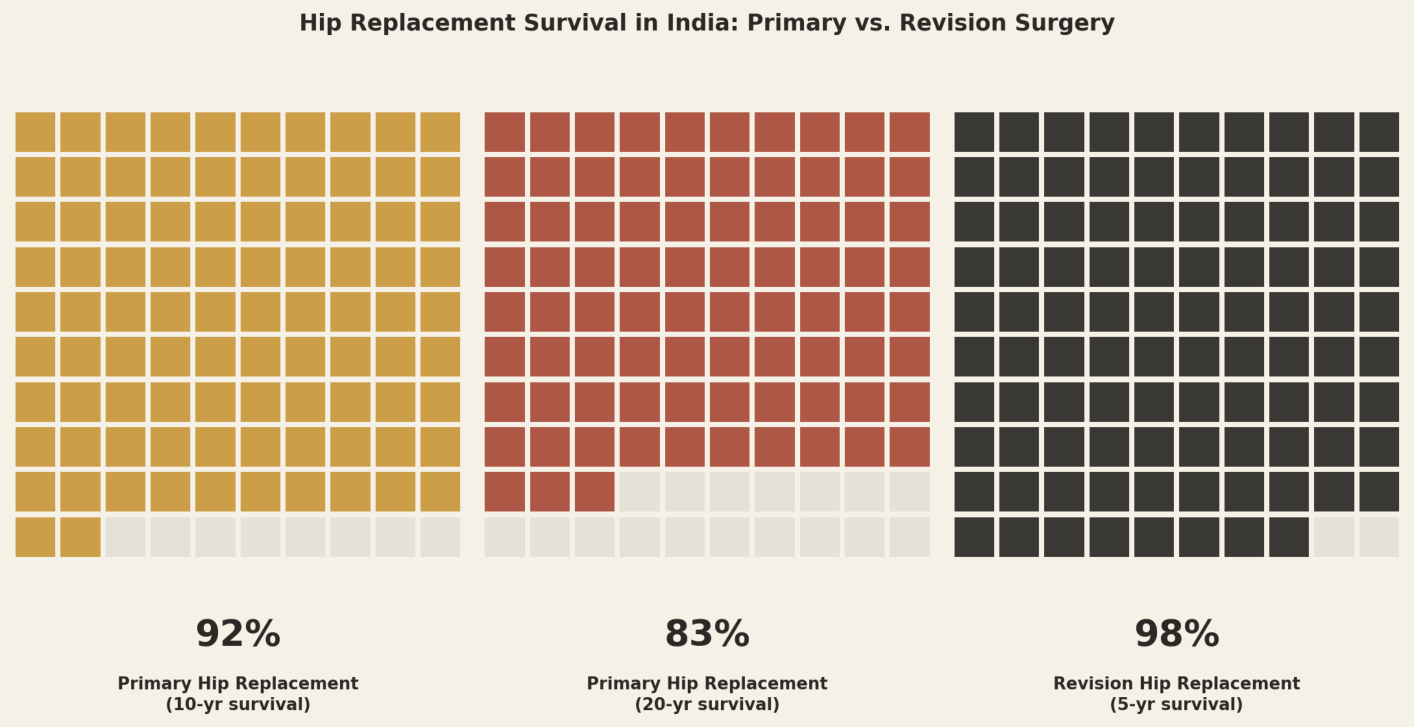
- The page 2 visual compares approximately 92% 10-year survival for primary hip replacement, 83% 20-year survival and 98% five-year survival for revision hip replacement. The guide uses these figures to demonstrate that both primary and revision procedures can achieve strong outcomes, while emphasising that implant generation and bearing-surface selection remain important factors in long-term success.
- For Iraqi patients, hospital selection should include verification of accreditation and assessment of external outcome tracking. The guide recommends checking JCI and NABH accreditation and asking whether the hospital participates in India's national joint registry and tracks implant-specific survival over time. Registry participation is presented as an additional benchmark rather than relying only on unpublished internal claims.
- Surgeon volume matters, but the source stresses that volume alone does not determine the quality of a hip replacement. Patients should ask why a particular cemented, uncemented or hybrid implant has been selected for their age, bone density and activity level, and should request implant-specific survival information. Younger or more active patients should also ask about bearing-surface alternatives and the trade-offs between them.
- A strong hip replacement programme should involve more than the operating surgeon. The guide highlights fellowship-trained joint arthroplasty expertise, anaesthesia experience with regional techniques, structured physiotherapy and dedicated pain management. Modern enhanced-recovery programmes may begin rehabilitation within a day of surgery, making a written day-by-day rehabilitation plan an important question for Iraqi patients travelling to India.
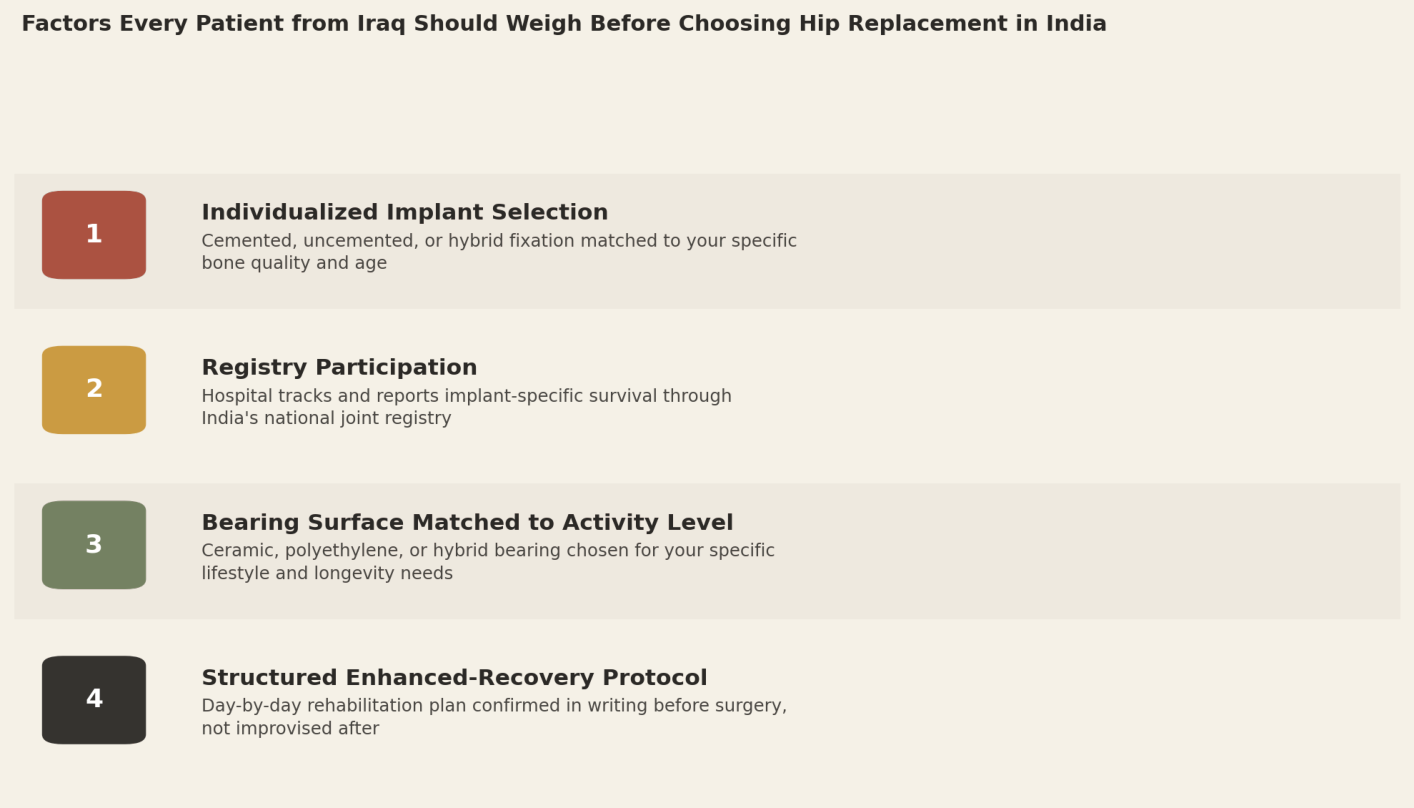
- The source identifies several red flags: recommending the same implant and bearing surface for every patient, inability to provide implant-specific survival data, absence of external registry participation, lack of a structured rehabilitation plan and quoting a fixed price without first reviewing bone quality and anatomy on imaging. The page 4 checklist reinforces four priorities: individualised implant selection, registry participation, activity-appropriate bearing surface and a structured enhanced-recovery programme.
Quick Facts
- Treatment
- Total hip replacement
- Primary Patients
- Iraqi patients seeking hip replacement in India
- Main Speciality
- Orthopaedic joint replacement
- Key Specialist
- Fellowship-trained joint arthroplasty surgeon
- Implant Types
- Cemented, uncemented or hybrid
- Bearing Surfaces
- Ceramic, polyethylene and other patient-appropriate combinations
- Primary Survival
- Approximately 90–95% at 10 years in cited literature
- Twenty-Year Survival
- Approximately 80–85% in cited literature
- Indian Registry Data
- Approximately 92% five-year survival for cited metal-on-polyethylene bearings
- Revision Survival
- 98.1% five-year survival in the cited cemented revision-stem study
- Revision Twelve-Year Survival
- 83.9% in the cited study
- Implant Selection
- Should reflect age, bone quality and activity level
- Revision Expertise
- Ask for tracked revision hip arthroplasty experience
- Rehabilitation
- Structured physiotherapy should begin early after surgery
- Pain Management
- Regional techniques and multimodal medication may support mobilisation
- Technology
- Computer-assisted or robotic-assisted surgery may be considered for selected cases
- Complex Cases
- Ask about specialised revision implants and patient-specific instrumentation
- Accreditation
- Verify JCI and NABH accreditation
- Registry
- Ask whether the hospital participates in joint registry reporting
- Author
- Dr. Dheeraj Bojwani
- Experience
- 24+ Years
In Brief
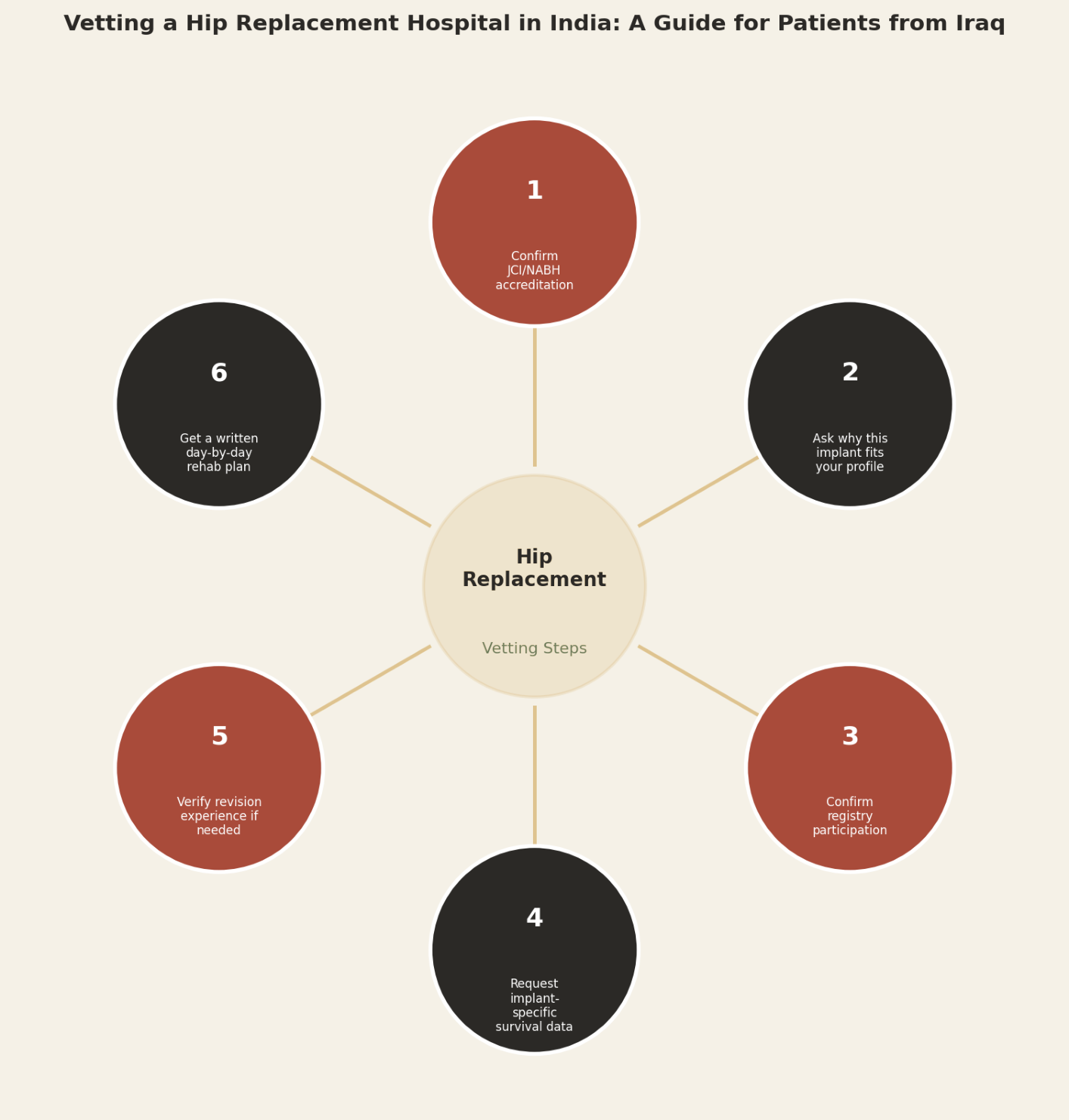
For Iraqi patients considering hip replacement in India, the most important question is not simply which surgeon performs the highest number of operations, but why a particular implant and bearing surface are appropriate for the patient’s age, bone quality and activity level. The guide’s page 4 checklist places individualised implant selection, registry participation, activity-matched bearing choice and a structured day-by-day rehabilitation programme at the centre of hospital evaluation.
Why the Choice of Hip Surgeon in India Matters as Much as the Choice of Implant
Based on my interactions with international patients, published data on hip replacement is genuinely reassuring at the population level, with survival commonly cited in the range of 90 to 95 percent at ten years and 80 to 85 percent at twenty years for a well-performed primary procedure. India’s own joint registry, growing since 2019, has begun tracking implant-specific survival domestically, with metal-on-polyethylene bearings showing roughly 92 percent survival at five years in early registry data, with ceramic bearings performing somewhat better in appropriately selected patients. For revision hip surgery specifically, a separate peer-reviewed study of cemented revision stems reported a five-year implant survival of 98.1 percent, declining to 83.9 percent at twelve years, figures that illustrate genuinely strong outcomes are achievable in revision cases too, provided the right technique and implant are chosen. A separate, genuinely revealing Indian study specifically analysing revision hip replacement found that a meaningful share of failures traced back to outdated implant designs, including smooth stainless steel stems originally intended for a different purpose, and older-generation polyethylene in cemented cups, rather than failures of modern implant technology itself. This tells a family something important: the specific implant generation and bearing surface chosen for you, not simply the fact of having a hip replacement in a reputable hospital, is what most determines whether your hip lasts decades rather than needing early revision.
How Patients from Iraq Can Verify a Hip Replacement Hospital’s Accreditation in India
The fastest filter I recommend to every Iraqi patient calling about hip replacement is verifiable accreditation, not marketing language. Joint Commission International, JCI, audits a hospital’s overall clinical safety systems against the same standard used across the United States and Europe. The National Accreditation Board for Hospitals and Healthcare Providers, NABH, is India’s own domestic equivalent, and in my experience of 24 years advising patients on this exact decision, a centre holding both marks together is a meaningfully stronger signal than either alone. For hip replacement specifically, ask one further, very direct question: does this hospital participate in India’s national joint registry, tracking its own implant-specific survival data over time, or does it rely only on internal, unpublished figures with no external benchmark.
Hip Replacement Volume and Implant-Selection Criteria That Predict Outcomes in India
Based on my interactions with dozens of orthopaedic programmes over the years, a surgeon’s reasoning behind the specific implant and bearing surface recommended for your case, not simply their overall hip replacement volume, is one of the clearest predictors of a good long-term outcome. A surgeon’s genuine annual volume still matters, since published research consistently links higher surgical volume with lower complication rates, but volume alone does not substitute for individualised implant selection. Ask directly, in writing:
- Given my specific age, bone density, and activity level, why has this specific implant type, cemented, uncemented, or hybrid, and this specific bearing surface been recommended for my case?
- What is this hospital's own implant-specific survival data at five and ten years, and does it participate in India's national joint registry?
- If revision surgery is ever needed in the future, does this surgeon have specific, tracked experience in revision hip arthroplasty, distinct from primary replacement volume?
- For a younger, more active patient specifically, what bearing surface options exist to reduce long-term wear, and what are the trade-offs of each?
A surgeon confident in their own reasoning will answer these specifically. A surgeon who recommends the same implant and bearing surface for every patient regardless of age or activity level deserves a second opinion before you commit.
Vetting a Hip Replacement Hospital in India: A Guide for Patients from Iraq
Questions Patients from Iraq Should Ask About the Hip Replacement Team in India
Hip replacement outcomes depend on more than the surgeon alone. In my experience of 24 years watching these programmes operate, the strongest units include a surgeon with specific fellowship training in joint arthroplasty, an anaesthesiologist experienced in regional anaesthesia techniques that can meaningfully speed early mobilisation after surgery, and a structured physiotherapy team guiding the specific rehabilitation protocol that begins within a day of the operation in most modern enhanced-recovery programmes. A dedicated pain management approach, often combining regional nerve blocks with multimodal medication rather than relying heavily on opioids alone, is a further detail worth confirming, since effective early pain control directly supports the faster mobilisation that enhanced-recovery protocols depend on. Ask specifically who fills each of these roles for your case, and confirm that a clear, day-by-day rehabilitation plan has been outlined before your surgery, not improvised afterward.
Hip Replacement Technology Standards in India That Patients from Iraq Should Check
The specific technology and technique available change both surgical precision and long-term implant performance. Ask whether the hospital offers computer-assisted or robotic-assisted hip replacement for cases where precise implant alignment is particularly important, since alignment accuracy has been linked to reduced long-term wear in published research. Ask which specific bearing surface combinations are available, since ceramic-on-ceramic and ceramic-on-polyethylene options generally offer different wear characteristics suited to different patient profiles, and highly cross-linked polyethylene has itself improved considerably compared with older generations of the material. For patients with prior hip surgery or complex bone anatomy, ask whether the hospital has access to specialised revision implant systems and patient-specific instrumentation, since standard implants may not suit every anatomy. Ask directly which of these specific capabilities apply to your case, not simply whether the hospital owns the equipment somewhere in the building.
Red Flags Patients from Iraq Should Watch For When Choosing a Hip Replacement Hospital in India
Over the years, certain patterns have become reliable warning signs for me. A hospital that recommends the same implant type and bearing surface for every patient, regardless of age, bone quality, or activity level, has not individualised your care in the way current best practice supports. A hospital that cannot provide its own implant-specific survival data, or that does not participate in any external joint registry, is asking you to trust internal, unverifiable claims. A hospital without a clear, structured, day-by-day rehabilitation plan in place before surgery is likely to leave your recovery less organised than it should be. And a hospital that quotes a single flat price without first reviewing your specific bone quality and anatomy on imaging is very likely underestimating the complexity your case may actually involve.
Factors Every Patient from Iraq Should Weigh Before Choosing Hip Replacement in India
A Closing Thought for Iraqi Families
Hip replacement is genuinely one of the most successful and well-established procedures in modern orthopaedics, but its long-term success depends on a specific, individualised match between your bone quality, age, and activity level and the implant chosen for you, not a one-size-fits-all approach applied to every patient. Based on my interactions with international patients over more than two decades, the patients who ask about implant-specific data, registry participation, and individualised reasoning consistently achieve better long-term outcomes than those who accept a general reassurance alone. My role, and the role of any advisor a patient works with, should be to help you ask these exact questions and confirm honestly that the specific surgeon and specific hospital in front of you are the right fit for your exact case. Iraq’s patients deserve the same standard of scrutiny in this decision as any patient anywhere else in the world.
Sources & Further Reading
- Joint Commission International (JCI) — Accredited Organizations Directory (jointcommissioninternational.org)
- National Accreditation Board for Hospitals & Healthcare Providers (NABH), India (nabh.co)
- PubMed Central — Epidemiology of Revision Total Hip Arthroplasty: An Indian Experience (pmc.ncbi.nlm.nih.gov)
- International Orthopaedics (Springer) — Long-Term Implant Survival in Revision Hip Arthroplasty with Cemented Stem (link.springer.com)
- American Academy of Orthopaedic Surgeons (AAOS) — Hip Replacement Patient Information (aaos.org)
Frequently Asked Questions by Iraqi Patients about Selecting a Hip Replacement Surgeon and Hospital in India
Can Iraqi patients undergo hip replacement surgery in India?
Yes. The guide is specifically designed for Iraqi patients evaluating hip replacement surgeons and hospitals in India and focuses on implant selection, surgical expertise and long-term outcomes.
How should an Iraqi patient choose a hip replacement surgeon in India?
Patients should look for specific joint-arthroplasty expertise, relevant annual surgical volume and experience with both primary and revision hip replacement. The surgeon should also explain why a particular implant suits the patient's profile.
Should Iraqi patients choose a cemented or uncemented hip implant?
The guide does not recommend one fixation method for everyone. Cemented, uncemented and hybrid options should be considered according to the patient's age, bone quality, anatomy and activity level.
Which hip bearing surface is suitable for Iraqi patients?
The appropriate bearing surface depends on individual characteristics, particularly age and activity level. Patients should ask about available ceramic and polyethylene combinations and the expected long-term wear of each option.
How long can a hip replacement last?
The source cites approximately 90–95% survival at 10 years and 80–85% at 20 years for well-performed primary procedures. Longevity can vary according to implant selection, patient factors and other clinical circumstances.
Can Iraqi patients receive revision hip replacement in India?
Yes. The guide specifically recommends checking a surgeon's tracked revision hip arthroplasty experience separately from their primary hip replacement volume, particularly for patients who have already undergone hip surgery.
Is robotic or computer-assisted hip replacement available in India for Iraqi patients?
The guide recommends asking whether computer-assisted or robotic-assisted hip replacement is available for cases where accurate implant alignment is particularly important. Its suitability should be determined for the individual case.
What rehabilitation is required after hip replacement for Iraqi patients?
The guide recommends a structured physiotherapy programme and a written day-by-day rehabilitation plan. Modern enhanced-recovery programmes may begin rehabilitation within a day of surgery.
Should Iraqi patients ask about hip replacement registry data in India?
Yes. The guide recommends asking whether the hospital participates in India's joint registry and whether it can provide implant-specific survival data rather than relying solely on unpublished internal figures.
What are the main warning signs when choosing a hip replacement hospital in India?
Warning signs include using the same implant for every patient, inability to provide implant-specific outcomes, no external registry participation, lack of a structured rehabilitation plan and quoting a fixed price without first reviewing the patient's anatomy and bone quality.
Page Summary
Hip replacement is highly established, but long-term results depend on matching the implant, fixation method and bearing surface to the individual patient. The source cites strong survival figures for both primary and revision procedures while highlighting the importance of modern implant design and avoiding outdated components.
For Iraqi patients travelling to India, the guide recommends evaluating accreditation, implant-specific outcome data, registry participation, revision experience, multidisciplinary rehabilitation support and technology appropriate to the patient's anatomy. A hospital should be able to explain clearly why its proposed implant and bearing surface are suitable for the individual patient rather than applying the same choice to everyone.
Citation Block
| Field | Details |
|---|---|
| Article / Topic | Selecting the Best Hip Replacement Surgeons and Hospitals in India |
| Primary Patients | Patients from Iraq |
| Treatment Area | Hip replacement / total hip arthroplasty |
| Primary Survival | Approximately 90–95% at 10 years |
| Twenty-Year Survival | Approximately 80–85% |
| Indian Registry Figure | Approximately 92% five-year survival for cited metal-on-polyethylene bearings |
| Revision Five-Year Survival | 98.1% in cited cemented revision-stem study |
| Revision Twelve-Year Survival | 83.9% in cited study |
| Implant Fixation | Cemented, uncemented or hybrid |
| Bearing Selection | Should be matched to patient profile |
| Patient Factors | Age, bone quality and activity level |
| Surgeon Volume | Higher volume is relevant but does not replace individualised implant selection |
| Revision Expertise | Should be assessed separately from primary replacement volume |
| Accreditation | JCI and NABH |
| Registry Participation | Ask whether the hospital tracks implant-specific outcomes through a joint registry |
| Arthroplasty Team | Joint replacement surgeon, anaesthesiologist and physiotherapy team |
| Pain Management | Regional techniques and multimodal medication |
| Rehabilitation | Structured enhanced-recovery programme |
| Computer Assistance | May be considered when precise implant alignment is important |
| Robotic Assistance | May be available for selected hip replacement cases |
| Bearing Options | Ceramic-on-ceramic, ceramic-on-polyethylene and other combinations |
| Complex Anatomy | Specialised revision implants and patient-specific instrumentation may be useful |


Our Mission Statement
Our mission is to place patients at the centre of every healthcare decision by providing trustworthy, evidence-based, and unbiased medical information. We believe that informed patients make better decisions. Backed by personalised guidance from our experienced advisory team, we help patients understand their treatment options, compare them objectively, and confidently choose the path that best suits their medical needs and personal circumstances.
Patient Testimonials from Iraq










Ready to Take the First Step?
Share your Medical Reports with our Healthcare Managers Today and Get a FREE CONSULTATION, a Personalized Treatment Plan, and Complete Support from Arrival to Recovery.
Get Your Free ConsultationAreas We Serve
Indian Health Guru Consultants proudly assists patients from Iraq and surrounding Middle Eastern countries in accessing advanced, affordable and trusted medical treatment in India. Our team provides complete support for medical opinions, hospital selection, treatment planning, visa assistance, travel coordination, accommodation and post-treatment follow-up.
We regularly serve patients from:
- Iraq
- Turkey
- Iran
- Kuwait
- Jordan
- Syria
- Qatar
- Bahrain
- Oman
- Yemen
- Saudi Arabia
- United Arab Emirates
No matter where you are located, our experienced team is committed to making your medical journey to India safe, smooth, transparent and stress-free from the first enquiry to your return home.
From Iraq to India: Your Complete Patient Guide
- Penile Implant Surgery in India for Iraqis
- Cosmetic and Aesthetic Surgery in India for Iraqis
- Leukemia, Lymphoma and Blood Cancer Treatment in India for Iraqis
- CyberKnife Treatment in India for Iraqis
- Cancer Treatment in India for Iraqi Patients
- Colorectal Cancer Treatment and Surgery in India for Iraqis
- Heart Failure Treatment and Surgery in India for Iraqis
- Neurosurgery in India for Iraqis
- Laparoscopic and Robotic Myomectomy in India for Iraqis
- Pancreatic Cancer Surgery in India for Iraqis
- Paediatric Heart Surgery in India for Iraqis
- IVF and Fertility Treatment in India for Iraqis
- Kidney Transplant in India for Iraqis
- Cornea Transplant and Advanced Eye Surgery in India for Iraqis
- Spine Surgery in India for Iraqis
- Robotic Cancer Surgery in India for Iraqis
- Proton Therapy in India for Iraqis
- Knee Surgery in India for Iraqis