

Kidney Transplant in India: A Complete Guide for Patients from Bangladesh
What a Bangladeshi family should know before choosing a hospital, city and transplant team across the border — costs, process and the questions worth asking before you book a ticket.
Chronic kidney disease is strikingly common in Bangladesh, and the country's transplant capacity has not kept pace with the need it creates. A peer-reviewed assessment published in the journal Kidney360 found that 16 to 22 percent of Bangladeshi adults live with chronic kidney disease, and that every year 35,000 to 40,000 people progress to kidney failure — yet in the country's best year on record, only 404 kidney transplants were performed nationally. For the great majority of patients reaching end-stage kidney failure, dialysis, not transplantation, remains the only treatment they will ever receive at home, despite transplant offering meaningfully better long-term survival and quality of life. This guide sets out what kidney transplant surgery in India actually involves, what it realistically costs compared with the UK and US, and the practical decisions that separate a smooth trip from a stressful one.
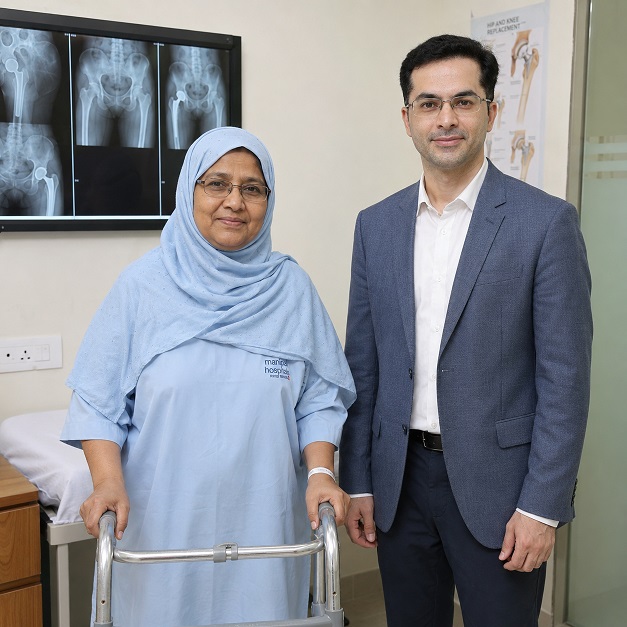
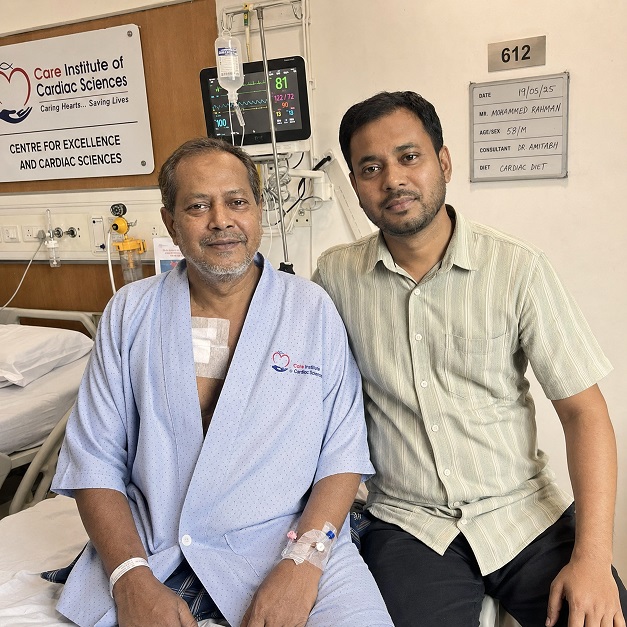
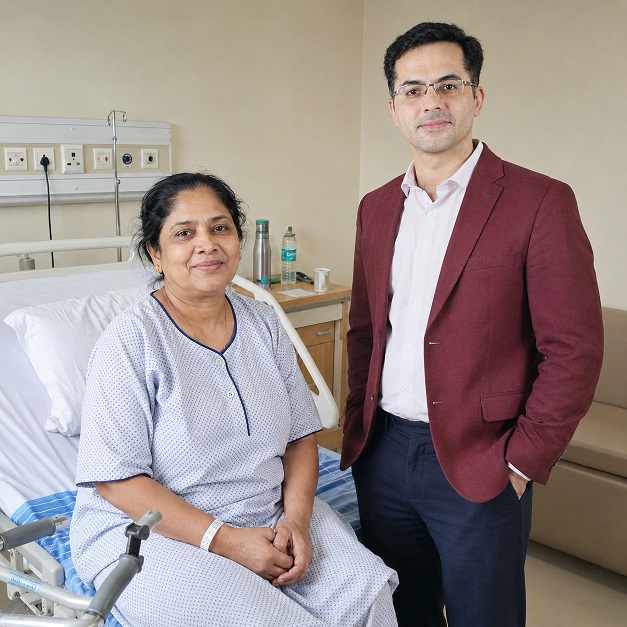
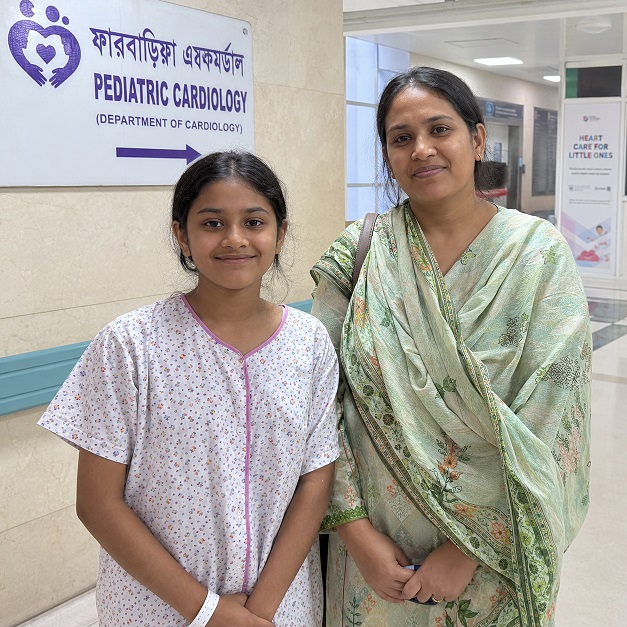
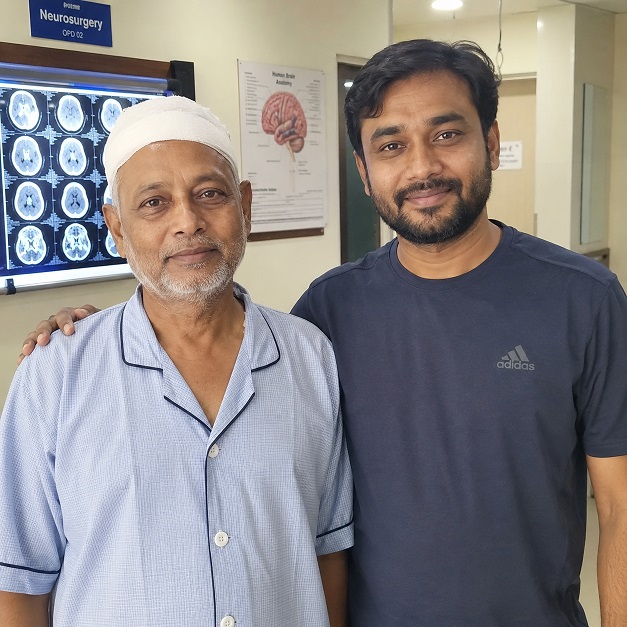
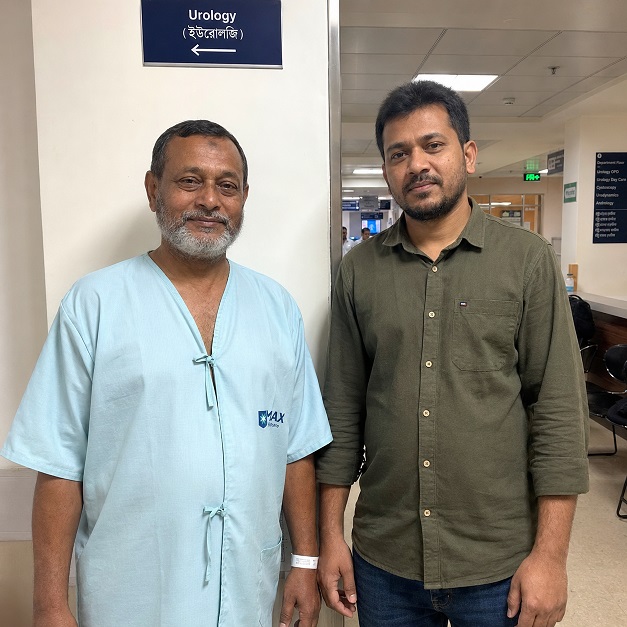
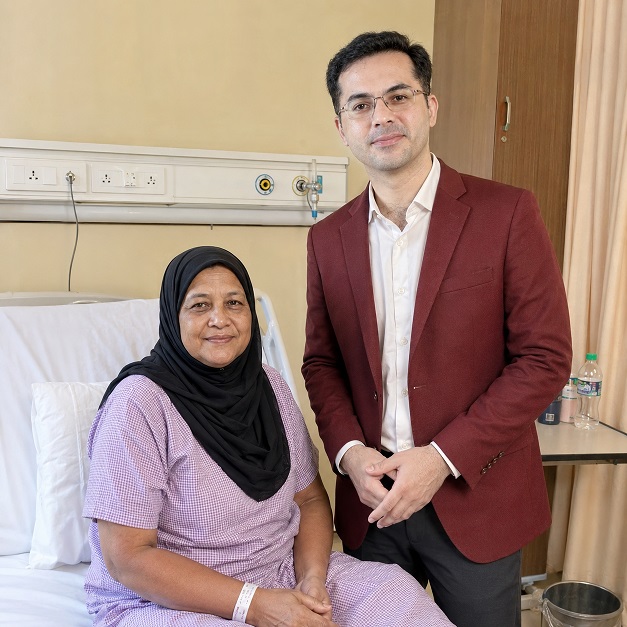
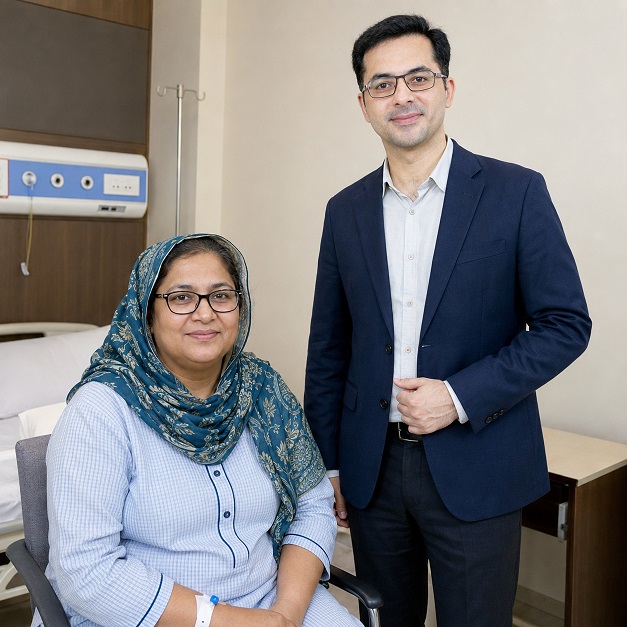
Healing Journeys of Bangladeshi Patients


Key Takeaways
- The guide highlights the substantial gap between kidney disease burden and transplant capacity in Bangladesh. A peer-reviewed assessment cited in the guide estimates that 16–22% of Bangladeshi adults live with chronic kidney disease, with approximately 35,000–40,000 people progressing to kidney failure each year. Yet the country's best recorded year had only 404 kidney transplants, leaving dialysis as the main treatment for most patients reaching end-stage kidney failure.
- For international patients, the guide identifies living-donor kidney transplantation as the principal pathway in India. Deceased-donor kidneys are generally not accessible to foreign nationals because they are allocated to patients on India's national waiting list. ABO-incompatible transplantation and paired exchange may provide alternatives when a willing family donor is not a direct blood-type match.
- One of the most important planning issues for Bangladeshi families is the legal donor requirement. The guide explains that a foreign patient's living donor must generally qualify as a near relative—spouse, parent, child, sibling or grandparent—with the relationship documented and typically verified through a DNA test before approval by the government Authorisation Committee.
- The guide recommends starting donor identification and legal preparation as early as possible after kidney failure is diagnosed, rather than waiting until years of dialysis have passed. The DNA verification and Authorisation Committee process alone can commonly take four to eight weeks, making it one of the biggest factors affecting the total treatment timeline.
- India is presented as an option for Bangladeshi families because of high living-donor transplant volume, established ABO-incompatible and paired-exchange programmes and dedicated transplant centres in Kolkata, Chennai, Delhi and Mumbai. The guide also notes experience managing hepatitis-and diabetes-related kidney disease, which are important contributors to kidney failure in the region.
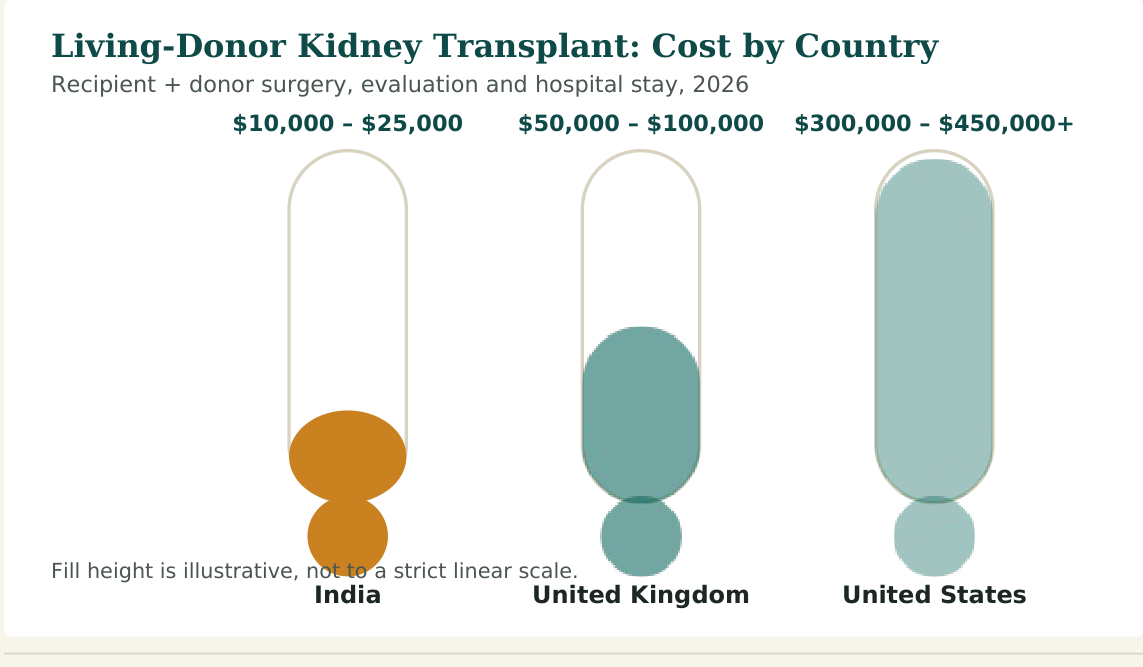
- The cost chart on page 3 gives an indicative 2026 range of US$10,000–25,000 in India for a standard living-donor kidney transplant covering recipient and donor surgery, evaluation and hospital stay. The comparable ranges shown are US$50,000–100,000 in the UK and US$300,000–450,000+ in the US. ABO-incompatible, complex or repeat cases may cost more.
- The guide stresses that Bangladeshi families should confirm exactly what the hospital quotation includes, particularly both recipient and donor surgery, pre-transplant evaluation and additional treatment for ABO incompatibility if required. Lifelong immunosuppression after transplantation is a separate continuing expense and must be included in long-term financial planning.
- The seven-stage journey diagram on page 4 shows teleconsultation and laboratory review, cost confirmation, visa and embassy documentation, DNA testing and Authorisation Committee approval, same-day recipient and donor surgery, ICU recovery and return to Bangladesh. The total process from starting preparation to flying home is typically 5–7 weeks, with immunosuppression monitoring continuing for life.
Quick Facts
- Author
- Dr. Dheeraj Bojwani
- Experience
- 24+ Years
- Treatment
- Kidney Transplant
- Country
- India
- Patients
- Bangladeshi Patients
- Key Specialist
- Nephrologist / Kidney Transplant Surgeon
- Primary Transplant Type
- Living-Donor Kidney Transplant
- Alternative Options
- ABO-Incompatible Transplant and Paired Exchange
- Foreign Donor Requirement
- Generally a legally recognised near relative
- Near Relatives
- Spouse, Parent, Child, Sibling or Grandparent
- Verification
- Relationship documentation and DNA testing
- Approval
- Government Authorisation Committee
- Approval Timeline
- Commonly 4–8 weeks
- India Cost
- US$10,000–25,000 for standard living-donor transplantation
- UK Cost
- US$50,000–100,000
- US Cost
- US$300,000–450,000+
- Typical Time in India
- Approximately 5–7 weeks
- Surgery
- Recipient and donor procedures are shown as taking place on the same day
- ICU Recovery
- Approximately 7–10 days shown in the treatment journey
- Long-Term Medication
- Lifelong immunosuppression
- Hospital Check
- Verify NABH or JCI accreditation directly
- Centre Check
- Ask about living-donor, ABO-incompatible and paired-exchange experience
- Legal Check
- Confirm donor eligibility before making travel arrangements
- Medical Visa
- Patient and living donor require appropriate medical-visa documentation
- Follow-Up
- Lifelong nephrology, immunosuppression and transplant monitoring in Bangladesh
- Key Warning
- Do not book travel before confirming donor eligibility and the Authorisation Committee process.
In Brief
Kidney transplant in India can provide Bangladeshi patients access to high-volume living-donor transplant centres, including programmes for ABO-incompatible and paired-exchange transplantation when a direct donor match is not available. The guide places particular emphasis on confirming early that the donor meets India's legal near-relative requirement and completing DNA verification and Authorisation Committee approval before surgery. A standard living-donor kidney transplant is estimated at approximately US$10,000–25,000 in India, with families generally needing 5–7 weeks in India for legal approval, evaluation, surgery and initial recovery, followed by lifelong immunosuppression and nephrology monitoring after returning to Bangladesh.
What Kidney Transplant Surgery Actually Involves
A kidney transplant replaces the function of two failing kidneys with a single healthy one, and the source of that kidney shapes the entire process. Transplant teams generally work with:
- Living donor kidney transplant — a kidney from a healthy, willing, compatible donor, almost always the pathway used by international patients. A living donor can lead a normal, healthy life with one remaining kidney.
- Deceased donor kidney transplant — generally not accessible to foreign nationals in India, since deceased-donor kidneys are allocated to patients on the national waiting list.
- ABO-incompatible transplant — an option when a willing donor's blood type does not match the recipient's, using additional pre-transplant treatment to allow the transplant to proceed safely anyway.
- Paired exchange — where two donor-recipient pairs, each incompatible with their own relative, swap donors so both transplants become possible.
Ask a nephrologist to confirm which pathway applies to your situation, and whether an ABO-incompatible or paired-exchange option is worth exploring if the most obvious family donor is not a direct blood-type match.
Why the Regional Care Gap Matters for Treatment Planning
Because Bangladesh performs only a small fraction of the kidney transplants its population needs each year, most patients with kidney failure remain on long-term dialysis, which carries a real and ongoing financial burden as well as lower long-term survival than a successful transplant. This has a direct planning consequence: families should treat a transplant not as a last resort after years of dialysis, but as worth investigating seriously and early, since outcomes are generally better the sooner a well-matched transplant can be arranged. It also means the search for a compatible living donor among close relatives should start as soon as kidney failure is diagnosed, well before choosing a specific hospital.
Why India Specifically for Kidney Transplant?
India has become the leading destination for Bangladeshi families seeking kidney transplant surgery abroad. Peer-reviewed research surveying patients directly at the Indian Visa Application Centre in Chittagong found that the decision consistently comes down to a combination of experienced specialist teams, hospital quality and cost. Several practical advantages reinforce this pattern for kidney transplant specifically:
- Paired exchange — where two donor-recipient pairs, each incompatible with their own relative, swap donors so both transplants become possible.
- Very high living-donor transplant volume, with dedicated centres in Kolkata, Chennai, Delhi and Mumbai performing living-donor procedures at a scale far beyond Bangladesh's current domestic capacity.
- Established ABO-incompatible and paired-exchange programmes, giving families a realistic path forward even when the most willing family donor is not a direct blood-type match.
- Deep experience managing hepatitis and diabetes-related kidney disease, both major contributors to kidney failure in this region.
- Easy connectivity and an established medical-visa system built specifically around Bangladeshi patients, including a dedicated government portal for hospital invitation letters and provision for both the patient and the living donor to travel together.
Advisor's Note — DR. Dheeraj Bojwani
"In 24 years of guiding families through this decision, the clearest advice I give a Bangladeshi family facing a kidney transplant is this: understand early that Indian law requires a foreign patient's living donor to be a near relative — spouse, parent, child, sibling or grandparent — verified with a DNA test and approved by a government Authorisation Committee, a process that alone can take four to eight weeks. This is not optional paperwork to rush through at the last minute; build it into your timeline from the very beginning."
Kidney Transplant India Cost vs Other Countries
What the Numbers Actually Mean
The headline number matters less than what it includes. A Bangladeshi family comparing quotes should ask each Indian hospital to confirm whether the figure covers both the recipient's and the donor's surgery and hospital stay, pre-transplant evaluation for both, and any additional treatment needed for an ABO-incompatible transplant. Lifelong immunosuppression medication after the transplant is a separate, ongoing cost that continues for the rest of the recipient's life.
Peer-reviewed research on cross-border medical travel found that international patients spend an average of 3,800 to 7,000 US dollars per visit once transport, accommodation and incidental costs are added to treatment itself — a range worth budgeting for on top of the surgery cost shown above. Realistically, families should plan for 5 to 7 weeks in India, which includes several weeks for legal donor verification and Authorisation Committee approval before surgery can even be scheduled.
A note on insurance
Most Bangladeshi health insurance policies do not cover overseas treatment, and Indian hospitals generally expect self-pay or an advance deposit from international patients. Confirm this before travelling rather than after arrival.
The Typical Journey of a Bangladeshi Family Planning Kidney Transplant in India
Most Bangladeshi families follow a broadly similar sequence, whether they travel independently or through a medical-facilitation service. Knowing the shape of it in advance makes each step easier to plan for.
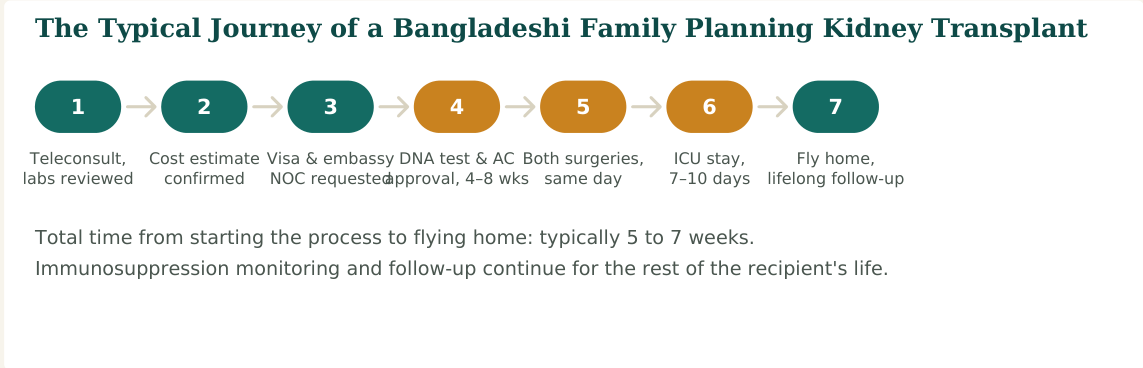
Total time from starting the process to flying home: typically 5 to 7 weeks. Immunosuppression monitoring and follow-up continue for the rest of the recipient's life.
Factors a Bangladeshi Family Should Weigh Before Kidney Transplant in India
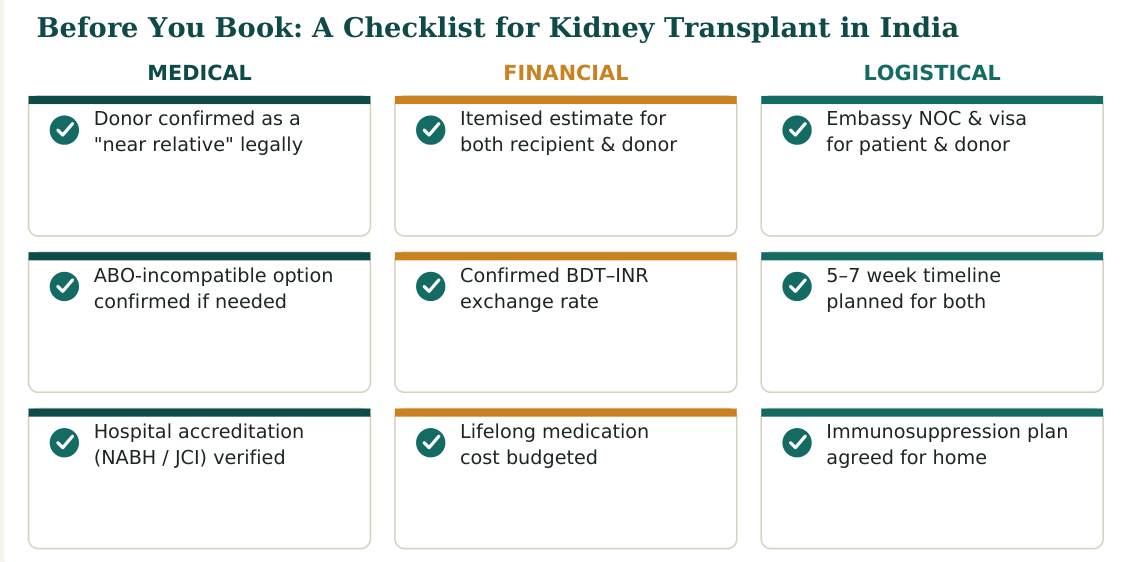
Beyond the surgery itself, the decisions that most affect a family's experience are logistical and financial rather than purely medical. Consider each of the following before confirming a hospital:
- Confirm the donor qualifies as a "near relative" under Indian law — spouse, parent, child, sibling or grandparent. Foreign nationals cannot generally use unrelated or emotionally-connected donors, unlike some Indian domestic cases.
- Which city, not just which hospital. Kolkata is closest and most familiar linguistically; Chennai, Delhi and Mumbai often have a wider choice of high-volume dedicated transplant centres.
- The centre's ABO-incompatible and paired-exchange programme, if the most willing donor is not a direct blood-type match.
- Genuine hospital accreditation. Ask whether the hospital holds NABH or JCI accreditation and verify it directly through the accreditation board's own directory rather than taking a brochure's word for it.
- An itemised, written estimate covering both recipient and donor surgery, evaluation, and any ABO-incompatible treatment if needed.
- The DNA test and Authorisation Committee timeline, since this legal approval step, not the surgery itself, is often what determines how long the whole trip takes.
- A written lifelong immunosuppression and monitoring plan for after you return, coordinated with a nephrologist in Bangladesh, since this medication and follow-up continues permanently.
- Embassy documentation arranged early, including the No Objection Certificate confirming the patient's and donor's identities, which the treating hospital will need well before surgery can be scheduled.
Before You Book: A Checklist for Kidney Transplant in India
A Closing Words
For most Bangladeshi families, India offers a genuine path to kidney transplant that domestic capacity currently cannot provide at the scale needed. The value depends entirely on the specifics: confirming early that a willing family donor meets India's legal near-relative requirement, understanding the DNA test and Authorisation Committee timeline as a core part of planning rather than an afterthought, a transparent itemised estimate covering both patients, and a realistic plan for the lifelong medication and monitoring that follows every kidney transplant. Families who ask detailed questions before booking, rather than after arriving, consistently report a smoother experience — medically and financially.
Sources
- 🌐 National Medical Commission of India — statutory body for verifying a doctor's registration and specialist qualifications. · nmc.org.in
- 🌐 National Accreditation Board for Hospitals & Healthcare Providers (NABH) — India's principal healthcare accreditation authority, under the Quality Council of India. · nabh.co
- 🌐 Global Dialysis Perspective: Bangladesh. Peer-reviewed assessment, Kidney360 journal, hosted via NIH/NCBI, quantifying chronic kidney disease burden and transplant capacity in Bangladesh. · pmc.ncbi.nlm.nih.gov/articles/PMC10617799
- 🌐 Determinants of Bangladeshi patients' decision-making process and satisfaction toward medical tourism in India. Peer-reviewed study, hosted via NIH/NCBI. · pmc.ncbi.nlm.nih.gov/articles/PMC10185743
- 🌐 Government of India — Medical Value Travel / e-Medical Visa Portal, Bureau of Immigration, Ministry of Home Affairs — official channel for hospital invitation letters and medical-visa provisions for Bangladeshi nationals. · indianfrro.gov.in/frro/medicalvaluetravel
Frequently Asked Questions by Bangladeshi Patients about Kidney Transplant in India
Can a Bangladeshi patient receive a kidney from a family member in India?
Yes, but the donor must generally qualify as a near relative under Indian regulations. The guide identifies a spouse, parent, child, sibling or grandparent, with relationship verification and government approval required.
What if a Bangladeshi patient's willing family donor is not a direct blood-type match?
The family can ask the transplant team about an ABO-incompatible transplant or paired exchange. These options may make transplantation possible despite a direct blood-type mismatch.
How long does kidney transplant approval take for Bangladeshi patients in India?
The DNA verification and Authorisation Committee process commonly takes four to eight weeks after the necessary documents are submitted. The guide recommends beginning this process as early as possible.
How much does a kidney transplant cost in India for Bangladeshi patients?
The page 3 cost chart gives an indicative range of US$10,000–25,000 for a standard living-donor transplant covering recipient and donor surgery, evaluation and hospital stay. Complex or ABO-incompatible cases may cost more.
Does the kidney transplant package include both the donor and recipient?
The guide recommends specifically confirming this with the hospital. A proper quotation should state whether it includes both surgeries, pre-transplant evaluation and hospital stays for the donor and recipient, as well as any additional ABO-incompatible treatment.
How long should a Bangladeshi family plan to stay in India for kidney transplantation?
The guide recommends planning for approximately 5–7 weeks, because legal donor verification and Authorisation Committee approval can take several weeks before surgery is scheduled.
Which Indian cities are highlighted for Bangladeshi kidney-transplant patients?
The guide highlights Kolkata, Chennai, Delhi and Mumbai as cities with dedicated high-volume living-donor transplant centres. Kolkata may be particularly convenient because of its geographic and linguistic familiarity for many Bangladeshi families.
What should Bangladeshi families check when choosing a kidney transplant centre?
They should assess living-donor transplant volume, ABO-incompatible and paired-exchange experience, accreditation, multidisciplinary support and long-term follow-up arrangements rather than choosing a hospital on price alone.
Will kidney transplant follow-up continue after returning to Bangladesh?
Yes. The guide emphasises that immunosuppression and transplant monitoring continue for the recipient's entire life. The Indian team should provide a written long-term plan that can be coordinated with a nephrologist in Bangladesh.
What is the most important thing Bangladeshi families should do before booking travel?
Confirm donor eligibility, relationship documentation, DNA testing requirements and the Authorisation Committee process before making travel arrangements. This legal pathway can take longer than the actual surgery and is often the biggest source of delay.
Page Summary
The six-page guide explains kidney transplant in India for Bangladeshi patients, focusing on living-donor transplantation, donor eligibility, India's legal requirements, ABO-incompatible transplantation and paired exchange. It emphasises early donor identification, DNA verification, Authorisation Committee approval, transparent costing and lifelong immunosuppression planning. The page 3 cost chart places a standard living-donor transplant at US$10,000–25,000 in India, while the page 4 journey diagram presents a seven-stage pathway requiring approximately 5–7 weeks, including the 4–8 week legal approval process and initial recovery.
Citation Block
| Field | Information |
|---|---|
| Article / Topic | Kidney Transplant in India for Patients from Bangladesh |
| Treatment | Living-donor kidney transplantation |
| Country / Patients | India / Bangladeshi Patients |
| Key Specialists | Nephrologist and Kidney Transplant Surgeon |
| Primary Donor Type | Living donor |
| Foreign Donor Requirement | Generally a legally recognised near relative |
| Near-Relative Categories | Spouse, parent, child, sibling or grandparent |
| Donor Verification | Relationship documentation and DNA testing |
| Legal Approval | Government Authorisation Committee |
| Approval Timeline | Commonly 4–8 weeks after required documentation is submitted |
| Alternative Options | ABO-incompatible transplant and paired exchange |
| India Cost | US$10,000–25,000 for standard living-donor transplantation |
| Typical Overall Stay | Approximately 5–7 weeks |
| Hospital Recovery | Approximately 7–10 days of ICU/hospital recovery shown in the journey |
| Quotation Check | Confirm both recipient and donor surgery, evaluation and ABO-incompatible treatment if required |
| Long-Term Cost | Lifelong immunosuppression medication is a separate ongoing expense |
| Centre Requirement | High-volume living-donor transplant programme with appropriate multidisciplinary support |
| Programme Check | Confirm ABO-incompatible and paired-exchange capability if direct donor matching is unsuccessful |
| Hospital Check | Verify NABH or JCI accreditation directly |
| Embassy Documentation | No Objection Certificate and identity documentation should be arranged early |
| Medical Visa | Appropriate medical-visa documentation is required for both patient and living donor |
| Follow-Up | Lifelong immunosuppression monitoring and nephrology follow-up in Bangladesh |
| Financial Planning | Budget separately for travel, accommodation, incidental expenses and lifelong medication |
| Key Selection Criteria | Legal donor eligibility, transplant volume, programme capability, transparent costing and lifelong follow-up planning |
| Important Warning | Donor eligibility and government approval should be confirmed before travel because the legal process can significantly affect the treatment timeline |


Our Mission Statement
Our mission is to place patients at the centre of every healthcare decision by providing trustworthy, evidence-based, and unbiased medical information. We believe that informed patients make better decisions. Backed by personalised guidance from our experienced advisory team, we help patients understand their treatment options, compare them objectively, and confidently choose the path that best suits their medical needs and personal circumstances.
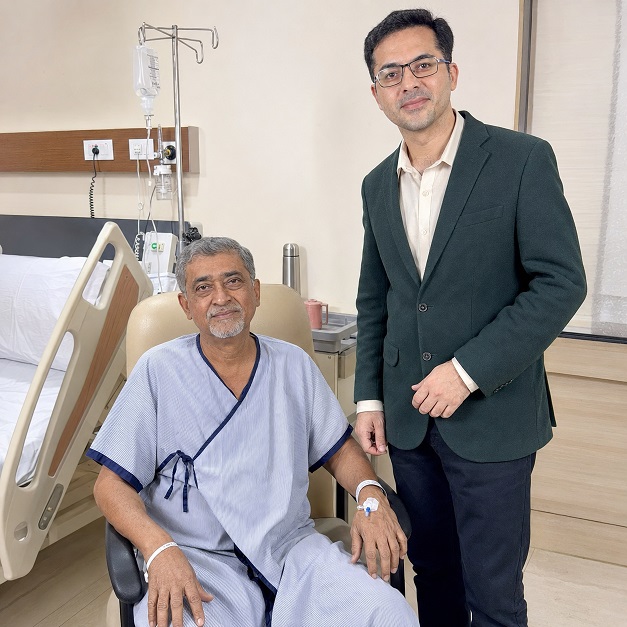
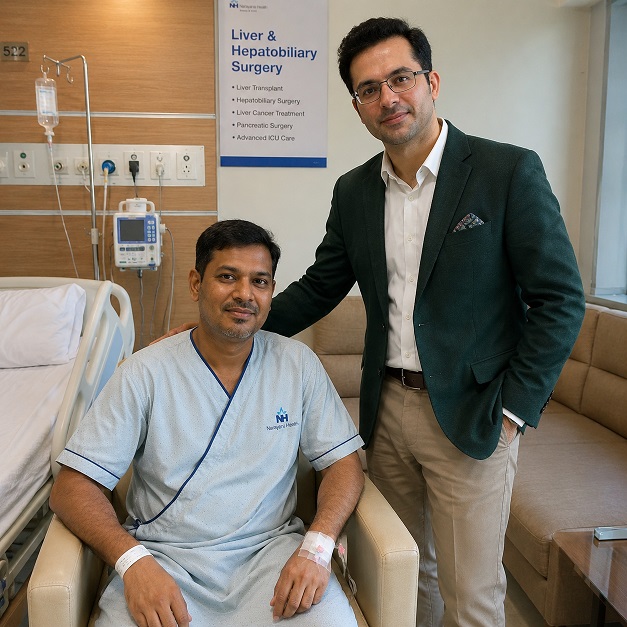
Patient Testimonials from Bangladesh
Ready to Take the First Step?
Share your medical reports with our healthcare managers today and receive a FREE CONSULTATION, a personalized treatment plan and complete support from your arrival to your recovery.
Get Your Free ConsultationFrom Bangladesh to India: Your Complete Patient Guide
- Complex Orthopaedic and Joint Revision Surgery in India for Bangladeshi Patients
- Heart Failure Treatment and Surgery in India for Bangladeshi Patients
- Joint Arthroscopy and Sports Medicine in India for Bangladeshi Patients
- Leukemia, Lymphoma and Blood Cancer Treatment in India for Bangladeshi Patients
- Kidney Transplant in India for Bangladeshi Patients
- Liver Transplant in India for Bangladeshi Patients
- Hip Surgery in India for Bangladeshi Patients
- Knee Surgery in India for Bangladeshi Patients
- Spine Surgery in India for Bangladeshi Patients
- Shoulder Surgery in India for Bangladeshi Patients
- IVF and Fertility Treatment in India for Bangladeshi Patients
- Robotic Cancer Surgery in India for Bangladeshi Patients
- Brain Tumor Treatment in India for Bangladeshi Patients
- Neurosurgery in India for Bangladeshi Patients
- Prostate Cancer Treatment and Surgery in India for Bangladeshi Patients
- Cardiac Surgery in India for Bangladeshi Patients
- Dental Implants and Smile Makeover in India for Bangladeshi Patients
- Weight Loss and Bariatric Surgery in India for Bangladeshi Patients