Apollo Hospital
 Fortis Hospital
 Artemis Hospital
 Max Hospital
 Columbia Asia Hospital
 Nova Hospital
 Medanta Hospital


 Jaslok Hospital
 Lilavati Hospital

 Global Hospitals


Ankle Fusion Operation - Arthodesis Surgery in India
Key Takeaways
- Ankle fusion (arthrodesis) is performed to eliminate pain by permanently stiffening the ankle joint while preserving movement in the foot and lower leg joints.
- The surgery involves removing damaged joint surfaces, harvesting bone graft from the pelvis, and fixing the ankle with screws or an external fixator, followed by a plaster cast or external frame.
- Patients typically stay in the hospital for three to five days, must avoid weight‑bearing for about six to twelve weeks, and the cast is usually removed around 14 weeks, with recovery continuing for up to a year.
- Pre‑operative preparation includes stopping smoking, reducing excess weight, ensuring cardiovascular and respiratory conditions are controlled, and arranging post‑operative support from a relative or friend.
- Potential complications include anesthesia‑related risks, wound infection, deep‑vein thrombosis, failure of the bones to fuse (requiring further surgery), and, rarely, nerve or blood‑vessel injury.
What is it?
You have developed arthritis in your ankle. The surfaces of your joint are no longer smooth. The bones are rough and the cartilage lining has worn away. As a result, your ankle is painful and stiff.
The Operation
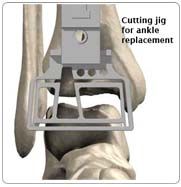 The main aim of the operation is to stop the pain in your ankle. The ankle joint is made completely stiff, but you will still be able to move the joint below the ankle and the joints in the foot. This operation is called either a fusion of the ankle, or arthrodesis. You will be given a general anaesthetic and be asleep for the whole operation. One or two cuts will be made over your ankle. The damaged joint surfaces of your ankle will be removed. A separate cut will be made over the rim of your pelvic bone. This is so bone can be taken from your pelvis and used to fill any gaps between the bones in your ankle. The bones may then be held together with screws.A plaster cast will then be put on up to your thigh. Sometimes an external fixator is used instead of screws and a plaster.
An external fixator is a frame that is fixed to the outside of your leg, above and below your ankle. The skin will then be closed up with stitches. A plastic tube drain runs from the wound through the skin. You will be in hospital for three to five days following your operation. You will be allowed to go home when you can walk safely with crutches.
Any Alternatives
Steroid injections into your ankle will not give permanent pain relief. Physiotherapy will not lessen the pain. If the pain in your ankle interferes with your life and the X-rays show that the joint is severely damaged, then you should have your ankle fused. Replacement ankle joints are being developed but are still experimental and not generally available.
Before the operation
Stop smoking and get your weight down if you are overweight. (See Healthy Living). If you know that you have problems with your blood pressure, your heart, or your lungs, ask your family doctor to check that these are under control. Check the hospital's advice about taking the Pill or hormone replacement therapy (HRT). Check you have a relative or friend who can come with you to the hospital, take you home, and look after you for the first week after the operation. Bring all your tablets and medicines with you to the hospital. On the ward, you may be checked for past illnesses and may have special tests, to make sure that you are well prepared and that you can have the operation as safely as possible. . Many hospitals now run special preadmission clinics, where you visit for an hour or two, a few weeks or so before the operation for these checks.
After - In Hospital
The wound may be painful. You will be given injections or tablets to control this. Ask for more if the pain is getting worse. A general anaesthetic will make you slow, clumsy and forgetful for about 24 hours. The nurses will help you with everything you need until you are able to do things for yourself. Do not make important decisions during this time. You will be able to drink within a few hours after the operation provided you are not feeling sick. The next day you should be able to manage normal food. The wounds will have simple adhesive dressings over them. The nurses will usually pull out your wound drain one or two days after your operation. This does not hurt. Your stitches are taken out 10 to 12 days after the operation. You must not put weight on your foot until the doctor tells you, This is usually 6 to 12 weeks after the operation. The physiotherapist will teach you to hop with a frame or crutches. You must not let your plaster cast become wet. You must not get your leg wet if you have had an external fixator fitted. You will be given an appointment to visit the orthopaedic outpatient Department about six weeks after your operation. The nurses will advise about sick notes, certificates etc.
After - At Home
When you go home, you should be able to move around the house using the crutches. You should not put weight on the ankle for six weeks or so. The plaster will probably be changed at six weeks, and as long as it is healing well, you should be able to start putting weight on the ankle.. The plaster may be finally taken off at about 14 weeks. The external fixator would be taken out at this time with a little operation. Your leg will continue to improve for at least one year. You will not be able to go shopping for the first few weeks after you go home. Please make arrangements for friends or family to shop for you. How soon you get back to work depends on your job. If you can get to work without driving yourself or by using public transport you may be able to return to work six weeks after your operation. You should not do manual work until your ankle is solidly fused, which will take at least 14 weeks or more. You may never be able to perform heavy manual tasks following your operation. You must not drive until you have been told that your ankle is soundly fused. You are unlikely to drive for at least four months after your operation.
Possible Complications
As with any operation under general anaesthetic there is a very small risk of complications related to your heart or your lungs. The tests that you will have before the operation will make sure that you can have the operation in the safest possible way and will bring the risk for such complications very close to zero.
Wound infection sometimes happens. You will be given antibiotics to try and prevent this. You can develop a blood clot in the veins of your calf (deep vein thrombosis DVT). A combination of medicine (an injection of a blood thinner) and compression stockings will be used to try and prevent this. The bones may not fuse. If this happens, a further operation would be necessary. If an external frame has been put on your leg, the pins may become infected. If this occurs, you will be given antibiotics. The pins would then be replaced under a general anaesthetic.
Very rarely, a nerve or a blood vessel can be damaged during the operation and you might need another operation to fix the problem.
Some of the common countries from which patients travel to India for surgery are:
| USA | UK | Canada |
| Australia | New Zealand | Nigeria |
| Kenya | Ethiopia | Uganda |
| Tanzania | Zambia | Congo |
| Sri Lanka | Bangladesh | Pakistan |
| Afghanistan | Nepal | Uzbekistan |
Surgery in India: click here
Phone Numbers Reach Us-
India & International : +91-9860755000 / +91-9371136499
Email : contact@indianhealthguru.com
Frequently Asked Questions
Below are the downloadable links that will help you to plan your medical trip to India in a more organized and better way. Attached word and pdf files gives information that will help you to know India more and make your trip to India easy and memorable one.
| Click icon to Download Document | ||||||
| About India |  |  | Destinations in India | | | |
| Indian Embassy List | | | Medical Tourism FAQ | | | |
| Visa For India | | | ||||