

Selecting the Best Proton Therapy Specialists and Hospitals in India: A Guide for Patients from Iraq
A doctor’s honest, question-by-question guide for patients from Iraq on vetting a proton therapy hospital in India — tumor-specific evidence, accreditation, technology standards, and the exact questions worth asking before you book anything.
Over the years, I have found that proton therapy is one of the treatments most often oversold in general marketing language, presented as simply “safer radiation” for every cancer type, when the honest evidence is considerably more specific: proton therapy shows genuine, measurable benefit for certain tumour types and age groups, while for others the evidence remains less definitive, and a family deserves to know which category their specific situation falls into.
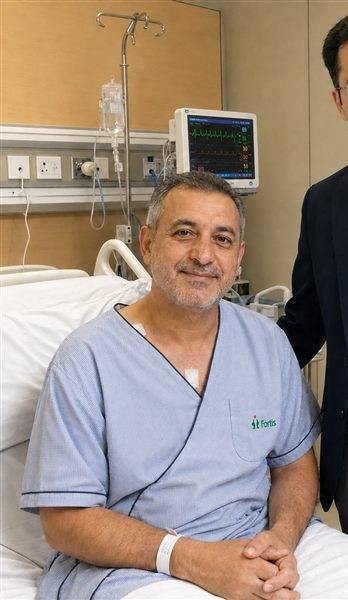
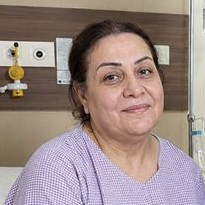
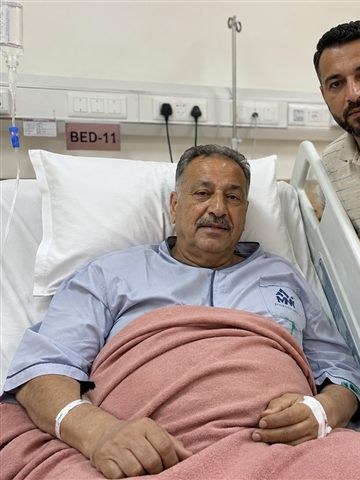
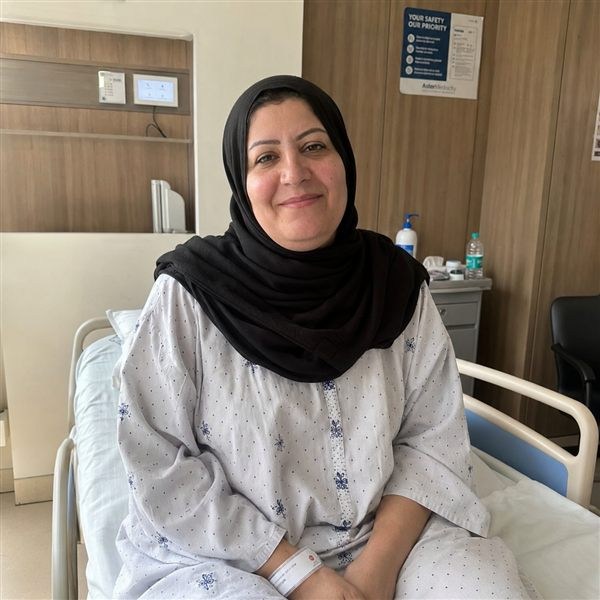
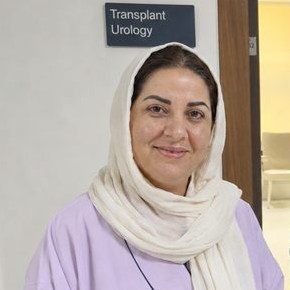
Healing Journeys of Iraqi Patients
Key Takeaways
- Proton therapy should not automatically be considered the safer radiation treatment for every cancer. The source stresses that its benefits are stronger for some tumour types and age groups, while evidence remains less definitive for others.
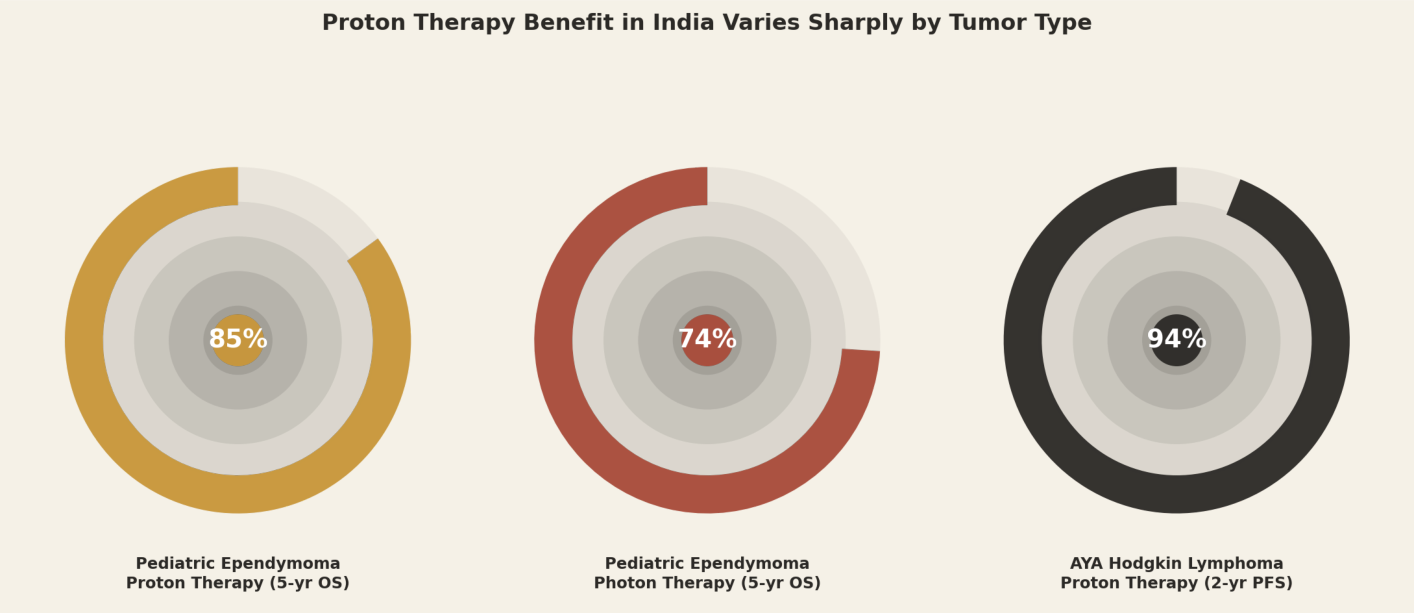
- For paediatric intracranial ependymoma, the cited systematic review and meta-analysis reported five-year overall survival of 84.7% with proton therapy compared with 73.8% with conventional photon radiotherapy, along with better local tumour control with proton therapy for this specific tumour type.
- The evidence is less definitive in some other cancers. In adolescents and young adults with early-stage Hodgkin lymphoma, the cited study reported two-year progression-free survival of 94% with proton therapy versus 83% with photon therapy, but the difference did not reach statistical significance.
- The source also highlights uncertainty around long-term benefits in children. The National Cancer Institute has noted that randomised clinical trials directly comparing proton and photon therapy have not yet been conducted in children, and the true reduction in long-term second-cancer risk remains uncertain.
- The page 2 visual compares approximately 85% five-year overall survival for paediatric ependymoma treated with proton therapy, 74% with photon therapy and 94% two-year progression-free survival for AYAs with Hodgkin lymphoma receiving proton therapy. These figures illustrate differences reported in selected studies and should not be interpreted as guaranteed individual outcomes.
- A proton therapy programme requires several specialists working together. The source identifies a radiation oncologist experienced in proton therapy, medical physicist and, for paediatric cases, paediatric oncologist. Young children may also require a dedicated paediatric anaesthesiologist because precise positioning can require sedation or anaesthesia during individual treatment sessions.
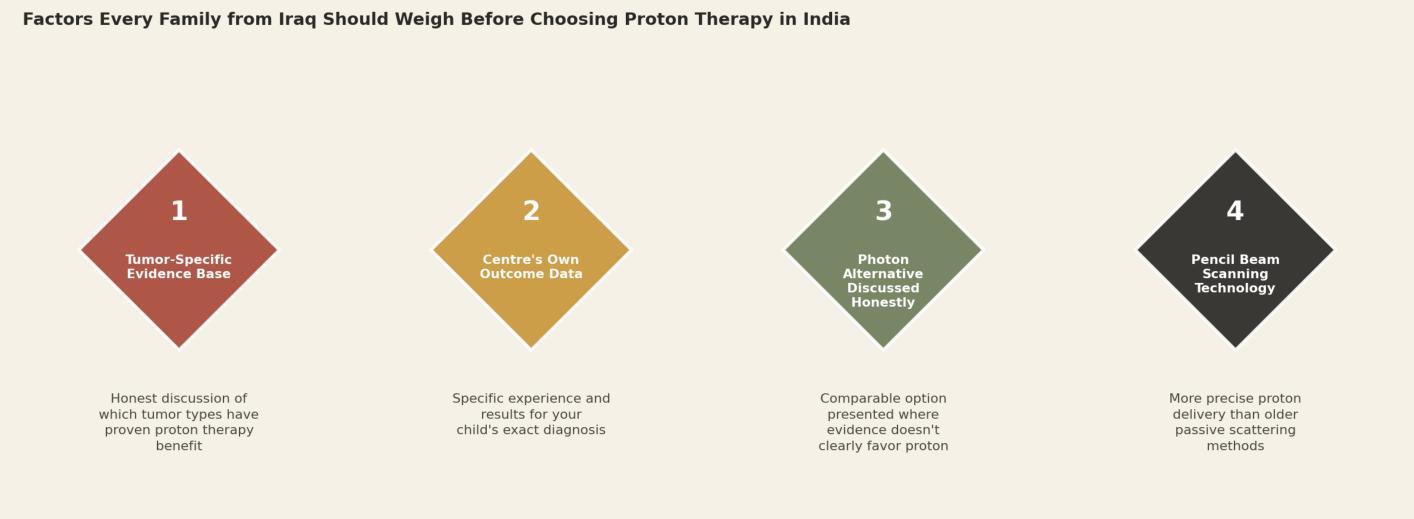
- The main red flag is a centre that claims proton therapy is superior for every cancer without discussing limitations or alternatives. The page 4 checklist highlights tumour-specific evidence base, the centre's own outcome data, honest discussion of photon as an alternative and pencil beam scanning technology.
Quick Facts
- Treatment
- Proton beam therapy
- Primary Patients
- Iraqi patients and families seeking advanced radiation treatment in India
- Main Speciality
- Radiation oncology
- Key Specialist
- Radiation oncologist with specific proton therapy experience
- Main Advantage
- Highly targeted radiation delivery with potential sparing of healthy tissue in selected cases
- Important Principle
- Benefit varies substantially by tumour type
- Ependymoma 5-Year Survival
- 84.7% with proton therapy in the cited review
- Ependymoma Photon Comparison
- 73.8% with conventional photon radiotherapy
- AYA Hodgkin Lymphoma 2-Year PFS
- 94% with proton therapy in the cited study
- Photon Comparison
- 83% in the cited Hodgkin lymphoma study
- Evidence Limitation
- Long-term second-cancer risk reduction in children remains uncertain
- Alternative
- Photon radiotherapy may be equally reasonable for some tumour types
- Core Team
- Radiation oncologist and medical physicist
- Paediatric Team
- Paediatric oncologist and paediatric anaesthesiologist when required
- Technology
- Pencil beam scanning
- Positioning
- Advanced imaging and immobilisation are important
- Quality Assurance
- Regular imaging and treatment-plan verification may be required
- Accreditation
- Verify current JCI and/or NABH status
- Long-Term Care
- Monitor late effects, particularly in children
- Author
- Dr. Dheeraj Bojwani
- Experience
- 24+ Years
In Brief
The most important question for an Iraqi family is not simply whether a hospital has proton therapy, but whether proton therapy is supported by meaningful evidence for the patient’s exact tumour type and location. Families should ask how many similar patients the centre has treated, what outcomes it has achieved, whether photon radiotherapy remains a reasonable alternative, and how long-term side effects will be monitored. A centre that presents proton therapy as superior for every cancer without discussing limitations or alternatives deserves a second opinion.
Why the Choice of Proton Therapy Centre in India Matters as Much as the Choice of Technology
Based on my interactions with international families, the published evidence on this exact distinction is genuinely informative. A systematic review and meta-analysis of pediatric intracranial ependymoma, a specific type of childhood brain tumour, found five-year overall survival of 84.7 percent with proton beam therapy compared with 73.8 percent using conventional photon radiotherapy, alongside meaningfully better local tumour control, a real and clinically significant advantage for this specific tumour type. For adolescents and young adults with early-stage Hodgkin lymphoma, a separate study found two-year progression-free survival of 94 percent with proton therapy compared with 83 percent with photon therapy, though this particular difference did not reach statistical significance given the study’s size, illustrating that a promising trend is not always the same as proven superiority. The American National Cancer Institute has specifically noted that no randomised clinical trials comparing proton and photon therapy have yet been conducted in children, and that the true magnitude of any reduction in long-term second cancer risk, one of proton therapy’s most often cited advantages, remains genuinely uncertain. India is notably one of only a small number of middle-income countries, alongside China and Thailand, to have proton therapy centres already operating domestically, a genuine achievement, though this also means the number of centres with deep, specific experience remains limited nationally. This tells a family something important: ask specifically what evidence exists for your child’s exact tumour type, rather than accepting a general claim that proton therapy is simply the safer choice for every situation.
How Patients from Iraq Can Verify a Proton Therapy Hospital’s Accreditation in India
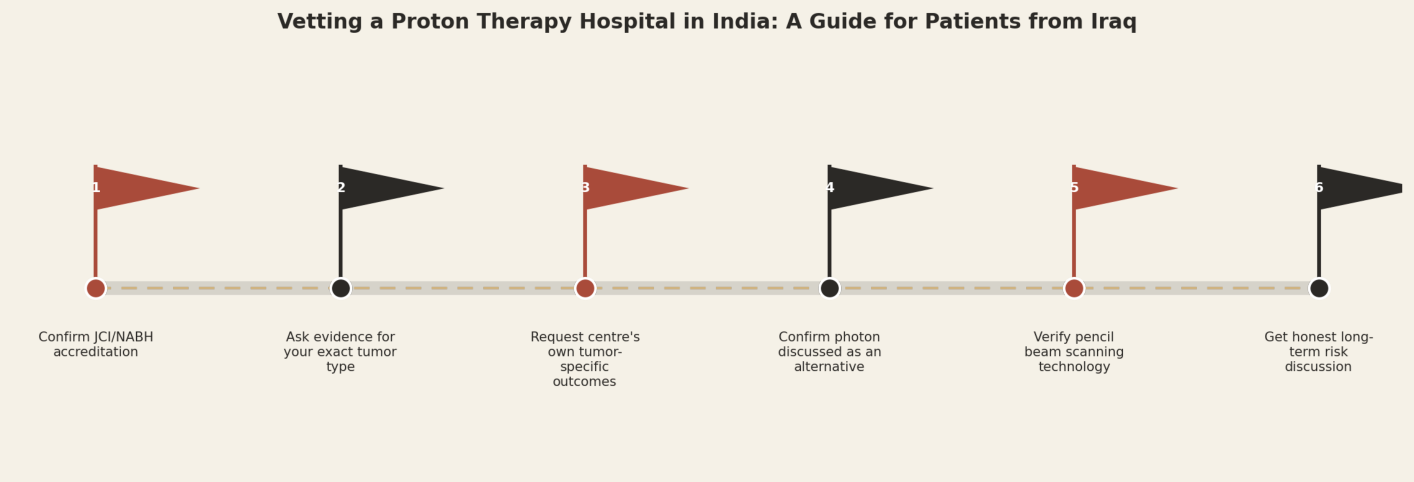
The fastest filter I recommend to every Iraqi family calling about proton therapy is verifiable accreditation, not marketing language. Joint Commission International, JCI, audits a hospital’s overall clinical safety systems against the same standard used across the United States and Europe. The National Accreditation Board for Hospitals and Healthcare Providers, NABH, is India’s own domestic equivalent, and in my experience of 24 years advising families on this exact decision, a centre holding both marks together is a meaningfully stronger signal than either alone. For proton therapy specifically, ask one further, very direct question: what is this centre’s own specific experience and outcome data for your child’s exact tumour type, since the evidence base for proton therapy’s benefit varies considerably by diagnosis.
Proton Therapy Volume and Tumour-Specific Criteria That Predict Outcomes in India
Based on my interactions with dozens of radiation oncology programmes over the years, a centre’s specific experience with your exact tumour type, not simply its general proton therapy capability, is one of the clearest signs of a trustworthy, evidence-based recommendation. In my experience of 24 years advising families on this exact decision, the centres most worth trusting are the ones willing to say honestly when photon radiotherapy is an equally reasonable option for a specific tumour type. Ask directly, in writing:
- What is the specific published or centre-reported evidence supporting proton therapy over conventional photon radiotherapy for my child's exact tumour type and location?
- How many patients with this specific tumour type has this centre treated using proton therapy, and what are their own reported outcomes?
- For tumours where the evidence is less definitive, has the centre discussed photon radiotherapy as a genuinely equivalent alternative, or is proton therapy being recommended regardless of the specific evidence for this tumour type?
- What is the centre's specific plan for monitoring long-term side effects, particularly for a child whose developing body will be followed for decades after treatment?
A centre confident in its own reasoning will answer these specifically and honestly, including acknowledging where evidence is still developing. A centre that presents proton therapy as unconditionally superior for every cancer type deserves a second opinion before you commit.
Vetting a Proton Therapy Hospital in India: A Guide for Patients from Iraq
Questions Patients from Iraq Should Ask About the Proton Therapy Team in India
Proton therapy planning and delivery are never genuinely the work of one specialist alone. In my experience of 24 years watching these programmes operate, the strongest units bring together a radiation oncologist with specific proton therapy experience, a medical physicist for the highly precise dose planning this technology requires, and, for paediatric cases, a paediatric oncologist involved in the overall treatment strategy. A dedicated paediatric anaesthesiologist is a further important role for young children, since achieving the precise, motionless positioning proton therapy requires often means sedation or anaesthesia is needed for each individual treatment session over several weeks. Ask specifically who fills each of these roles for your case, and confirm that your specific tumour type and its evidence base have been discussed openly before treatment begins.
Proton Therapy Technology Standards in India That Patients from Iraq Should Check
The specific technology available changes what precision a centre can achieve. Ask whether the centre uses pencil beam scanning, a more precise proton delivery technique than older passive scattering methods, since this technology allows more targeted dose delivery and potentially better sparing of healthy tissue. Ask what specific imaging and immobilisation technology is used to ensure the child remains precisely positioned for each treatment session, since proton therapy’s precision advantage depends entirely on accurate, consistent positioning. Ask also whether the centre performs regular quality assurance imaging throughout the multi-week treatment course to confirm the tumour and surrounding anatomy have not shifted in ways that would require the treatment plan to be adjusted. Ask directly which of these specific capabilities apply to your case, not simply whether the hospital owns proton therapy equipment in general terms.
Red Flags Patients from Iraq Should Watch For When Choosing a Proton Therapy Hospital in India
Over the years, certain patterns have become reliable warning signs for me. A centre that recommends proton therapy for every cancer type without discussing the specific evidence for your child’s exact tumour has not given you an honest, evidence-based recommendation. A centre that cannot state its own specific experience and outcomes for your child’s exact diagnosis has not demonstrated the specialised expertise this technology requires. A centre that does not discuss photon radiotherapy as a genuine alternative where evidence supports comparable outcomes is not presenting the complete picture of your child’s treatment options. And a centre that overstates the certainty of long-term benefits, such as reduced second cancer risk, without acknowledging that this evidence is still developing in children specifically, is not giving your family an honest picture of current knowledge.
Factors Every Family from Iraq Should Weigh Before Choosing Proton Therapy in India
A Closing Thought for Iraqi Families
Proton therapy is a genuinely valuable technology for specific tumour types and situations, and it deserves a treatment team that explains honestly which category your child’s diagnosis falls into, rather than a general claim that it is simply the safer choice for every cancer. Based on my interactions with international patients over more than two decades, the families who ask about tumour-specific evidence, centre experience, and honest comparison with photon radiotherapy consistently arrive at treatment better informed than those who accept a general marketing claim at face value. My role, and the role of any advisor a family works with, should be to help you ask these exact questions and confirm honestly that the specific team and specific hospital in front of you are the right fit for your family’s exact diagnosis. Iraq’s families deserve the same standard of scrutiny in this decision as any family anywhere else in the world.
Sources & Further Reading
- Joint Commission International (JCI) — Accredited Organizations Directory (jointcommissioninternational.org)
- National Accreditation Board for Hospitals & Healthcare Providers (NABH), India (nabh.co)
- PMC — Systematic Review and Meta-Analysis of Photon Radiotherapy vs. Proton Beam Therapy for Pediatric Intracranial Ependymoma (ncbi.nlm.nih.gov/pmc)
- PMC — Comparative Effectiveness of Proton Therapy vs. Photon Radiotherapy in AYAs for Classical Hodgkin Lymphoma (ncbi.nlm.nih.gov/pmc)
- National Cancer Institute (NCI) — Pediatric Proton and Photon Therapy Comparison Cohort (dceg.cancer.gov)
Frequently Asked Questions by Iraqi Patients about Selecting a Proton Therapy Specialist and Hospital in India
Is proton therapy available in India for Iraqi patients?
Yes. The source specifically discusses proton therapy centres operating in India and provides criteria for Iraqi families evaluating proton treatment.
Is proton therapy better than photon radiotherapy for every cancer?
No. The source specifically warns against treating proton therapy as universally superior. Its benefits vary according to tumour type, location and patient characteristics.
How effective is proton therapy for childhood ependymoma?
The cited systematic review reported five-year overall survival of 84.7% with proton therapy compared with 73.8% with conventional photon radiotherapy, along with better local tumour control.
Can Iraqi children with brain tumours receive proton therapy in India?
The source specifically discusses paediatric intracranial ependymoma and proton therapy. Eligibility depends on the child's exact tumour type, location, previous treatment and radiation plan.
Is proton therapy effective for Hodgkin lymphoma in young Iraqi patients?
The cited study reported two-year progression-free survival of 94% with proton therapy compared with 83% with photon therapy, although the difference was not statistically significant.
What should Iraqi families ask a proton therapy hospital about their child's tumour?
They should ask for evidence specific to the exact tumour type and location, the centre's experience with similar cases and its own reported outcomes.
What proton therapy technology should Iraqi patients look for in India?
The source recommends asking about pencil beam scanning, appropriate imaging and immobilisation systems, and regular quality-assurance imaging during the treatment course.
Which specialists should be involved in proton therapy for Iraqi children?
A strong paediatric programme may include a proton-experienced radiation oncologist, medical physicist, paediatric oncologist and paediatric anaesthesiologist when sedation or anaesthesia is needed.
Does proton therapy reduce the long-term risk of second cancers in children?
The source states that this potential benefit remains uncertain. Families should be given an honest explanation of the current evidence.
How should Iraqi families choose the best proton therapy hospital in India?
They should compare tumour-specific evidence, the centre's experience with the exact diagnosis, treatment technology, multidisciplinary expertise and long-term follow-up.
Page Summary
Proton therapy can be a valuable treatment for selected cancers, but its benefits should be evaluated according to the exact tumour type rather than promoted as universally superior radiation therapy. The source presents particularly encouraging evidence for paediatric intracranial ependymoma while also showing that evidence for other conditions, such as Hodgkin lymphoma in adolescents and young adults, may be less conclusive.
Iraqi families should therefore compare proton centres according to tumour-specific experience, outcome data, multidisciplinary expertise and treatment technology. They should also confirm whether photon therapy has been discussed when appropriate and whether the centre has a structured plan for positioning, quality assurance and long-term monitoring.
Citation Block
| Field | Details |
|---|---|
| Article / Topic | Selecting the Best Proton Therapy Specialists and Hospitals in India |
| Target Country | Iraq |
| Treatment Area | Proton beam therapy |
| Main Speciality | Radiation oncology |
| Key Selection Factor | Tumour-specific evidence and centre experience |
| Ependymoma 5-Year Proton Survival | 84.7% |
| Ependymoma 5-Year Photon Survival | 73.8% |
| Ependymoma Local Control | Reported as better with proton therapy in cited review |
| AYA Hodgkin Lymphoma 2-Year Proton PFS | 94% |
| AYA Hodgkin Lymphoma Photon PFS | 83% |
| Statistical Limitation | Hodgkin lymphoma difference did not reach statistical significance |
| Paediatric Evidence Limitation | No randomised proton-versus-photon trials in children cited |
| Second Cancer Risk | Long-term reduction remains uncertain in children |
| Accreditation | Verify JCI and NABH status |
| Core Specialist | Proton-experienced radiation oncologist |
| Physics Expertise | Medical physicist for precise dose planning |
| Paediatric Expertise | Paediatric oncologist |
| Delivery Technology | Pencil beam scanning |
| Positioning Technology | Imaging and immobilisation systems |
| Alternative Treatment | Photon radiotherapy where clinically appropriate |


Our Mission Statement
Our mission is to place patients at the centre of every healthcare decision by providing trustworthy, evidence-based, and unbiased medical information. We believe that informed patients make better decisions. Backed by personalised guidance from our experienced advisory team, we help patients understand their treatment options, compare them objectively, and confidently choose the path that best suits their medical needs and personal circumstances.
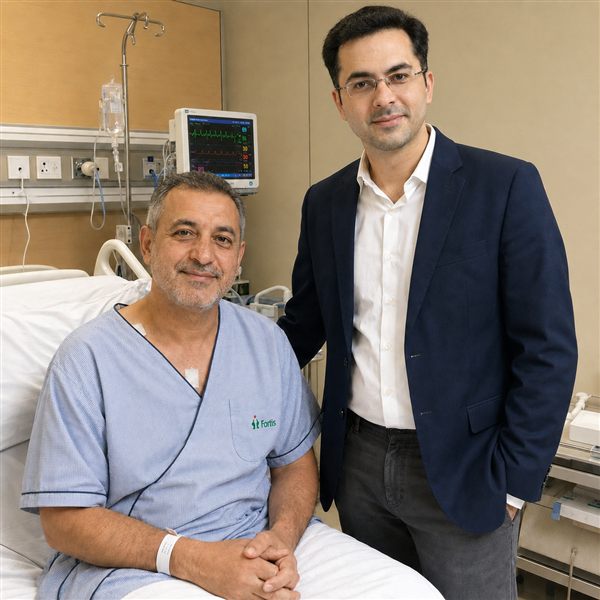
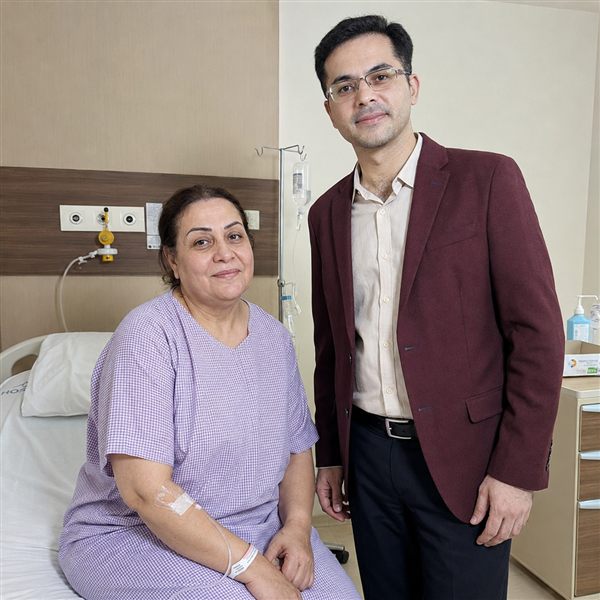
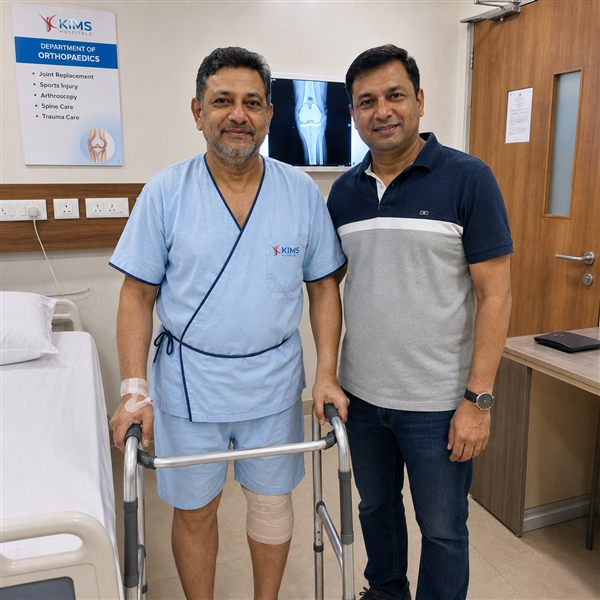
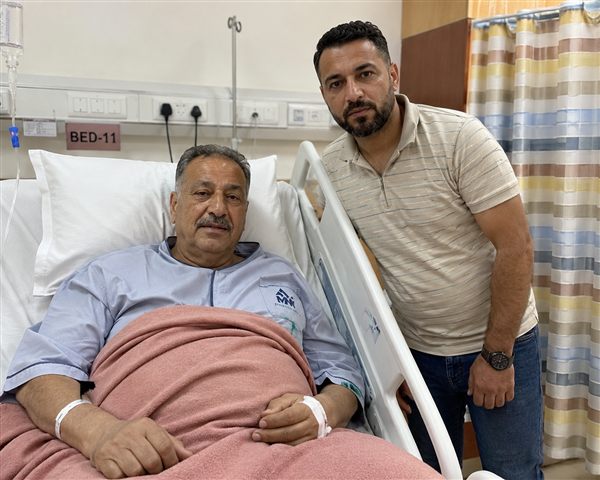
Patient Testimonials from Iraq
Ready to Take the First Step?
Share your Medical Reports with our Healthcare Managers Today and Get a FREE CONSULTATION, a Personalized Treatment Plan, and Complete Support from Arrival to Recovery.
Get Your Free ConsultationAreas We Serve
Indian Health Guru Consultants proudly assists patients from Iraq and surrounding Middle Eastern countries in accessing advanced, affordable and trusted medical treatment in India. Our team provides complete support for medical opinions, hospital selection, treatment planning, visa assistance, travel coordination, accommodation and post-treatment follow-up.
We regularly serve patients from:
- Iraq
- Turkey
- Iran
- Kuwait
- Jordan
- Syria
- Qatar
- Bahrain
- Oman
- Yemen
- Saudi Arabia
- United Arab Emirates
No matter where you are located, our experienced team is committed to making your medical journey to India safe, smooth, transparent and stress-free from the first enquiry to your return home.
From Iraq to India: Your Complete Patient Guide
- CyberKnife Treatment in India for Iraqis
- Plastic and Reconstructive Surgery in India for Iraqis
- Cervical and Lumbar Disc Replacement Surgery in India for Iraqis
- Breast Cancer Treatment in India for Iraqi Patients
- Paediatric Neurosurgery in India for Iraqis
- Paediatric Orthopaedic Surgery in India for Iraqis
- Pancreatic Cancer Surgery in India for Iraqis
- Urosurgery and Reconstructive Urology in India for Iraqis
- Spine Surgery in India for Iraqis
- Scoliosis Correction Surgery in India for Iraqis
- Bone Marrow Transplant in India for Iraqi Patients
- Cardiac Pacemaker Treatment in India for Iraqi Patients
- Heart Valve Replacement in India for Iraqis
- Neurosurgery in India for Iraqis
- Parkinson's Treatment and DBS Surgery in India for Iraqis
- Knee Surgery in India for Iraqis
- Prostate Cancer Treatment and Surgery in India for Iraqis
- Cardiac Surgery in India for Iraqis