

Selecting the Best Cardiac Pacemaker Surgeons and Hospitals in India: A Guide for Patients from Iraq
A doctor’s honest, question-by-question guide for patients from Iraq on vetting a pacemaker hospital in India — accreditation, device-specific volume, team composition, and the exact questions worth asking before you book anything.
Over the years, I have noticed that pacemaker implantation is one of the procedures Iraqi families most often underestimate as “simple,” and in most cases it genuinely is a safe, well-established procedure. In my experience of 24 years advising patients on this exact decision, the real variable that determines whether it stays simple is not the procedure itself but which specific device type your case needs and how many of that specific device type the implanting team places every year. This guide sets out exactly what to verify before choosing where in India to have a pacemaker fitted.
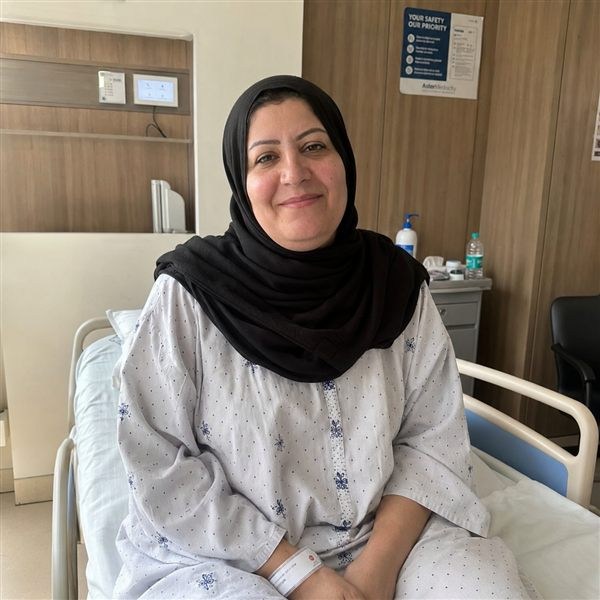
Healing Journeys of Iraqi Patients

Key Takeaways
- Pacemaker implantation is generally presented in the source as a safe and well-established procedure, but the important decision is identifying the correct device and an experienced team for that particular device type. The guide reports that standard single- and dual-chamber pacemaker implantation at experienced Indian centres commonly has success rates above 97–99%. A six-year tertiary-centre study involving 1,771 patients reported device infection in 0.17%, lead dislodgement in 0.17% and an overall procedural complication rate of 1.14%. These figures apply specifically to standard pacemaker implantation and should not automatically be applied to more technically demanding devices.
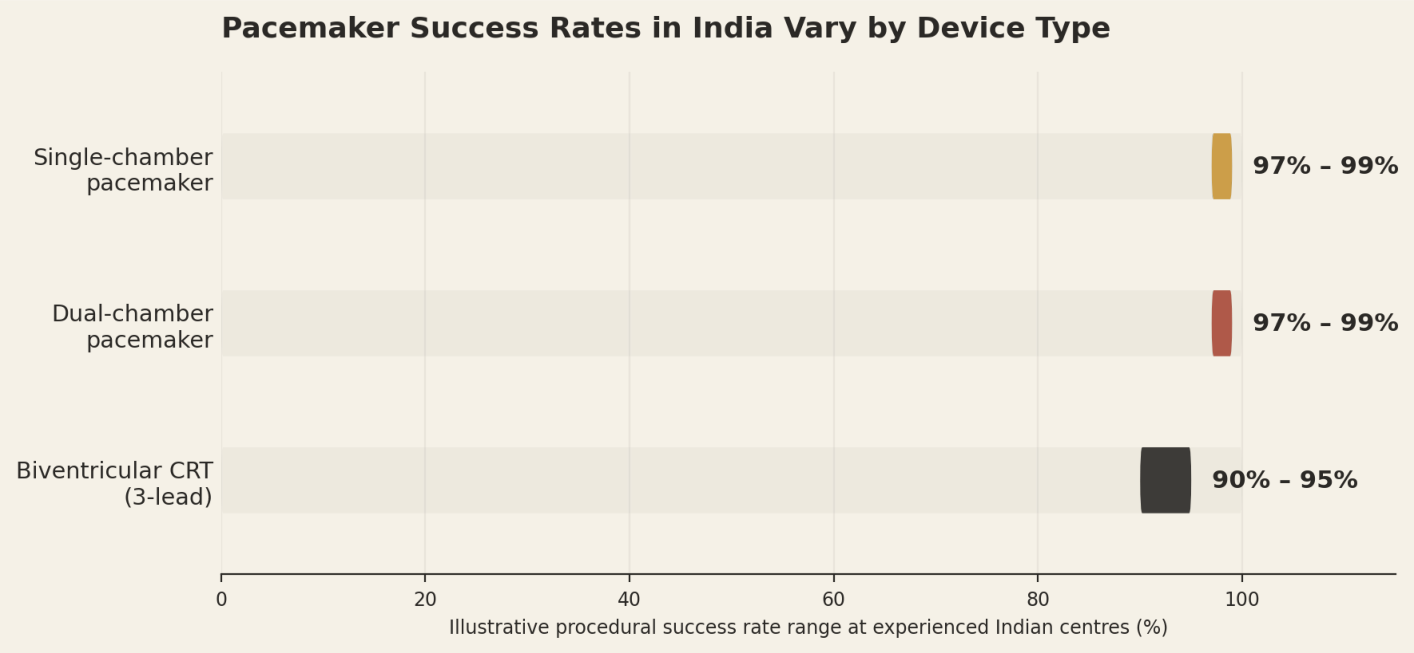
- The type of pacemaker matters when Iraqi patients compare hospitals in India. The source distinguishes standard single- and dual-chamber devices from biventricular cardiac resynchronisation therapy systems, which use three leads and require more technically demanding placement of the coronary sinus lead. The chart on page 2 illustrates this difference, showing procedural success ranges of 97–99% for both single- and dual-chamber pacemakers compared with approximately 90–95% for biventricular CRT at experienced Indian centres.
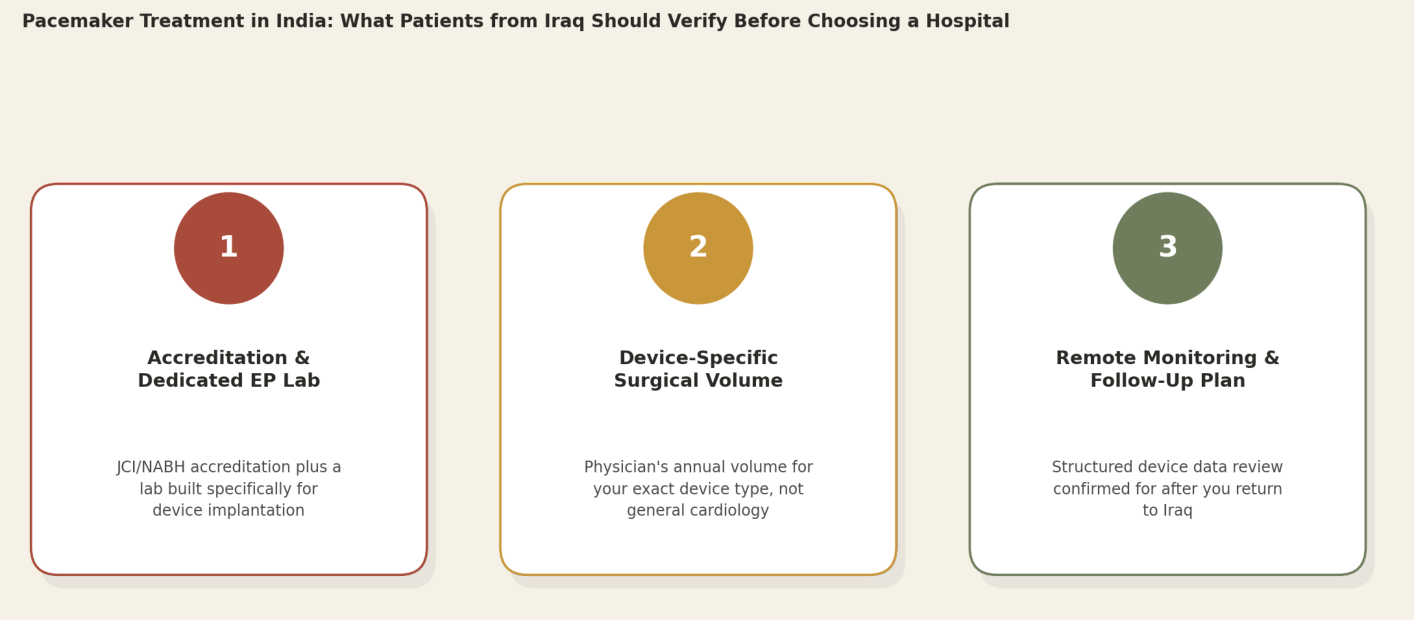
- Accreditation is recommended as an initial filter when Iraqi families evaluate cardiac hospitals. The guide advises checking JCI and NABH accreditation and then asking whether the hospital has a dedicated electrophysiology laboratory rather than relying solely on a general cardiac catheterisation laboratory. The current NABH directory also allows healthcare organisations to be checked by accreditation and speciality, including cardiology, which reinforces the value of independently verifying accreditation rather than relying on hospital marketing claims.
- Device-specific implantation volume is another major selection criterion. Iraqi patients should ask how many single-chamber, dual-chamber or biventricular CRT devices the electrophysiologist has implanted during the past year and over their career. The source stresses that general cardiology experience is less useful than experience with the exact device required by the patient. Patients should also request the hospital’s own infection and lead-displacement rates for that particular device type.
- The cardiac device team remains important even though pacemaker implantation is generally performed by an electrophysiologist. The guide recommends checking whether the programme has a dedicated device nurse or technician for programming and monitoring, an on-site cardiac surgeon who can provide backup for rare serious complications such as cardiac perforation, and a structured remote-monitoring programme. For Iraqi patients returning home after implantation, the ability to transmit and review device data remotely is particularly relevant because follow-up continues for years after the procedure.
- Technology should be assessed according to the patient’s actual indication rather than simply whether a hospital owns particular equipment. The source identifies fluoroscopic and electroanatomic mapping systems as useful for precise lead placement, particularly in biventricular CRT procedures. It also discusses leadless pacemaker technology, which places a self-contained device inside the heart without traditional leads and may be suitable for selected patients. Iraqi patients should therefore ask which technology is appropriate for their case and why.
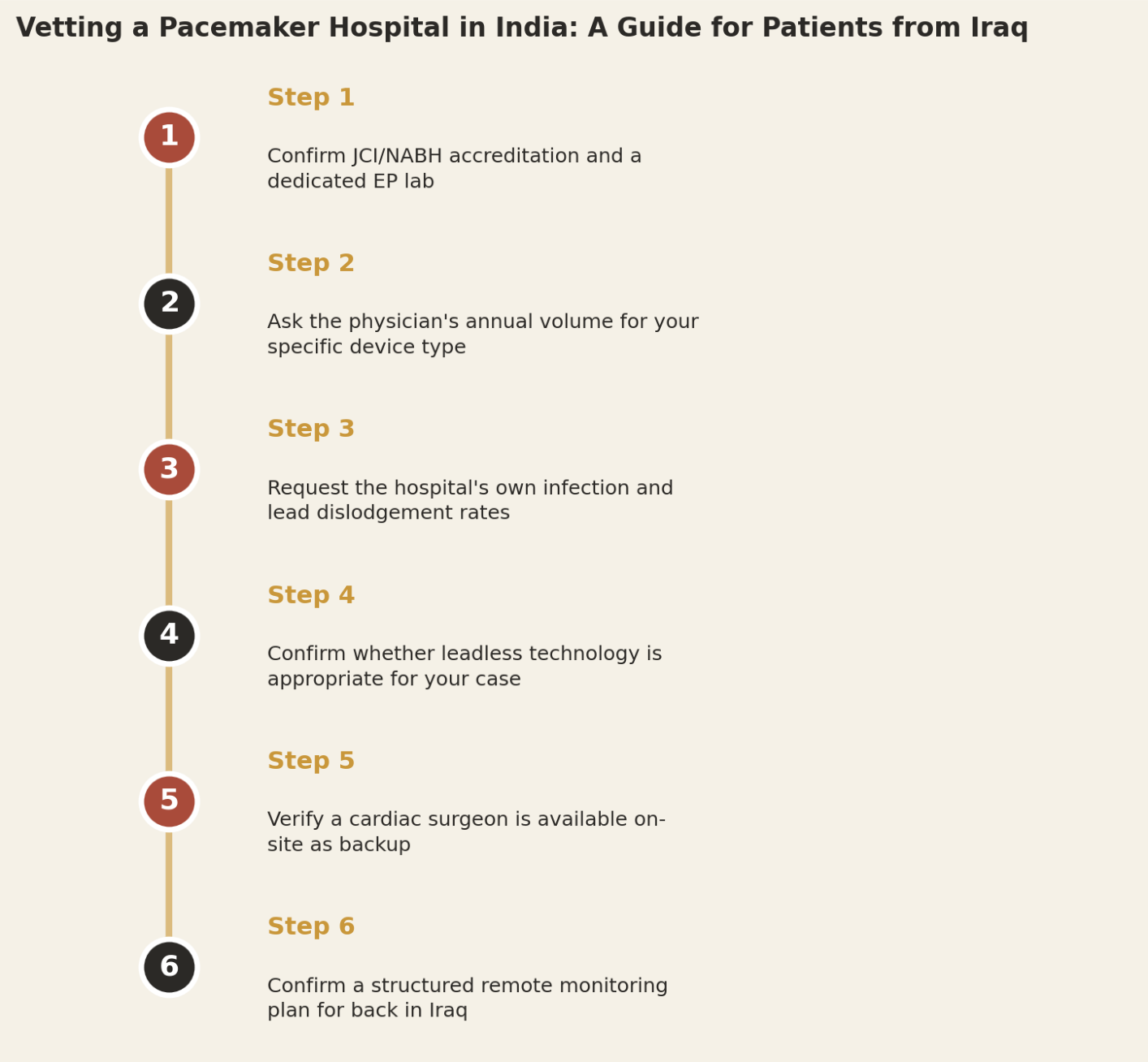
- The guide identifies three important warning signs: a hospital that cannot provide device-specific infection or lead-displacement rates, a centre recommending a standard pacemaker without adequately assessing whether a biventricular system may be more appropriate for a patient with a particular heart-failure profile, and a hospital with no structured plan for remote device monitoring after the patient returns to Iraq. The six-step visual checklist on page 4 reinforces the recommended process: verify accreditation and a dedicated electrophysiology lab, check device-specific physician volume, request complication rates, assess leadless technology where relevant, confirm cardiac-surgical backup and establish remote monitoring in Iraq.
Quick Facts
- Treatment
- Cardiac pacemaker implantation
- Primary Patients
- Iraqi patients seeking pacemaker treatment in India
- Main Speciality
- Cardiac electrophysiology
- Key Specialist
- Electrophysiologist experienced with the required device type
- Standard Devices
- Single-chamber and dual-chamber pacemakers
- Advanced Device
- Biventricular CRT pacemaker for selected patients
- Leadless Option
- Leadless pacemaker technology may be suitable for selected indications
- Standard Success Rate
- Approximately 97–99% at experienced centres
- Biventricular CRT
- Approximately 90–95% procedural success in the source chart
- Reported Infection Rate
- 0.17% in the cited six-year tertiary-centre study
- Reported Lead Dislodgement
- 0.17% in the cited study
- Overall Complication Rate
- 1.14% in the cited 1,771-patient study
- Hospital Accreditation
- Verify JCI and/or NABH accreditation
- EP Laboratory
- Confirm a dedicated electrophysiology laboratory
- Physician Volume
- Ask for annual and career volume for the exact device type
- Technology
- Fluoroscopy and electroanatomic mapping may support complex implantation
- Cardiac Backup
- Confirm on-site cardiac surgical backup
- Remote Monitoring
- Confirm structured device monitoring after returning to Iraq
- Follow-Up
- Device programming and monitoring continue after implantation
- Pre-Travel
- Provide cardiac records and relevant diagnostic reports for review
- Author
- Dr. Dheeraj Bojwani
- Experience
- 24+ Years
In Brief
For Iraqi patients considering pacemaker implantation in India, the most important selection criteria are device-specific electrophysiology experience, verifiable hospital accreditation, dedicated electrophysiology infrastructure, complication data and long-term monitoring arrangements. The source indicates that standard single- and dual-chamber procedures have reported success rates of 97–99% at experienced centres, while the page 2 chart places biventricular CRT success at approximately 90–95%. Patients should therefore avoid accepting one general “pacemaker success rate” and instead ask how frequently the team performs the exact implantation required, what its infection and lead-displacement rates are, whether leadless technology is appropriate, and how device monitoring will continue after returning to Iraq.
Why the Choice of Electrophysiologist in India Matters as Much as the Choice of Hospital
Based on my interactions with international patients, published Indian data shows that pacemaker implantation is genuinely very safe at experienced centres, with success rates commonly exceeding 97 to 99 percent for standard single- and dual-chamber devices. A large six-year study from a tertiary centre in India, covering 1,771 patients, reported device-related infection in just 0.17 percent of cases, lead dislodgement in 0.17 percent, and an overall procedural complication rate of only 1.14 percent, figures that compare favourably with international registries. These numbers, however, apply specifically to standard pacemaker implantation. Cardiac resynchronisation therapy, the three-lead biventricular systems used for certain heart failure patients, is technically more demanding, since the third lead must be threaded into the coronary sinus, a step considerably harder than standard right-sided lead placement, and success and complication rates for this specific device type genuinely differ from a standard two-lead pacemaker. A hospital that quotes one blended “pacemaker success rate” without asking which device type your case needs has not yet engaged with your specific situation.
How Patients from Iraq Can Verify a Cardiac Hospital’s Accreditation in India
The fastest filter I recommend to every Iraqi family calling about a pacemaker is verifiable accreditation, not marketing language. Joint Commission International, JCI, audits a hospital’s overall clinical safety systems against the same standard used across the United States and Europe. The National Accreditation Board for Hospitals and Healthcare Providers, NABH, is India’s own domestic equivalent, and in my experience of 24 years advising families on this exact decision, a centre holding both marks together is a meaningfully stronger signal than either alone. For pacemaker and device implantation specifically, ask one further question directly: does the hospital have a dedicated electrophysiology laboratory, distinct from a general cardiac catheterisation lab, with imaging and mapping equipment built specifically for device implantation and arrhythmia diagnosis.
The Volume and Experience Metrics That Predict Pacemaker Outcomes in India
Based on my interactions with dozens of cardiac device programmes over the years, an implanting physician’s annual volume for your specific device type is one of the clearest predictors available to a family. Some of India’s highest-volume electrophysiologists have performed several thousand permanent pacemaker implantations over their careers, including complex biventricular systems, and that accumulated experience is measurable and worth asking about directly. Ask, in writing:
- How many permanent pacemakers of my specific device type, single-chamber, dual-chamber, or biventricular CRT, has this physician implanted in the past year, and over their career?
- What is the hospital’s own reported device infection and lead dislodgement rate for this specific device type?
- Is a dedicated electrophysiology lab, separate from general cardiac catheterisation, used for implantation?
- Does the hospital offer leadless pacemaker technology for patients who may benefit from avoiding traditional leads entirely, and does the implanting team have specific experience with it?
A team confident in its own numbers will answer these specifically. A team that responds only with general reassurance deserves a second opinion before you commit.
Questions Patients from Iraq Should Ask About the Cardiac Device Team in India
Pacemaker implantation is usually performed by a single electrophysiologist, but the surrounding team still matters. In my experience of 24 years watching these programmes operate, the strongest units have a dedicated device nurse or technician for post-implantation programming and monitoring, a cardiac surgeon available on-site as backup in case of a rare but serious complication such as cardiac perforation, and a structured remote monitoring programme for the device once you return home. Ask specifically whether remote monitoring is available and how device data will be reviewed once you are back in Iraq, since ongoing follow-up matters as much as the implantation itself for a device that will remain in place for years.
Cardiac Device Technology Standards in India That Patients from Iraq Should Check
The specific technology available changes what a team can safely offer. Fluoroscopic and electroanatomic mapping systems allow precise lead placement, particularly important for the coronary sinus lead in biventricular systems. Leadless pacemaker technology, a self-contained device implanted directly inside the heart without traditional leads, has been successfully introduced in India and can reduce certain long-term complications for suitable patients, though it is not appropriate for every indication. Ask directly which of these specific technologies apply to your case and why, not simply whether the hospital owns the equipment somewhere in the building.
Red Flags Patients from Iraq Should Watch For When Choosing a Cardiac Hospital in India
Over the years, certain patterns have become reliable warning signs for me. A hospital that cannot state its own device-specific infection or lead dislodgement rate, offering only a general “very safe procedure” reassurance, has not given you information you can use. A hospital recommending a standard pacemaker without first properly evaluating whether your specific heart failure profile might actually benefit more from a biventricular system deserves direct questioning. And a hospital that has no structured plan for remote device monitoring once you return to Iraq is asking you to manage a lifelong device with no ongoing safety net.
Vetting a Cardiac Pacemaker Hospital in India: A Guide for Patients from Iraq
A Closing Thought for Iraqi Families
Pacemaker implantation is safe and well-established, but that safety depends on choosing a team with genuine, specific experience in your exact device type and a structured plan for the years of monitoring that follow. Based on my interactions with international patients over more than two decades, the families who ask about device-specific volume, infection rates, and remote monitoring plans consistently make better-informed decisions than those who accept a general reassurance alone. My role, and the role of any advisor a family works with, should be to help you ask these exact questions and confirm honestly that the specific team and specific hospital in front of you are the right fit for your family’s exact situation. Iraq’s families deserve the same standard of scrutiny in this decision as any family anywhere else in the world.
Sources & Further Reading
- Joint Commission International (JCI) — Accredited Organizations Directory (jointcommissioninternational.org)
- National Accreditation Board for Hospitals & Healthcare Providers (NABH), India (nabh.co)
- PubMed Central — Demographic Patterns in Permanent Pacemaker Implantation, Tertiary Centre India (pmc.ncbi.nlm.nih.gov)
- American College of Cardiology — Pacemaker Patient Information (acc.org)
- Heart Rhythm Society — Cardiac Implantable Electronic Device Guidance (hrsonline.org)
Frequently Asked Questions by Iraqi Patients about Selecting a Cardiac Pacemaker Surgeon and Hospital in India
Is pacemaker implantation available in India for Iraqi patients?
Yes. The guide specifically addresses Iraqi patients seeking pacemaker implantation in India and explains how to assess electrophysiologists, hospitals, device types and follow-up arrangements.
What is the success rate of standard pacemaker implantation in India for Iraqi patients?
The source reports that experienced Indian centres commonly achieve approximately 97–99% success for standard single- and dual-chamber pacemakers. These figures should not automatically be applied to more complex CRT procedures.
What is the difference between a single-chamber and dual-chamber pacemaker?
The source identifies both as standard pacemaker categories and advises patients to ask how much experience the implanting electrophysiologist has with their specific device type. The appropriate device depends on the patient's clinical situation.
What is a biventricular CRT pacemaker and why is it different?
Biventricular CRT uses three leads and is technically more demanding because the third lead must be positioned through the coronary sinus. The source chart reports approximately 90–95% procedural success at experienced centres.
Should Iraqi patients ask about leadless pacemaker treatment in India?
Yes, when clinically relevant. Leadless technology may avoid traditional leads for selected patients, so Iraqi patients should ask whether it is appropriate for their indication and whether the hospital's team has specific experience with the technology.
How experienced should an Indian pacemaker surgeon be for an Iraqi patient?
Patients should ask how many pacemakers of their exact type the electrophysiologist has implanted during the past year and over their career. Device-specific experience is more informative than a general claim of cardiac experience.
What pacemaker complications should Iraqi patients ask Indian hospitals about?
They should request the hospital's own infection and lead-displacement rates for the specific device type. The cited study reported infection and lead dislodgement rates of 0.17% each.
Should Iraqi patients choose a hospital with a dedicated electrophysiology laboratory?
The guide recommends asking whether the hospital has a dedicated electrophysiology laboratory separate from a general cardiac catheterisation laboratory, with equipment designed for device implantation and arrhythmia-related procedures.
How is pacemaker follow-up managed after Iraqi patients return home from India?
Patients should confirm that the Indian hospital offers structured remote device monitoring and establish how device data will be reviewed after returning to Iraq. Long-term monitoring is an important part of pacemaker care.
What should Iraqi patients verify before travelling to India for pacemaker implantation?
They should verify JCI/NABH accreditation, dedicated electrophysiology facilities, device-specific physician volume, hospital complication rates, suitability of leadless or CRT technology where relevant, cardiac-surgical backup and a structured remote-monitoring plan.
Page Summary
Pacemaker implantation in India can be a well-established treatment option, but Iraqi patients should not select a hospital solely because it advertises high overall success rates. The source recommends evaluating the exact device required, the electrophysiologist's experience with that device, hospital accreditation, dedicated electrophysiology facilities, device-specific complication rates and availability of appropriate technology. The page 2 chart demonstrates why device-specific comparison matters, with standard single- and dual-chamber pacemakers shown at 97–99% success compared with approximately 90–95% for biventricular CRT at experienced centres.
Long-term care is equally important for Iraqi patients because a pacemaker remains in place for years. Before travelling, patients should establish who will manage programming and monitoring, whether remote device monitoring is available in Iraq, and whether the Indian centre has appropriate cardiac-surgical backup. The source's final recommendation is to judge the specific electrophysiology team and hospital on measurable device-specific experience and follow-up arrangements rather than relying on general reassurance.
Citation Block
| Field | Details |
|---|---|
| Article / Topic | Selecting the Best Cardiac Pacemaker Surgeons and Hospitals in India |
| Primary Patients | Patients from Iraq |
| Treatment | Pacemaker implantation and cardiac device therapy |
| Main Specialist | Electrophysiologist |
| Standard Device Types | Single-chamber and dual-chamber pacemakers |
| Advanced Device Type | Biventricular CRT pacemaker |
| Standard Procedural Success | Approximately 97–99% at experienced centres |
| CRT Procedural Success | Approximately 90–95% in the source chart |
| Study Population | 1,771 patients in a six-year tertiary-centre study |
| Reported Infection Rate | 0.17% |
| Reported Lead Dislodgement | 0.17% |
| Overall Procedural Complication Rate | 1.14% |
| Accreditation | JCI and NABH should be verified |
| Dedicated Facility | Electrophysiology laboratory |
| Physician Volume | Ask annual and career volume for the exact device |
| Hospital Data | Request device-specific infection and lead-displacement rates |
| Leadless Pacemaker | Ask whether it is appropriate and whether the team has specific experience |
| Technology | Fluoroscopic and electroanatomic mapping systems |
| Device Team | Electrophysiologist with dedicated device nurse or technician |
| Surgical Backup | On-site cardiac surgeon recommended as backup |
| Remote Monitoring | Structured monitoring should be available after return to Iraq |
| Follow-Up | Device programming and data review should continue after implantation |
| Red Flag | Only a generic pacemaker safety or success rate is provided |


Our Mission Statement
Our mission is to place patients at the centre of every healthcare decision by providing trustworthy, evidence-based, and unbiased medical information. We believe that informed patients make better decisions. Backed by personalised guidance from our experienced advisory team, we help patients understand their treatment options, compare them objectively, and confidently choose the path that best suits their medical needs and personal circumstances.
Patient Testimonials from Iraq



Ready to Take the First Step?
Share your Medical Reports with our Healthcare Managers Today and Get a FREE CONSULTATION, a Personalized Treatment Plan, and Complete Support from Arrival to Recovery.
Get Your Free ConsultationAreas We Serve
Indian Health Guru Consultants proudly assists patients from Iraq and surrounding Middle Eastern countries in accessing advanced, affordable and trusted medical treatment in India. Our team provides complete support for medical opinions, hospital selection, treatment planning, visa assistance, travel coordination, accommodation and post-treatment follow-up.
We regularly serve patients from:
- Iraq
- Turkey
- Iran
- Kuwait
- Jordan
- Syria
- Qatar
- Bahrain
- Oman
- Yemen
- Saudi Arabia
- United Arab Emirates
No matter where you are located, our experienced team is committed to making your medical journey to India safe, smooth, transparent and stress-free from the first enquiry to your return home.
From Iraq to India: Your Complete Patient Guide
- Cosmetic and Aesthetic Surgery in India for Iraqis
- Heart Valve Replacement in India for Iraqis
- Cancer Treatment in India for Iraqi Patients
- Heart Failure Treatment and Surgery in India for Iraqis
- Plastic and Reconstructive Surgery in India for Iraqis
- Oral and Maxillofacial Surgery in India for Iraqis
- Kidney Transplant in India for Iraqis
- IVF and Fertility Treatment in India for Iraqis
- Spine Surgery in India for Iraqis
- Liver Transplant in India for Iraqis
- Gamma Knife Treatment in India for Iraqis
- Dental Surgery in India for Iraqis
- Cornea Transplant and Advanced Eye Surgery in India for Iraqis
- HIPEC Cancer Surgery in India for Iraqis
- Paediatric Orthopaedic Surgery in India for Iraqis
- Knee Surgery in India for Iraqis
- Brain Tumour Surgery in India for Iraqi Patients
- Laparoscopic and Robotic Myomectomy in India for Iraqis