

Selecting the Best Robotic Cancer Surgeons and Hospitals in India: A Guide for Patients from Iraq
A doctor’s honest, question-by-question guide for patients from Iraq on vetting a robotic cancer surgery hospital in India — surgeon case counts, accreditation, learning-curve transparency, and the exact questions worth asking before you book anything.
Over the years, I have found that “robotic surgery” has become such a widely recognised term that families often assume simply choosing a hospital with a robotic system is enough, when the genuinely important factor is where the specific surgeon sits on their own personal learning curve for your exact procedure, a detail that varies enormously and is almost never volunteered without being asked directly.
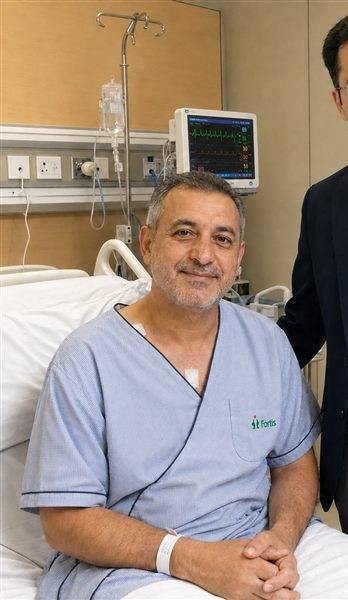
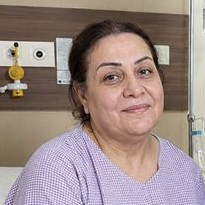
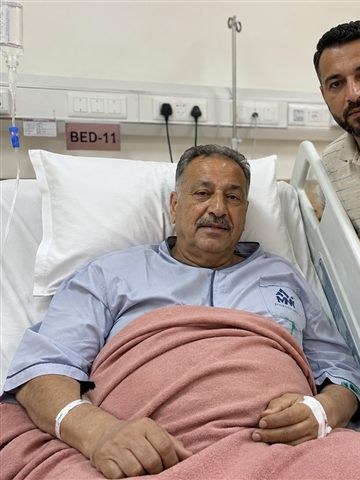
Healing Journeys of Iraqi Patients
Key Takeaways
- Robotic cancer surgery should not be selected simply because a hospital owns a robotic system. The source emphasises that the individual surgeon's experience with the exact procedure is more important than the hospital's general robotic reputation. Published robotic colorectal research cited in the guide found that surgeons may require approximately 28–50 cases to reach measurable proficiency for certain procedures.
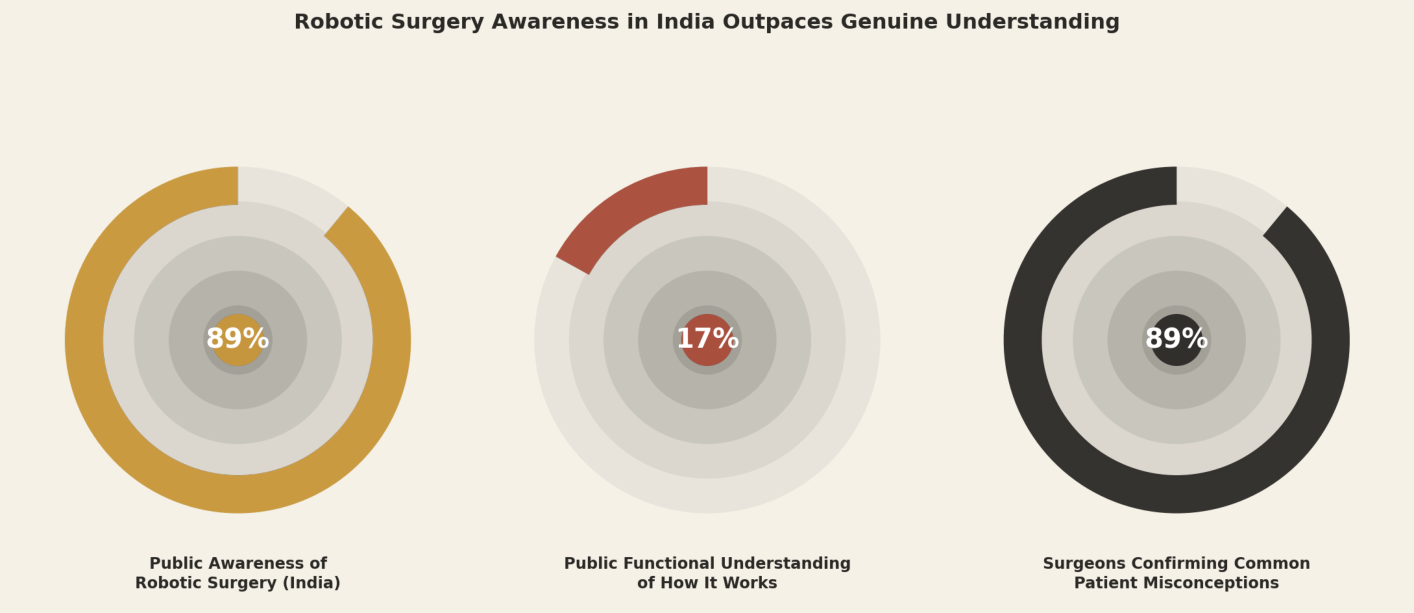
- The source also highlights a gap between public awareness and understanding of robotic surgery in India. A cited survey found that 89.2% of respondents were aware of robotic surgery, but only 17.3% demonstrated functional understanding of how it works. The same survey found that 89% of surgeons identified the belief that the robot operates autonomously as a common patient misconception.
- Early-career surgeon experience can vary considerably. The cited Indian survey reported an average of 12.4 console cases among early-career surgeons, which is below the 28–50 case range associated in the source with proficiency for more complex robotic cancer procedures.
- The page 2 visual highlights approximately 89% public awareness, 17% functional understanding and 89% of surveyed surgeons recognising a major patient misconception about robotic surgery. These figures reinforce the guide's central message that familiarity with the word "robotic" does not necessarily mean patients understand what determines surgical quality.
- Training and learning-curve transparency are important when selecting a robotic cancer surgeon. Patients should ask how many procedures of their specific cancer type the surgeon has personally performed, what structured training they completed, whether early cases were supervised by an experienced mentor and what their conversion rate to open surgery has been during their learning curve.
- Robotic cancer surgery depends on the entire operating team. The source recommends a surgeon with tracked experience in the relevant cancer procedure, a console-trained assistant who can provide support in a dual-console system, a trained robotic nursing and technical team and an anaesthesiologist familiar with robotic positioning requirements.
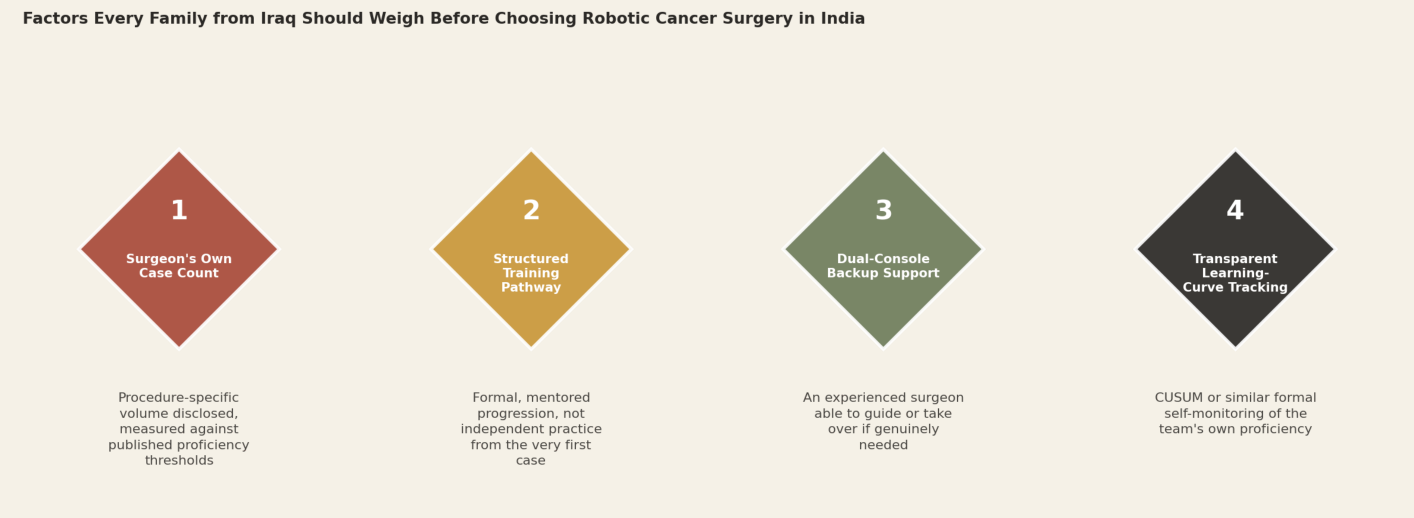
- The main red flag is a hospital that promotes robotic technology without surgeon-specific experience data. The page 4 checklist highlights the surgeon's own case count, structured training pathway, dual-console backup support and transparent learning-curve tracking.
Quick Facts
- Treatment
- Robotic cancer surgery
- Primary Patients
- Iraqi patients seeking robotic cancer treatment in India
- Main Speciality
- Surgical oncology
- Key Specialist
- Procedure-specific robotic cancer surgeon
- Main Selection Factor
- Individual surgeon's case count for the exact procedure
- Learning Curve
- Approximately 28–50 cases for proficiency in certain complex robotic procedures cited in the source
- Right Colectomy
- Published studies cited approximately 16–30 cases for a shorter learning curve
- Indian Survey
- Early-career surgeons averaged 12.4 console cases
- Key Training
- Structured robotic surgery training with supervised progression
- Team
- Robotic surgeon, console-trained assistant, nursing and technical team
- Anaesthesia
- Robotic-experienced anaesthesiologist
- Dual Console
- Can allow experienced surgeons to guide or take over when needed
- Backup
- Confirm alternative equipment or surgical approach
- Simulation
- Ongoing robotic training and simulation are important
- Learning-Curve Tracking
- CUSUM or similar structured monitoring may be used
- Accreditation
- Verify current JCI and/or NABH status
- Conversion Rate
- Ask for the surgeon's own conversion-to-open rate
- Decision Principle
- Procedure-specific expertise matters more than robotic branding
- Author
- Dr. Dheeraj Bojwani
- Experience
- 24+ Years
In Brief
For Iraqi patients considering robotic cancer surgery in India, the most useful comparison is between individual surgeons and procedure-specific expertise, not simply between robotic hospital brands or platforms. Patients should verify accreditation, personal case volume, structured training, conversion rates, dual-console support and ongoing learning-curve monitoring. A surgeon who cannot clearly state their experience with the exact procedure should be approached cautiously, even when the hospital has an advanced robotic system.
Why the Choice of Robotic Surgeon in India Matters as Much as the Choice of Technology
Based on my interactions with international patients, the published evidence on robotic surgery proficiency is genuinely specific and worth understanding. Multiple studies on robotic colorectal cancer surgery have found that surgeons typically require between 28 and 50 cases before reaching a measurable turning point in operative time and complication rates, with more complex rectal resections generally requiring more cases than more straightforward procedures such as right colectomy, which some studies place at a shorter 16 to 30 cases. A recent Indian survey of robotic surgery adoption found a striking gap between public awareness and genuine understanding: 89.2 percent of respondents were aware of robotic surgery as a concept, yet only 17.3 percent demonstrated a functional understanding of how the technology actually works, and 89 percent of surveyed surgeons identified the belief that the robot operates autonomously, without the surgeon’s hands controlling every movement, as the single most common patient misconception. The same survey found that early-career surgeons in India averaged only 12.4 console cases, a number considerably below the 28 to 50 cases published research associates with reaching proficiency in more complex robotic cancer procedures. A separate Indian high-volume centre study of 262 robotic rectal cancer cases documented this learning curve in detail using cumulative summation analysis, tracking exactly how console time, docking time, and outcomes improved as the surgical team gained experience. This tells a family something essential: the specific surgeon’s own case count for your exact procedure, not simply the hospital’s ownership of a robotic system, is what should shape your confidence in the recommendation.
How Patients from Iraq Can Verify a Robotic Cancer Surgery Hospital’s Accreditation in India
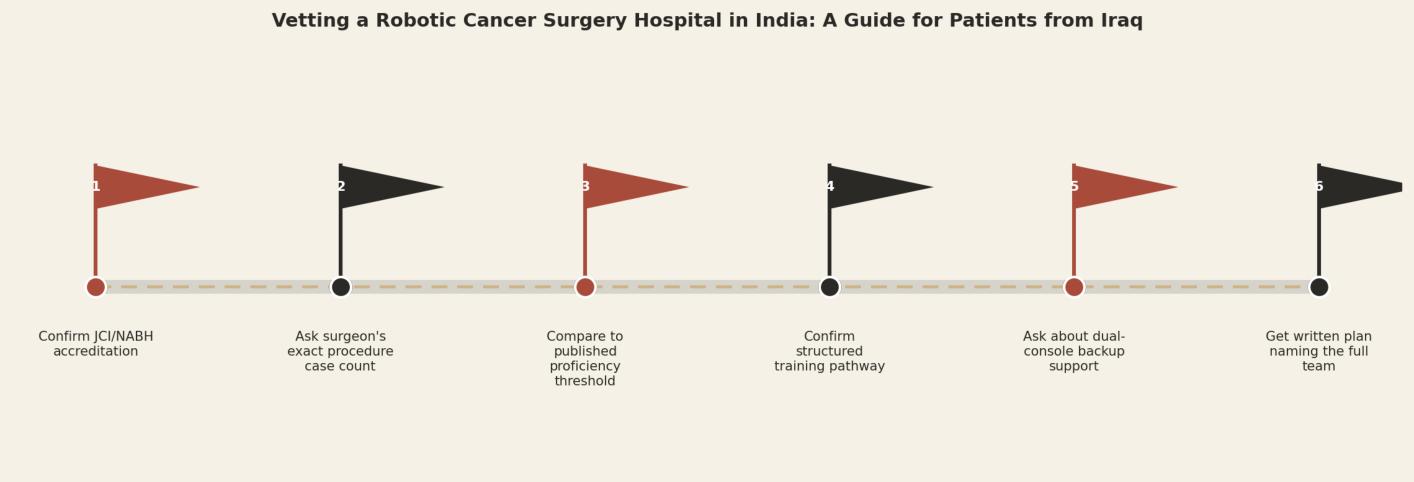
The fastest filter I recommend to every Iraqi family calling about robotic cancer surgery is verifiable accreditation, not marketing language. Joint Commission International, JCI, audits a hospital’s overall clinical safety systems against the same standard used across the United States and Europe. The National Accreditation Board for Hospitals and Healthcare Providers, NABH, is India’s own domestic equivalent, and in my experience of 24 years advising families on this exact decision, a centre holding both marks together is a meaningfully stronger signal than either alone. For robotic cancer surgery specifically, ask one further, very direct question: how many robotic procedures of my exact type has this specific surgeon personally performed, since published learning curve research shows this number, not the hospital’s general robotic surgery volume, is what predicts outcome quality.
Robotic Surgery Volume and Learning-Curve Criteria That Predict Outcomes in India
Based on my interactions with dozens of robotic surgery programmes over the years, a surgeon’s specific, procedure-matched case count, not a hospital’s overall robotic surgery reputation, is one of the clearest predictors of a good outcome. In my experience of 24 years advising families on exactly this kind of decision, the surgeons most worth trusting are the ones willing to state their own specific case count plainly, without treating the question as an unusual or unwelcome one. Ask directly, in writing:
- How many robotic procedures of my specific cancer type has this individual surgeon personally performed, and where does this fall relative to the published proficiency threshold for this exact procedure?
- What structured training programme did this surgeon complete before performing robotic surgery independently, and was it supervised by an experienced mentor during their own early cases?
- What is this surgeon's own conversion rate to open surgery, and how has this changed over their personal learning curve?
- Does the hospital use a formal, dual-console training structure where an experienced surgeon can take over or guide a less experienced colleague during a case if needed?
A surgeon confident in their own experience will answer these specifically and without defensiveness. A surgeon who cannot state their own procedure-specific case count deserves a second opinion before you commit.
Vetting a Robotic Cancer Surgery Hospital in India: A Guide for Patients from Iraq
Questions Patients from Iraq Should Ask About the Robotic Surgery Team in India
Robotic cancer surgery is never genuinely the work of one surgeon alone. In my experience of 24 years watching these programmes operate, the strongest units bring together a surgeon with specific, tracked robotic experience in your exact cancer type, a console-trained assistant surgeon capable of taking over in a dual-console system if needed, a specifically trained robotic surgery nursing and technical team, and an anaesthesiologist experienced in the specific positioning and physiological considerations robotic surgery requires. Ask specifically who fills each of these roles for your case, and confirm that the full operating team, not simply the lead surgeon, has specific experience with robotic technique.
Robotic Surgery Technology Standards in India That Patients from Iraq Should Check
The specific technology and infrastructure available change what a centre can safely offer. Ask which specific robotic platform the hospital uses, and whether backup equipment or an alternative approach is available if a technical malfunction occurs during surgery, since robotic systems, like any complex equipment, can occasionally require troubleshooting mid-procedure. Ask whether the hospital maintains a formal, ongoing training and simulation programme for its robotic surgery team, since skills maintenance matters as much as initial training. Ask also whether the surgical team uses cumulative summation, or CUSUM, analysis or a similarly structured method to formally track and document their own learning curve progress, since centres using this kind of rigorous self-monitoring have demonstrated genuine accountability for their own proficiency over time. Ask directly which of these specific capabilities apply to your case, not simply whether the hospital owns a robotic surgical system in general terms.
Red Flags Patients from Iraq Should Watch For When Choosing a Robotic Cancer Surgery Hospital in India
Over the years, certain patterns have become reliable warning signs for me. A surgeon who cannot state their own specific case count for your exact procedure type has not given you the single figure most directly linked to published proficiency thresholds. A hospital that emphasises its robotic system’s brand and marketing language without discussing individual surgeon experience is highlighting the technology rather than the expertise that actually determines your outcome. A hospital that cannot describe a structured training pathway for newer surgeons has not demonstrated the systematic approach that protects patients during a surgeon’s own learning curve. And a hospital that dismisses questions about console case counts as unnecessary or overly technical has not treated your family’s request for specific information with the seriousness it deserves.
Factors Every Family from Iraq Should Weigh Before Choosing Robotic Cancer Surgery in India
A Closing Thought for Iraqi Families
Robotic cancer surgery deserves a surgeon with genuine, tracked, procedure-specific experience well past the published proficiency threshold, not simply a hospital that owns an impressive piece of technology. Based on my interactions with international patients over more than two decades, the families who ask about individual surgeon case counts, training pathways, and learning-curve transparency consistently make better-informed decisions than those who assume robotic branding alone guarantees expertise. My role, and the role of any advisor a family works with, should be to help you ask these exact questions and confirm honestly that the specific surgeon and specific hospital in front of you are the right fit for your family’s exact diagnosis. Iraq’s families deserve the same standard of scrutiny in this decision as any family anywhere else in the world.
Sources & Further Reading
- Joint Commission International (JCI) — Accredited Organizations Directory (jointcommissioninternational.org)
- National Accreditation Board for Hospitals & Healthcare Providers (NABH), India (nabh.co)
- Cancers (MDPI) — Learning Curve for Robotic Colorectal Surgery: A Systematic Review (doi.org/10.3390/cancers16193420)
- PMC — Robotic-Assisted Surgery Adoption in India: A Mixed-Methods Evaluation of Digital Education Strategies and Surgical Training Needs (pmc.ncbi.nlm.nih.gov)
- PubMed — Prospective Analysis of Impact of Learning Curve in Robotic-Assisted Rectal Surgery in a High-Volume Indian Tertiary Care Centre (pubmed.ncbi.nlm.nih.gov)
Frequently Asked Questions by Iraqi Patients about Selecting a Robotic Cancer Surgeon and Hospital in India
Is robotic cancer surgery available in India for Iraqi patients?
Yes. The source specifically discusses robotic cancer surgery programmes in India and provides criteria for Iraqi patients evaluating surgeons and hospitals.
How many robotic cancer surgeries should an Iraqi patient ask a surgeon about?
Patients should ask for the surgeon's personal number of procedures for their specific cancer operation. The source cites published learning curves of approximately 28–50 cases for certain robotic cancer procedures.
Is robotic colorectal cancer surgery experience different from robotic surgery in general?
Yes. The source stresses that procedure-specific experience matters. Learning curves can differ between procedures, with some right colectomy studies showing shorter learning curves than more complex rectal resections.
Does owning a robotic surgical system mean a hospital is experienced in robotic cancer surgery?
No. The source specifically advises patients to focus on the individual surgeon's case count for the exact procedure rather than the hospital's general robotic surgery reputation.
What should Iraqi patients ask about a robotic cancer surgeon's training?
They should ask what structured training the surgeon completed, whether early procedures were supervised by an experienced mentor and how the surgeon progressed toward independent robotic surgery.
What is a conversion-to-open rate in robotic cancer surgery?
It refers to cases that begin robotically but require conversion to an open operation. The source recommends asking for the surgeon's own conversion rate and how it changed during their learning curve.
Is a dual-console robotic system useful for Iraqi cancer patients?
A dual-console setup can allow an experienced surgeon to guide or take over from another surgeon during a procedure. The guide recommends asking whether the hospital uses a formal dual-console training structure.
Which specialists should be part of a robotic cancer surgery team?
The source recommends a procedure-experienced robotic surgeon, console-trained assistant, robotic nursing and technical staff and an anaesthesiologist familiar with the requirements of robotic surgery.
What robotic technology should Iraqi patients check before cancer surgery?
Patients should ask which robotic platform is used, whether backup equipment or an alternative approach is available, and whether the centre provides ongoing simulation training and structured learning-curve monitoring.
How should Iraqi patients choose the best robotic cancer surgeon in India?
They should compare procedure-specific case volume, structured training, conversion rates, learning-curve transparency, team expertise and hospital accreditation.
Page Summary
The guide explains why Iraqi patients should look beyond a hospital's robotic equipment when choosing cancer surgery in India. Published learning-curve evidence indicates that proficiency can require substantial procedure-specific experience, and the source recommends asking directly about the surgeon's personal case count, training and outcomes.
A suitable robotic cancer programme should combine experienced surgeons with trained assistants, nursing and technical staff, appropriate anaesthesia support, backup planning and structured monitoring of surgical proficiency. Accreditation is useful as an initial filter, but procedure-specific surgeon experience remains a central consideration.
Citation Block
| Field | Details |
|---|---|
| Article / Topic | Selecting the Best Robotic Cancer Surgeons and Hospitals in India |
| Target Country | Iraq |
| Treatment Area | Robotic cancer surgery |
| Main Speciality | Surgical oncology |
| Key Selection Factor | Procedure-specific surgeon experience |
| Robotic Colorectal Learning Curve | Approximately 28–50 cases in cited studies |
| Complex Rectal Surgery | Generally requires greater experience |
| Right Colectomy Learning Curve | Approximately 16–30 cases in cited studies |
| Indian Survey Awareness | 89.2% |
| Functional Understanding | 17.3% |
| Common Patient Misconception | 89% of surveyed surgeons identified it |
| Early-Career Console Experience | 12.4 cases average in cited survey |
| High-Volume Indian Study | 262 robotic rectal cancer cases |
| Important Surgeon Data | Exact procedure case count |
| Training Assessment | Structured robotic training |
| Mentorship | Supervised early robotic cases |
| Team | Surgeon, assistant, robotic nursing and technical team |
| Dual-Console Support | Experienced surgeon can guide or take over |
| Learning-Curve Monitoring | CUSUM or similar structured analysis |
| Accreditation | JCI and/or NABH |

Our Mission Statement
Our mission is to place patients at the centre of every healthcare decision by providing trustworthy, evidence-based, and unbiased medical information. We believe that informed patients make better decisions. Backed by personalised guidance from our experienced advisory team, we help patients understand their treatment options, compare them objectively, and confidently choose the path that best suits their medical needs and personal circumstances.
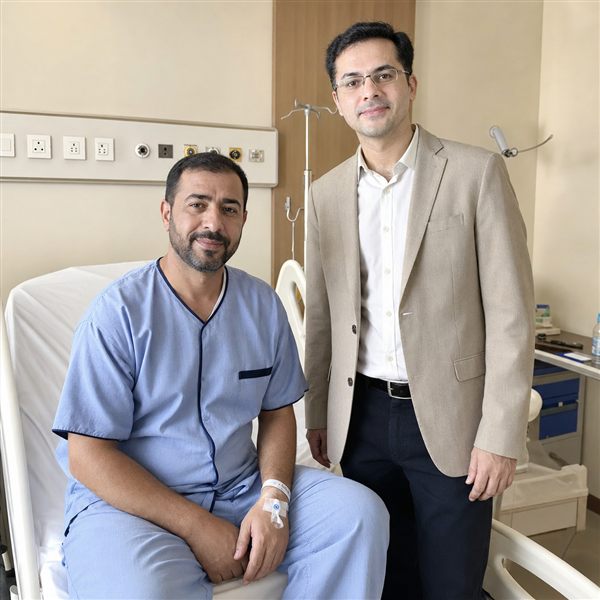
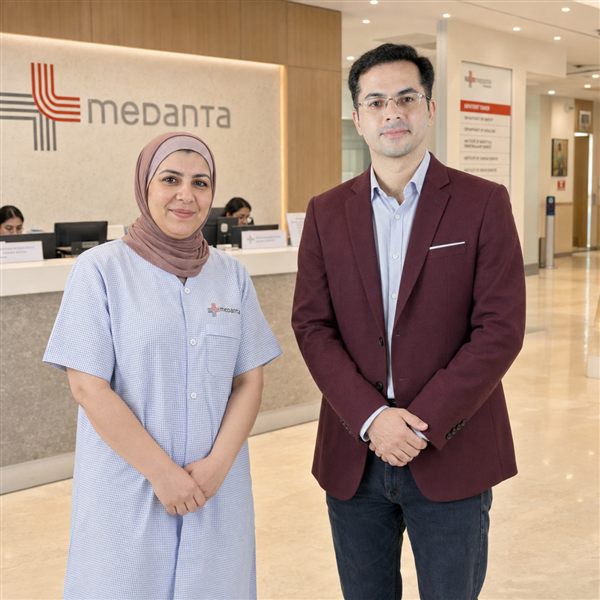
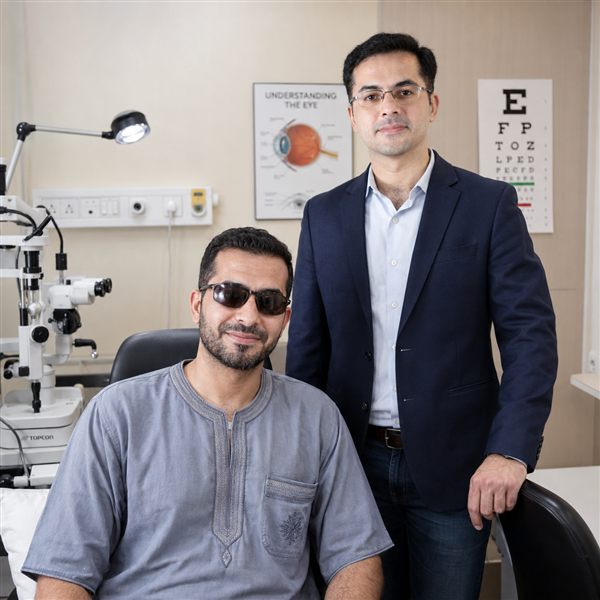
Patient Testimonials from Iraq
Ready to Take the First Step?
Share your Medical Reports with our Healthcare Managers Today and Get a FREE CONSULTATION, a Personalized Treatment Plan, and Complete Support from Arrival to Recovery.
Get Your Free ConsultationAreas We Serve
Indian Health Guru Consultants proudly assists patients from Iraq and surrounding Middle Eastern countries in accessing advanced, affordable and trusted medical treatment in India. Our team provides complete support for medical opinions, hospital selection, treatment planning, visa assistance, travel coordination, accommodation and post-treatment follow-up.
We regularly serve patients from:
- Iraq
- Turkey
- Iran
- Kuwait
- Jordan
- Syria
- Qatar
- Bahrain
- Oman
- Yemen
- Saudi Arabia
- United Arab Emirates
No matter where you are located, our experienced team is committed to making your medical journey to India safe, smooth, transparent and stress-free from the first enquiry to your return home.
From Iraq to India: Your Complete Patient Guide
- Penile Implant Surgery in India for Iraqis
- Kidney Transplant in India for Iraqis
- Paediatric Heart Surgery in India for Iraqis
- Knee Surgery in India for Iraqis
- Plastic and Reconstructive Surgery in India for Iraqis
- Bone Marrow Transplant in India for Iraqi Patients
- Pancreatic Cancer Surgery in India for Iraqis
- Paediatric Neurosurgery in India for Iraqis
- Spine Surgery in India for Iraqis
- HIPEC Cancer Surgery in India for Iraqis
- Scoliosis Correction Surgery in India for Iraqis
- Robotic Cancer Surgery in India for Iraqis
- Liver Transplant in India for Iraqis
- Heart Valve Replacement in India for Iraqis
- Colorectal Cancer Treatment and Surgery in India for Iraqis
- Cervical and Lumbar Disc Replacement Surgery in India for Iraqis
- Breast Cancer Treatment in India for Iraqi Patients
- Dental Surgery in India for Iraqis