

Selecting the Best Dental Surgery Specialists and Clinics in India: A Guide for Patients from Iraq
A doctor’s honest, question-by-question guide for patients from Iraq on vetting a dental surgery provider in India — specialty training, imaging technology, technique selection, and the exact questions worth asking before you book anything.
Over the years, I have found that Iraqi patients often lump every kind of dental treatment together in their minds, implants, fillings, extractions, root canals, as though a single dentist’s general skill applies equally to all of them. In my experience of 24 years advising patients on this exact decision, complex extractions, periodontal surgery, and root canal retreatment are each their own genuine sub-specialty, and the specific technique a dentist chooses, not simply their general competence, is what most often determines whether you keep a nerve intact, save a tooth that could have been extracted, or need the same procedure redone a second time.
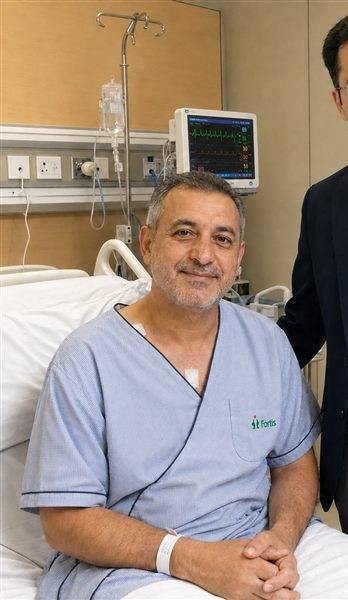
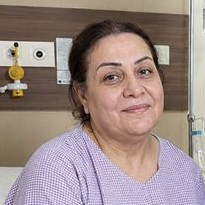
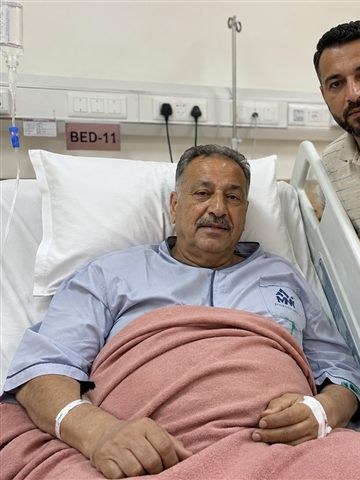
Healing Journeys of Iraqi Patients

Key Takeaways
- Dental surgery should not be treated as one broad category in which the same dentist is automatically suited to every procedure. The source explains that complex extractions, periodontal surgery and root canal retreatment require different technical expertise, and that the technique selected can influence whether a tooth is preserved, whether a nerve is protected and whether treatment needs to be repeated.
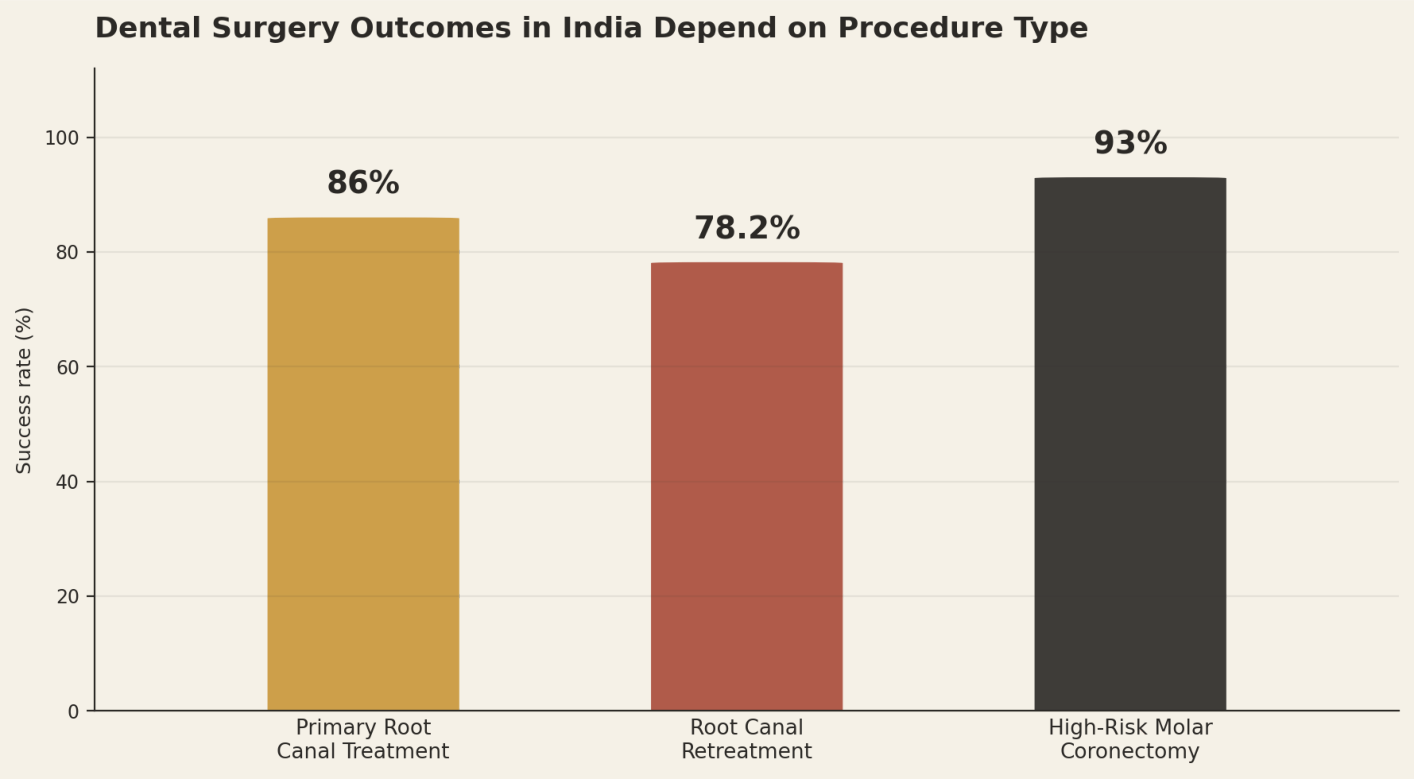
- The source provides several procedure-specific outcome figures. Published research cited in the guide reported 86% success for primary root canal treatment compared with 78.2% for secondary treatment or retreatment. Endodontic surgery also showed differences according to tooth location, with 78% success reported for maxillary teeth compared with 66% for mandibular teeth. For high-risk impacted lower wisdom teeth, coronectomy achieved 93% success in a cited series of 167 cases while maintaining a notably low rate of permanent nerve injury.
- The chart on page 2 presents these figures visually, showing 86% for primary root canal treatment, 78.2% for root canal retreatment and 93% for high-risk coronectomy. The guide specifically warns patients to establish which procedure category applies to their own case before comparing success rates, because these figures should not be treated as interchangeable.
- Accreditation provides an important initial filter when Iraqi patients compare dental surgery clinics in India. The guide recommends verifying NABH accreditation and considering JCI accreditation where a dental department is housed within a larger hospital. NABH's current Dental Healthcare Service Providers programme covers dental hospitals, teaching institutions and clinics and focuses on areas including patient safety, infection control, quality improvement, facility safety and trained staff.
- Procedure-specific experience is more useful than a clinic's general dental case count. For a complex or impacted extraction, Iraqi patients should ask whether 3D imaging has been used to assess the tooth's relationship to the nerve and whether coronectomy could be considered if the nerve-injury risk is high. For root canal retreatment, patients should request a retreatment-specific success rate rather than the clinic's first-time root canal results. For periodontal surgery, they should ask about experience with their specific gum disease and bone-loss pattern and the proposed long-term maintenance plan.
- Complex dental surgery may benefit from a team of specialists rather than one general dentist performing every procedure. The source describes oral surgeons for complex extractions, endodontists for root canal treatment and retreatment, and periodontists for gum and bone-related procedures. A dental anaesthesiologist or trained sedation specialist may also be relevant for anxious patients or procedures requiring extended treatment time.
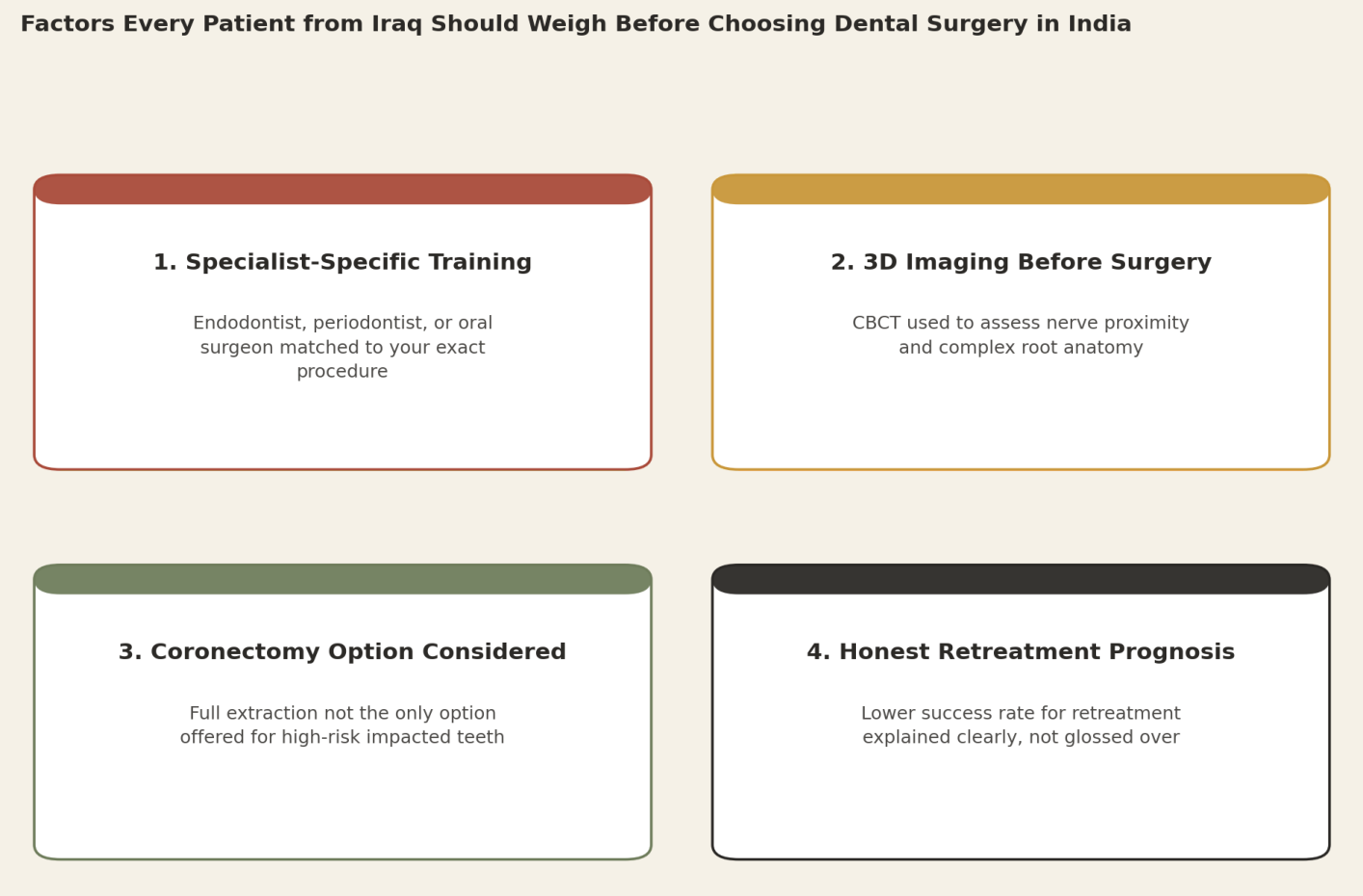
- The source identifies several warning signs: recommending full extraction for a high-risk impacted tooth without discussing coronectomy, presenting root canal retreatment as having the same prognosis as first-time treatment, attempting complex procedures near critical structures without 3D imaging, and failing to explain what caused a previous treatment to fail before beginning retreatment. The page 4 checklist highlights specialist-specific training, 3D imaging before surgery, consideration of coronectomy where appropriate and an honest explanation of retreatment prognosis.
Quick Facts
- Treatment
- Complex dental surgery and specialist dental procedures
- Primary Patients
- Iraqi patients seeking dental surgery in India
- Main Specialities
- Oral surgery, endodontics and periodontics
- Key Specialists
- Oral surgeon, endodontist and periodontist
- Primary Root Canal Success
- 86% in the cited research
- Root Canal Retreatment Success
- 78.2% in the cited research
- Endodontic Surgery
- 78% maxillary versus 66% mandibular success in the cited study
- High-Risk Coronectomy
- 93% success in the cited 167-case series
- Complex Extraction
- Assess nerve proximity before surgery
- Coronectomy
- Potential alternative to full extraction for selected high-risk impacted teeth
- Imaging
- 3D CBCT recommended for complex cases
- Root Canal Technology
- Dental operating microscope may assist retreatment
- Retreatment
- Previous treatment failure should be identified before re-treatment
- Specialist Training
- Should match the exact dental procedure
- Periodontal Surgery
- Assess specific gum disease and bone-loss pattern
- Sedation
- Specialist sedation support may be relevant for complex procedures
- Accreditation
- Verify NABH and relevant JCI accreditation
- Case-Specific Data
- Ask for outcomes specific to the procedure
- Treatment Plan
- Obtain a clear explanation of the selected technique
- Author
- Dr. Dheeraj Bojwani
- Experience
- 24+ Years
In Brief
For Iraqi patients travelling to India for dental surgery, the most important selection criterion is procedure-specific expertise rather than a clinic’s general reputation. The source’s page 4 visual checklist highlights four factors: specialist-specific training, 3D imaging before surgery, consideration of coronectomy where appropriate and an honest explanation of retreatment prognosis. These principles are particularly relevant for complex extractions, impacted wisdom teeth, root canal retreatment and periodontal surgery.
Why the Choice of Dental Surgery Specialist in India Matters as Much as the Choice of Clinic
Based on my interactions with international patients, the published data across these specific procedures tells a consistent story: the exact clinical situation and the exact technique chosen matter enormously. For root canal treatment, published research comparing outcomes found an 86 percent success rate for primary treatment compared with 78.2 percent for secondary treatment, meaning retreatment after an earlier root canal has failed, a meaningful gap that argues strongly for getting the first treatment right rather than assuming retreatment is simply routine. For endodontic surgery specifically, success also varies by the tooth's location, with one study reporting 78 percent success for maxillary teeth compared with 66 percent for mandibular teeth, reflecting genuine anatomical differences in accessibility and root complexity. For complex extractions, particularly impacted lower wisdom teeth sitting close to the nerve that supplies sensation to the lower lip and chin, a specific alternative technique called coronectomy, removing only the crown of the tooth and deliberately leaving the root in place to avoid disturbing the nerve, has been shown in a published series of 167 cases to achieve a 93 percent success rate with a notably low rate of permanent nerve injury. A dentist who only ever offers full extraction, without considering coronectomy for genuinely high-risk cases, is not offering the full range of modern technique.
How Patients from Iraq Can Verify a Dental Surgery Clinic’s Accreditation in India
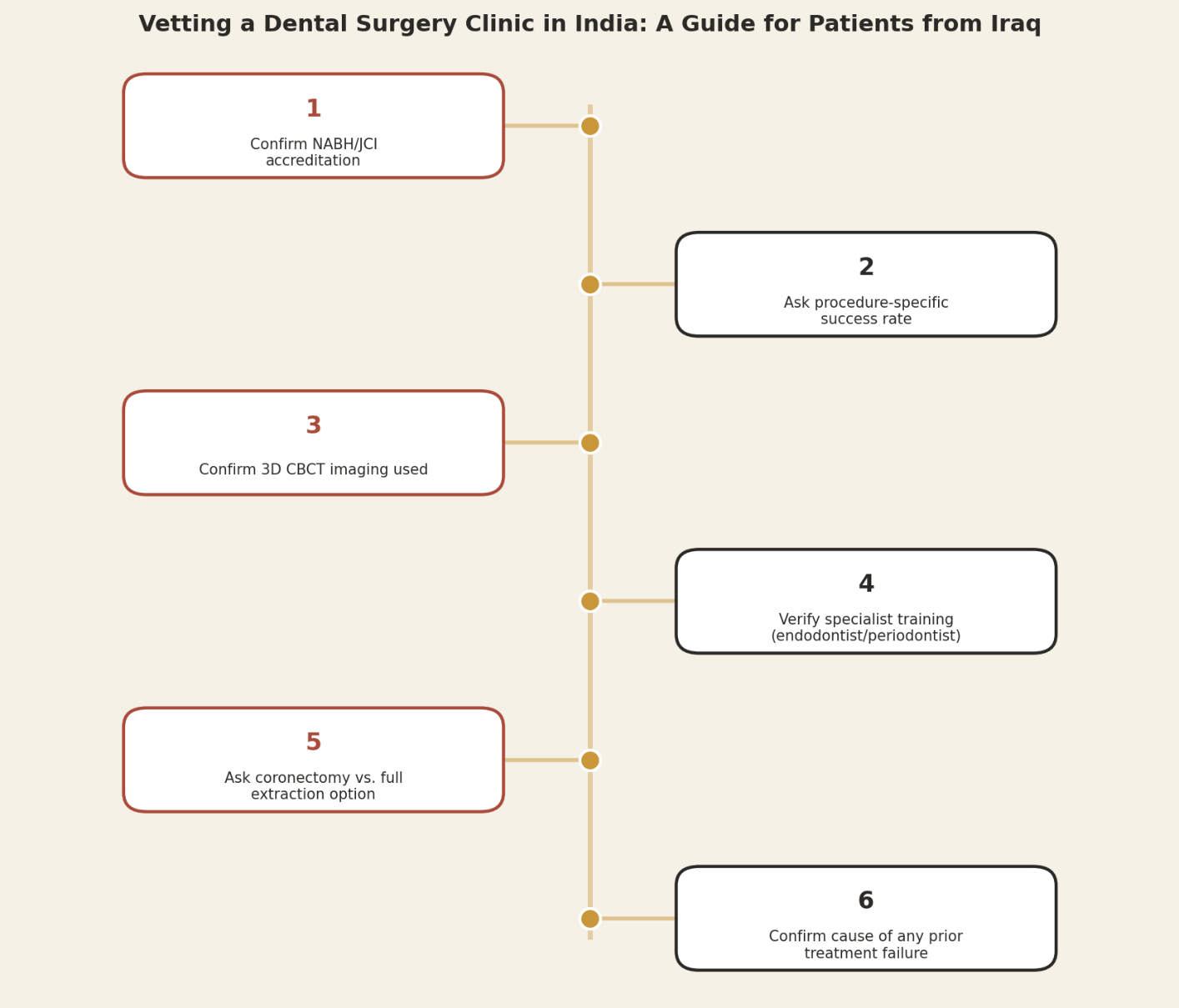
The fastest filter I recommend to every Iraqi patient calling about complex dental surgery is verifiable accreditation, not marketing language. The National Accreditation Board for Hospitals and Healthcare Providers, NABH, is India’s domestic accreditation body and increasingly extends to dedicated dental and maxillofacial centres, not simply general hospitals. Joint Commission International, JCI, accreditation, where held by a larger hospital housing a dental department, adds a further internationally recognised layer of clinical safety oversight. Based on my interactions with dozens of dental practices over the years, for complex extractions specifically, ask one further, very direct question: does the clinic use 3D cone-beam imaging to assess a tooth’s exact proximity to the nerve before extraction, since this is precisely the information needed to decide between full extraction and coronectomy.
Dental Surgery Volume and Technique Criteria That Predict Outcomes in India
Based on my interactions with dozens of dental surgery practices over the years, a dentist’s specific experience with your exact procedure type, complex extraction, periodontal surgery, or endodontic retreatment, is one of the clearest predictors of a good outcome. Ask directly, in writing:
- For a complex or impacted extraction, has the clinic assessed the tooth's proximity to the nerve using 3D imaging, and would coronectomy be considered as an alternative if the risk is genuinely high?
- For root canal retreatment specifically, what is the clinic's own success rate for retreatment cases, distinct from their success rate for straightforward, first-time root canal treatment?
- Does the clinic have a dentist with specific endodontic specialty training, distinct from a general dentist who also performs root canals occasionally?
- For periodontal surgery, what is the clinic's specific experience with your exact type of gum disease and bone loss pattern, and what long-term maintenance plan is recommended afterward?
A clinic confident in its own outcomes will answer these specifically. A clinic that offers the same single approach regardless of your specific anatomy or treatment history deserves a second opinion before you commit.
Vetting a Dental Surgery Clinic in India: A Guide for Patients from Iraq
Questions Patients from Iraq Should Ask About the Dental Surgery Team in India
Complex dental surgery benefits from more than one kind of expertise. In my experience of 24 years watching these practices operate, the strongest teams bring together an oral surgeon for complex extractions, an endodontist with specific specialty training for root canal treatment and retreatment, and a periodontist for gum and bone-related procedures, rather than a single general dentist attempting all three categories of work. A dental anaesthesiologist or trained sedation specialist is a further consideration for patients who are anxious about complex procedures or who need extended treatment time, since managing sedation safely is itself a specific skill distinct from the surgical procedure. Ask specifically who will perform your specific procedure, and confirm that this practitioner holds specific specialty training relevant to your exact treatment, not simply a general dental qualification.
Dental Surgery Technology Standards in India That Patients from Iraq Should Check
The specific technology available changes how precisely a dentist can plan and execute complex procedures. Ask whether the clinic uses 3D cone-beam computed tomography for surgical planning, since this level of detail is what makes it possible to accurately assess nerve proximity before extraction or to plan complex root canal anatomy before retreatment. Ask whether dental operating microscopes are used for root canal retreatment, since magnification meaningfully improves a specialist’s ability to locate and treat the fine root canal anatomy that a failed first treatment may have missed, particularly in cases involving fractured instruments left behind from a previous procedure. Ask also whether the clinic has a specific protocol for managing fractured endodontic instruments during retreatment, since published research shows this specific complication is considerably harder to resolve when the fragment sits deep in the root’s apical third rather than closer to the surface. Ask directly which of these specific capabilities apply to your case, not simply whether the clinic owns the equipment somewhere in the building.
Red Flags Patients from Iraq Should Watch For When Choosing a Dental Surgery Provider in India
Over the years, certain patterns have become reliable warning signs for me. A clinic that recommends full extraction for a high-risk impacted tooth without discussing coronectomy as a genuine alternative, particularly when the tooth sits close to the nerve, has not presented you with the full range of modern technique. A clinic that treats root canal retreatment as routinely as a first-time root canal, without acknowledging the meaningfully lower success rate retreatment carries, is not giving you an honest picture of your prognosis. A clinic without 3D imaging capability attempting complex extractions or retreatment near critical anatomical structures is working with less information than current best practice supports. And a clinic that cannot explain, in plain terms, what specifically went wrong with a previous failed treatment before beginning retreatment is likely to repeat the same mistake a second time.
Factors Every Patient from Iraq Should Weigh Before Choosing Dental Surgery in India
A Closing Thought for Iraqi Families
Complex dental surgery, whether a difficult extraction, gum disease requiring surgical treatment, or a root canal that needs to be redone, deserves a specialist with genuine, specific training in that exact procedure, not a general dentist extending their skills across every category of dental work. Based on my interactions with international patients over more than two decades, the patients who ask about specialty training, procedure-specific success rates, and 3D imaging capability consistently achieve better, more predictable outcomes than those who accept a general reassurance alone. My role, and the role of any advisor a patient works with, should be to help you ask these exact questions and confirm honestly that the specific specialist and specific clinic in front of you are the right fit for your exact case. Iraq’s patients deserve the same standard of scrutiny in this decision as any patient anywhere else in the world.
Sources & Further Reading
- National Accreditation Board for Hospitals & Healthcare Providers (NABH), India (nabh.co)
- Joint Commission International (JCI) — Accredited Organizations Directory (jointcommissioninternational.org)
- PubMed Central — Comparison of the Success Rate of Endodontic Treatment and Implant Treatment (pmc.ncbi.nlm.nih.gov)
- PubMed Central — The Success Rates and Outcomes of Mandibular Third Molar Coronectomy (ncbi.nlm.nih.gov/pmc)
- American Association of Endodontists (AAE) — Patient Information (aae.org)
Frequently Asked Questions by Iraqi Patients about Selecting a Dental Surgery Specialist in India
Can Iraqi patients receive complex dental surgery in India?
Yes. The guide specifically addresses Iraqi patients seeking specialist dental surgery in India, including complex extractions, root canal retreatment and periodontal procedures.
What is the success rate of root canal treatment in India for Iraqi patients?
The source cites 86% success for primary root canal treatment and 78.2% for secondary treatment or retreatment. Patients should ask for outcomes relevant to their specific procedure.
Is root canal retreatment available for Iraqi patients in India?
Yes. The guide specifically recommends asking whether the dentist has endodontic specialty training and what their own retreatment success rate is, separately from first-time root canal treatment.
Can Iraqi patients get wisdom tooth surgery in India?
Yes. For difficult impacted wisdom teeth, particularly those close to the nerve, patients should ask whether the specialist uses 3D imaging and whether coronectomy is an appropriate alternative to complete extraction.
What is coronectomy and when may it be considered?
Coronectomy removes the crown of an impacted tooth while leaving the root in place. The guide identifies it as a potential technique for selected high-risk impacted teeth located close to the nerve.
Is CBCT important for complex dental surgery in Iraqi patients?
For complex extractions and difficult retreatment cases, the guide recommends 3D CBCT because it can show nerve proximity and complex root anatomy more clearly than standard two-dimensional imaging.
Which specialist should Iraqi patients choose for root canal retreatment in India?
An endodontist with specific specialty training is recommended rather than relying only on a general dentist who occasionally performs root canals. The clinic should also be able to provide retreatment-specific outcome information.
Which specialist performs complex tooth extractions in India?
The guide recommends an oral surgeon for complex extractions, particularly where anatomy is difficult or the tooth is close to an important nerve.
Can Iraqi patients receive periodontal surgery in India?
Yes. For periodontal surgery, patients should ask about the specialist's experience with their exact gum disease and bone-loss pattern and what long-term maintenance programme will follow the procedure.
What should Iraqi patients check before choosing a dental surgery clinic in India?
They should verify accreditation, confirm specialist training, ask for procedure-specific outcomes, ensure appropriate 3D imaging is available, understand the proposed technique and investigate the reason for any previous treatment failure before proceeding.
Page Summary
Dental surgery encompasses several distinct procedures, and the guide stresses that Iraqi patients should match the specialist's training and technique to their exact dental problem. Primary root canal treatment, retreatment, endodontic surgery and high-risk impacted tooth removal have different clinical considerations and published outcomes, making generic clinic-wide success claims less useful.
For patients travelling to India, the selection process should include accreditation verification, procedure-specific experience, specialist training, 3D CBCT imaging where appropriate and a clear explanation of alternative techniques such as coronectomy. For retreatment, understanding why the original procedure failed is particularly important before repeating the treatment.
Citation Block
| Field | Details |
|---|---|
| Article / Topic | Selecting the Best Dental Surgery Specialists and Clinics in India |
| Primary Patients | Patients from Iraq |
| Treatment Area | Complex dental surgery |
| Main Specialities | Oral surgery, endodontics and periodontics |
| Primary Root Canal Success | 86% |
| Root Canal Retreatment Success | 78.2% |
| Maxillary Endodontic Surgery | 78% success in cited study |
| Mandibular Endodontic Surgery | 66% success in cited study |
| High-Risk Coronectomy | 93% success in cited 167-case series |
| Accreditation | NABH and relevant JCI accreditation |
| Complex Extraction Assessment | Evaluate proximity to the nerve |
| Imaging | 3D CBCT |
| Coronectomy | Alternative to full extraction in selected high-risk cases |
| Oral Surgeon | Specialist for complex extractions |
| Endodontist | Specialist for root canal treatment and retreatment |
| Periodontist | Specialist for gum and bone-related surgery |
| Sedation Specialist | May support anxious patients or extended procedures |
| Root Canal Microscope | Useful for detailed retreatment anatomy |
| Instrument Fragment Management | Ask about clinic-specific retreatment protocols |
| Retreatment Assessment | Identify the reason for previous treatment failure |
| Periodontal Assessment | Consider disease type and bone-loss pattern |
| Procedure-Specific Outcomes | Should be requested instead of generic clinic figures |

Our Mission Statement
Our mission is to place patients at the centre of every healthcare decision by providing trustworthy, evidence-based, and unbiased medical information. We believe that informed patients make better decisions. Backed by personalised guidance from our experienced advisory team, we help patients understand their treatment options, compare them objectively, and confidently choose the path that best suits their medical needs and personal circumstances.
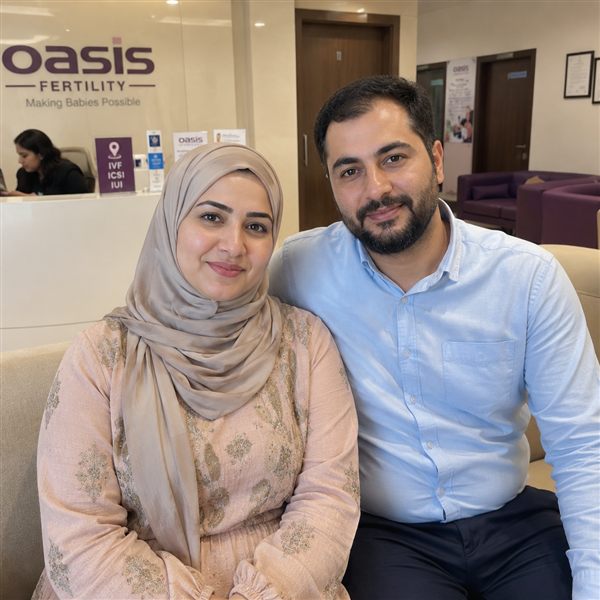
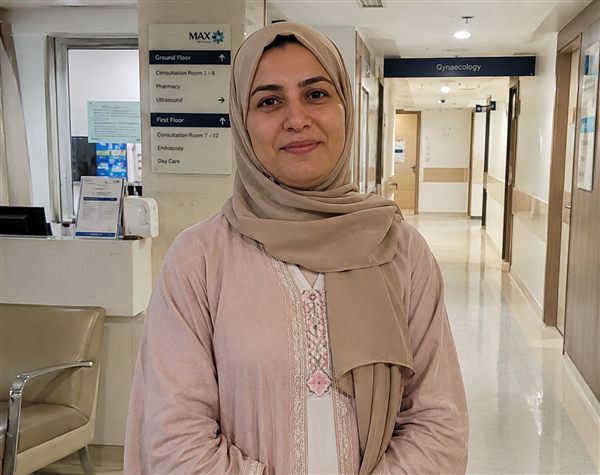
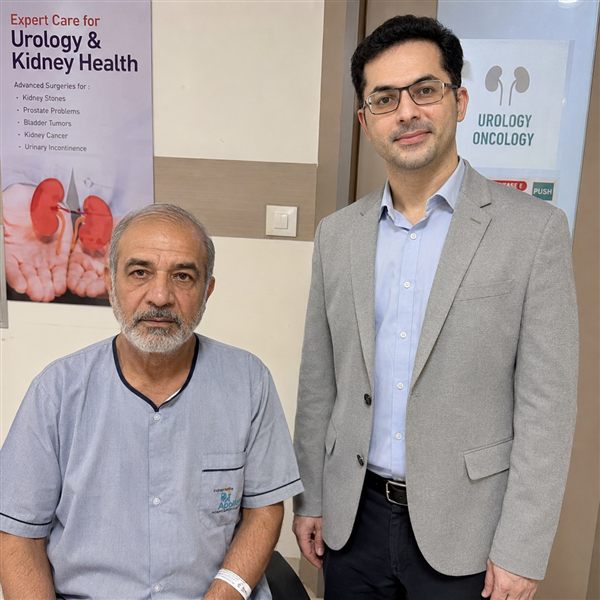
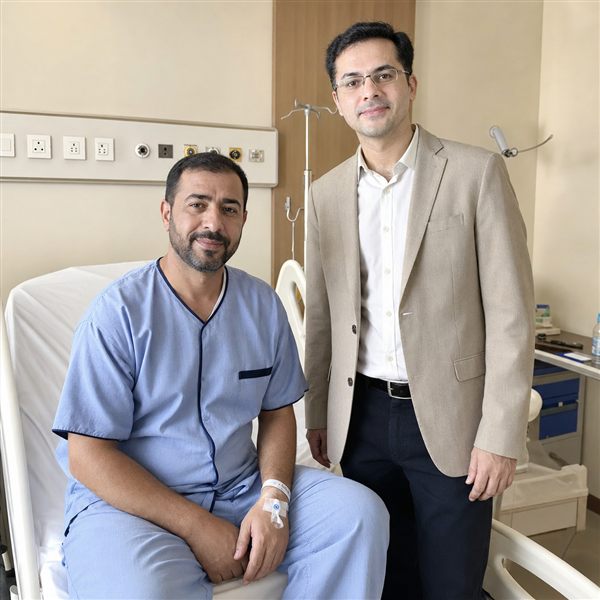
Patient Testimonials from Iraq

Ready to Take the First Step?
Share your Medical Reports with our Healthcare Managers Today and Get a FREE CONSULTATION, a Personalized Treatment Plan, and Complete Support from Arrival to Recovery.
Get Your Free ConsultationAreas We Serve
Indian Health Guru Consultants proudly assists patients from Iraq and surrounding Middle Eastern countries in accessing advanced, affordable and trusted medical treatment in India. Our team provides complete support for medical opinions, hospital selection, treatment planning, visa assistance, travel coordination, accommodation and post-treatment follow-up.
We regularly serve patients from:
- Iraq
- Turkey
- Iran
- Kuwait
- Jordan
- Syria
- Qatar
- Bahrain
- Oman
- Yemen
- Saudi Arabia
- United Arab Emirates
No matter where you are located, our experienced team is committed to making your medical journey to India safe, smooth, transparent and stress-free from the first enquiry to your return home.
From Iraq to India: Your Complete Patient Guide
- Heart Valve Replacement in India for Iraqis
- Breast Cancer Treatment in India for Iraqi Patients
- Dental Surgery in India for Iraqis
- Knee Surgery in India for Iraqis
- Paediatric Neurosurgery in India for Iraqis
- Joint Arthroscopy and Sports Medicine in India for Iraqis
- Scoliosis Correction Surgery in India for Iraqis
- Parkinson's Treatment and DBS Surgery in India for Iraqis
- Urosurgery and Reconstructive Urology in India for Iraqis
- Neuronavigation and Advanced Brain Surgery in India for Iraqis
- Weight Loss and Bariatric Surgery in India for Iraqis: Cost & Guide
- Paediatric Orthopaedic Surgery in India for Iraqis
- Robotic Cancer Surgery in India for Iraqis
- Cervical and Lumbar Disc Replacement Surgery in India for Iraqis
- Plastic and Reconstructive Surgery in India for Iraqis
- Colorectal Cancer Treatment and Surgery in India for Iraqis
- Neurosurgery in India for Iraqis
- Penile Implant Surgery in India for Iraqis