
 Ghana
 India
In Brief
For patients in Ghana living with missing teeth, damaged teeth, gum disease, or wanting a complete smile makeover, India offers advanced dental and implant care at a fraction of the cost of many other countries. Treatment ranges from single tooth replacement and root canal treatment to full-mouth rehabilitation, all-on-four/all-on-six implant-supported dentures, and complex oral and maxillofacial surgery, delivered by dental specialists using modern imaging and implant systems.
For a patient travelling from Ghana, the important question is not simply “Can this be done in India?” The more useful questions are: What exactly does my mouth need, and in what order? Is my jaw bone suitable for implants, or will I need bone grafting first? How many trips will this realistically take? What happens if something needs adjustment after I go home? And how do I choose a dental team with genuine implant experience rather than just an attractive price? This guide explains the clinical aspects of dental surgery and dental implants in India from the perspective of Ghana patients.
Guide Roadmap19 topics · tap any topic to jump5 stages
- Stage 1Topics 1–4
- Stage 2Topics 5–8
- Stage 3Topics 9–12
- Stage 4Topics 13–16
- Stage 5Topics 17–19
1.Ghana to India: What Is Dental Surgery and Dental Implants?
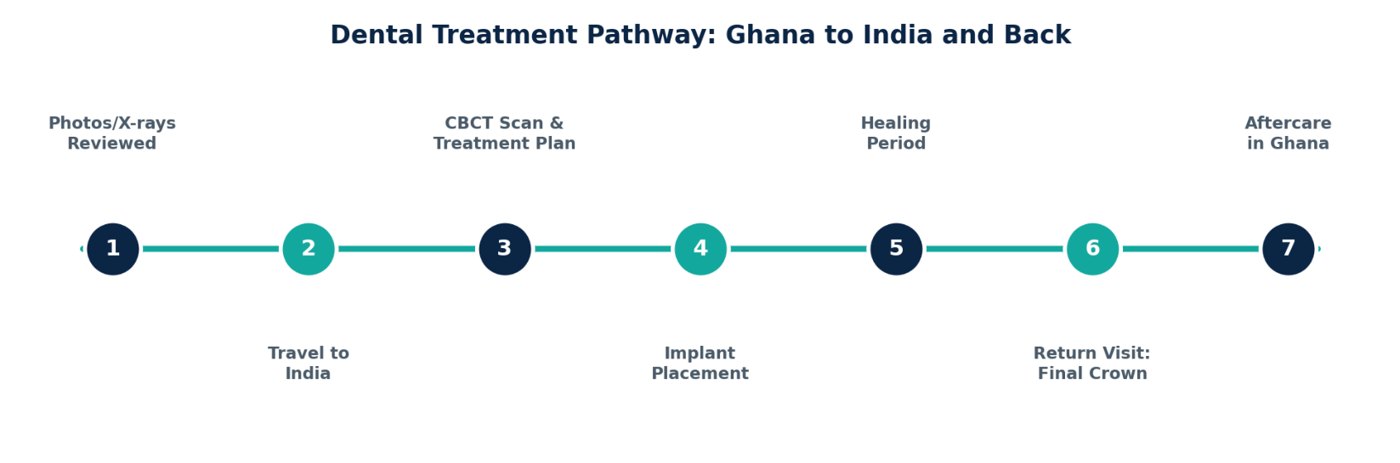
Dental surgery and implant dentistry cover procedures performed on the teeth, gums, jawbone and supporting oral structures. The objective depends on the diagnosis: removing a damaged tooth, treating gum disease, replacing missing teeth with implants, correcting bite or jaw alignment, or full-mouth rehabilitation combining several of these. Dental implant treatment in particular is not a single procedure but usually a staged process — assessment, any necessary bone or gum preparation, implant placement, a healing period, and finally the fitting of the crown, bridge or denture — which is why realistic trip planning matters as much as the treatment itself.
2.Common Conditions for Dental Treatment from Ghana in India
Missing or Extracted Teeth
Single or multiple missing teeth can be replaced with individual implants, an implant-supported bridge, or, for a fully edentulous jaw, an implant-supported denture.
Severely Decayed or Damaged Teeth
Teeth that cannot be saved with a filling or root canal may need extraction and replacement; those that can be saved may need root canal treatment and a crown.
Gum Disease (Periodontal Disease)
Inflammation and infection of the gums and supporting bone can loosen teeth over time and, if advanced, may affect candidacy for implants until treated.
Full or Partial Tooth Loss (Edentulism)
Patients missing most or all of their teeth may be candidates for full-mouth implant-supported solutions such as all-on-four or all-on-six treatment.
Insufficient Jaw Bone for Implants
Bone loss from long-term tooth loss or gum disease may require bone grafting or sinus lift procedures before implants can be placed.
Misaligned Bite or Jaw Position
Selected patients may benefit from orthodontic treatment or, in more significant cases, corrective jaw (orthognathic) surgery.
Cosmetic Concerns (Smile Makeover)
Patients seeking an improved smile may combine veneers, crowns, whitening and implants as part of a planned smile makeover.
Impacted Wisdom Teeth and Oral Pathology
Impacted teeth, cysts, or other conditions of the jaw may require surgical removal or further investigation.
3.Does Every Condition Need Surgery?
No. This is one of the most important principles for a Ghana patient considering travelling overseas. Depending on the diagnosis, appropriate treatment may include:
- A filling or root canal instead of extraction, where the tooth can be saved
- Non-surgical gum treatment (deep cleaning) instead of surgery for early gum disease
- A conventional bridge or denture instead of implants, where appropriate for the patient’s bone and budget
- Orthodontic treatment instead of surgery for selected bite problems
- Monitoring instead of immediate treatment for small, asymptomatic findings
Not every missing or damaged tooth requires an implant, and not every implant case requires bone grafting. A dental specialist should assess the mouth as a whole, including bone quality, gum health, and bite, before recommending a specific treatment plan.
4.When May Surgery Be Recommended?
- A tooth cannot be saved and is causing pain, infection, or functional problems
- One or more teeth are missing and affecting chewing, speech, or confidence
- Gum disease has progressed to the point of threatening tooth stability
- Jaw bone volume is adequate (or can be built up) to support implants
- A patient wants a comprehensive, planned smile makeover rather than piecemeal treatment
5.Warning Signs to Watch in Ghana Before Dental Treatment in India
- Severe tooth or jaw pain, especially with facial swelling
- Facial swelling spreading toward the eye or neck
- Fever with dental pain or swelling
- Difficulty swallowing or breathing with a dental infection
- Persistent bleeding from the gums or a tooth socket
- A loose or knocked-out tooth after injury
A patient with facial swelling spreading toward the eye or neck, fever with a dental infection, or difficulty breathing or swallowing should seek immediate local emergency care in Ghana rather than delaying to arrange overseas treatment, as dental infections can occasionally become serious.
6.Tests Required Before Dental Surgery from Ghana in India
Clinical Examination
A thorough assessment of teeth, gums, bite and oral hygiene forms the basis of any treatment plan.
Dental X-Rays (OPG)
A panoramic X-ray showing all teeth, the jaw, and major structures in one image.
CBCT (3D Cone-Beam CT) Scan
Provides detailed 3D imaging of bone volume and quality, essential for safe and accurate implant planning.
Gum (Periodontal) Assessment
Measures gum health and bone support around existing teeth.
Medical and Bone Health History
Conditions such as diabetes, osteoporosis, or certain medications can affect healing and implant planning.
7.Ghana to India: Major Types of Dental Surgery and Implant Treatment
Single Tooth Implants
A titanium implant is placed in the jaw bone to support a single crown, replacing one missing tooth without affecting neighbouring teeth.
Implant-Supported Bridges
Two or more implants support a bridge replacing several missing teeth in a row.
All-on-Four / All-on-Six Implant Dentures
A full arch of replacement teeth is supported by four to six implants, offering a fixed alternative to a removable denture for patients missing most or all of their teeth.
Bone Grafting and Sinus Lift
Procedures to build up jaw bone volume where it is insufficient for implant placement, particularly in the upper back jaw.
Root Canal Treatment and Crowns
Treatment to save an infected or damaged tooth, followed by a crown to restore its shape and function.
Corrective Jaw (Orthognathic) Surgery
Surgical repositioning of the jaw for significant bite or alignment problems, usually combined with orthodontic treatment.
8.Immediate-Load Implants and Digital Planning
In appropriately selected patients with good bone quality, some implant systems allow a temporary tooth to be fitted on the same day as implant placement (immediate loading), rather than waiting several months. Digital planning using 3D scans also allows implants to be positioned with guided precision. Not every patient is a candidate for immediate loading — bone quality, bite forces, and the number of implants involved all affect whether this is appropriate.
9.Implant Systems and Material Choices
Advanced Indian dental centres offer a range of internationally recognised implant systems and materials, including zirconia and titanium options, and various crown and bridge materials suited to different aesthetic and functional needs. A useful question for Ghana patients is not “Which is the most expensive implant brand?” but “Which system does this specific clinic have the most experience placing, and is it a well-established, internationally available brand so that any future maintenance can be carried out elsewhere if needed?”
Can the Dental Specialist Review My Photos and X-rays While I Am Still in Ghana?
10.Ghana to India: Risks and Possible Complications of Dental Surgery and Implants
- Infection
- Bleeding
- Implant failure or non-integration with the bone
- Nerve injury causing numbness or altered sensation
- Sinus complications with upper jaw implants
- Bone graft failure
- Gum recession around implants or teeth over time
- Prolonged healing in smokers or patients with certain medical conditions
- Need for further corrective treatment
The risk profile of a single, straightforward implant in good-quality bone is very different from that of full-mouth rehabilitation with bone grafting. Patients should request procedure-specific risk information rather than relying on generic complication percentages.
11.Recovery After Surgery
Early Phase
- Pain and swelling control
- Soft diet as advised
- Oral hygiene instructions specific to the procedure
- Avoiding smoking and strenuous activity during initial healing
- Follow-up review of the surgical site
Following Weeks
- Gradual return to normal diet
- Healing of the implant site before the permanent crown/bridge is fitted
- Gum healing and monitoring
- Adjustment appointments as needed
- Oral hygiene reinforcement
Longer-Term Recovery
A single implant crown is often completed within a few months from placement to final restoration, while full-mouth implant rehabilitation, particularly with bone grafting, may take six months to a year from start to finish across more than one visit to India.
12.Aftercare and Long-Term Maintenance
- Daily oral hygiene tailored to implants and any restorations
- Regular professional cleaning and check-ups
- Avoiding excessive force on new restorations initially
- Monitoring for gum health around implants (peri-implant care)
- Night-guard use if advised, to protect implants and teeth from grinding
- Long-term dental review, ideally including with your home dentist
13.When Can Patients Return to Work?
This depends on the extent of treatment. Many patients return to desk-based work within one to two days after a single implant placement, while more extensive surgery such as full-mouth rehabilitation or bone grafting may need a few additional days of rest before returning to normal activity.
14.How Long to Stay from Ghana in India for Dental Treatment?
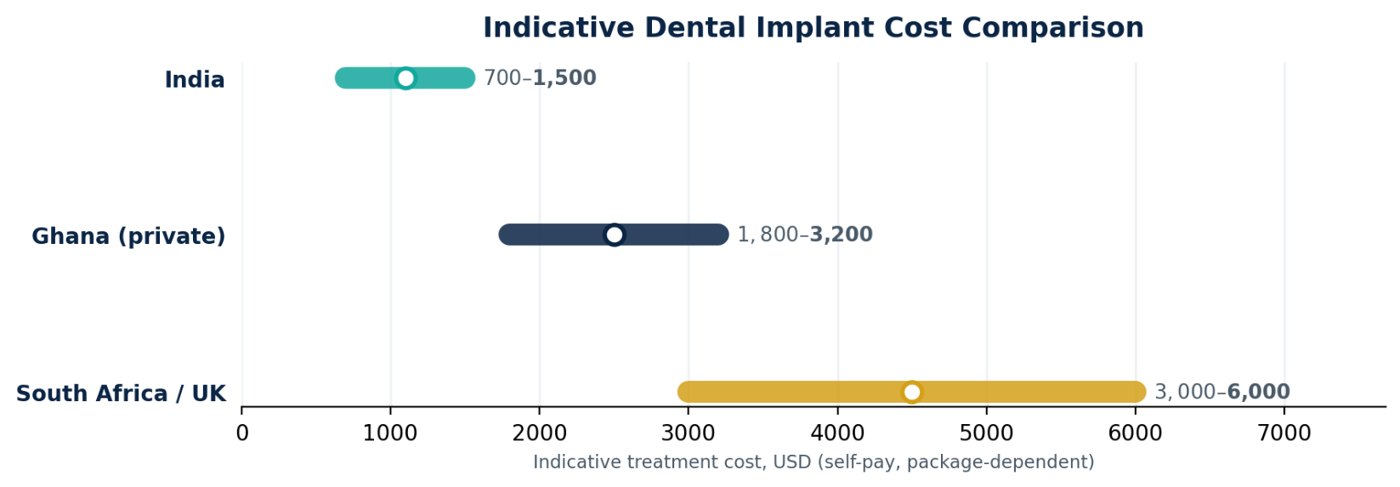
This depends entirely on the treatment plan. A single implant may only require an initial visit for placement and a later, shorter visit for the final crown once healing is complete, while full-mouth rehabilitation is typically staged across two or more visits separated by months of healing. A Ghana patient should ask for the complete staged plan and realistic total number of trips before starting treatment, not just the cost of the first visit.
15.Flying Back to Ghana After Dental Surgery
- Fit-to-fly timing, usually straightforward for most dental procedures
- Pain management plan for the journey
- Swelling and bruising expectations
- Dietary considerations for the flight
- Medication timing
- Avoiding smoking before and after surgery
- Written aftercare instructions to carry home
Patients who have had bone grafting, sinus lifts, or jaw surgery may need specific guidance about air travel timing and cabin pressure changes.
16.What Information Should You Take Back to Ghana?
- Detailed written treatment plan, including all planned future stages
- X-rays and CBCT scan images
- Implant system, brand and specifications used
- Crown/bridge material specifications
- Invoice and warranty documentation for implants where offered
- Medication list
- Oral hygiene and aftercare instructions
- Schedule for the next treatment stage if applicable
- Treating dentist/specialist’s contact details for follow-up questions
17.Follow-Up After Returning to Ghana
- Oral hygiene review with a local dentist
- Monitoring of the healing implant or surgical site
- Coordination with the Indian team for any next planned stage
- Addressing any minor adjustment needs locally where possible
- Long-term professional cleaning and implant maintenance
- Keeping the written treatment plan and implant documentation for future reference
18.How Successful Is This Surgery?
There is no meaningful single “success rate” for dental surgery and implants. Outcomes depend on bone quality, gum health, oral hygiene, smoking status, underlying medical conditions such as diabetes, and the complexity of the case. A single implant in a healthy, non-smoking patient with good bone cannot reasonably be compared with full-mouth rehabilitation in a patient requiring bone grafting. Patients should be cautious about clinics offering one universal success percentage or lifetime guarantee without qualification.
19.Questions to Ask from Ghana in India Before Agreeing to Surgery
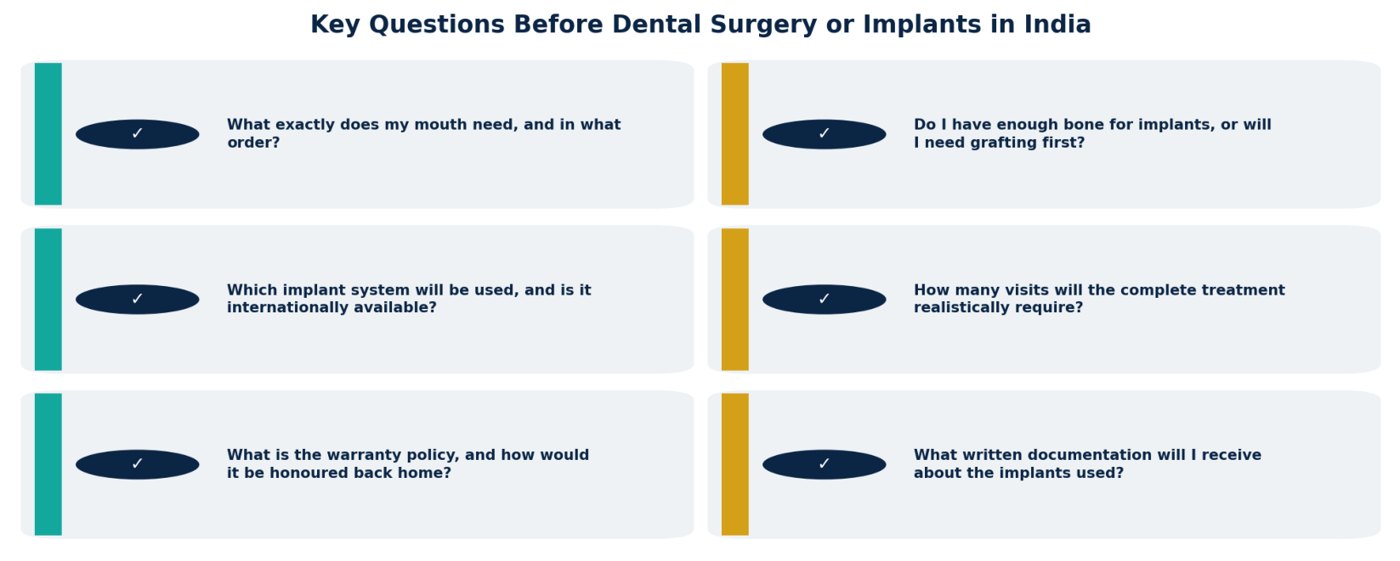
- What exactly does my mouth need, and in what order should it be done?
- Do I have enough bone for implants, or will I need grafting first?
- Which implant system and brand will be used, and is it internationally available?
- How many visits will the complete treatment realistically require?
- What happens if an implant fails or something needs adjustment after I go home?
- What is included in the quoted price, and what would cost extra?
- What are the major risks in my specific case?
- How many similar cases has this team treated?
- What is the warranty or guarantee policy, and how would it be honoured once I am back in Ghana?
- What written documentation will I receive about the implants and materials used?
Ghana Patients — Ready to Take the First Step?
Share your dental photos and X-ray reports from Ghana with our advisory team today and get a MEDICAL CONSULTATION, an indicative cost estimate in US$, and complete support — from your flight out of Accra to your dental treatment in India and follow-up back home.
Get Your Medical ConsultationFrequently Asked Questions: Ghana to India Dental Treatment
From Ghana, can my case be assessed remotely before I travel to India?
A preliminary opinion is often possible from photos and any existing X-rays, but a full treatment plan usually requires an in-person examination and a CBCT scan taken in India.
Do all missing teeth need implants?
No. Bridges or dentures remain reasonable options depending on the patient’s bone, budget, and preferences; a good treatment plan presents the alternatives.
From Ghana, can implants be placed in a single visit to India?
Placement itself is usually a single appointment, but the final crown is generally fitted only after a healing period of a few months, meaning most implant treatment requires at least two visits unless immediate-load treatment is suitable.
What if I need bone grafting?
This adds healing time before implants can be placed, and is usually explained clearly as part of the treatment plan and trip schedule.
How soon can I fly back to Ghana after treatment?
Most dental procedures do not require a long recovery before flying, though your dentist should confirm this based on your specific procedure.
What if something goes wrong after I return home?
Ask in advance how the clinic handles follow-up concerns from abroad, and keep all documentation and implant details so a local dentist can assist if needed.
From Ghana, what if I have had dental implants placed elsewhere before treatment in India?
Further treatment or replacement is often still possible. Bring previous records, X-rays, and details of the implant system used.
From Ghana, should I choose a clinic in India based on price alone?
No. Bone assessment, a clear staged treatment plan, an internationally recognised implant system, and the team’s specific implant experience matter more than the headline price.
Key Takeaway: Ghana to India Dental Surgery and Implants
Travelling from Ghana to India for dental surgery or implants can offer excellent value, but the treatment is rarely a single visit or a single procedure. The most important step is getting a complete, written, staged treatment plan based on a proper 3D scan, understanding how many trips it will realistically take, and confirming how follow-up concerns will be handled once you are back home. For a Ghana patient, choosing a team based on genuine implant experience and a well-established implant system matters more than the headline price of the first visit.
Citation Block: Ghana — Dental Surgery and Dental Implants in India
| Field | Details |
|---|---|
| Article / Topic | Ghana — Dental Surgery and Dental Implants in India: Complete Clinical & Surgical Guide |
| Primary Patient Group | From Ghana — people with missing or damaged teeth, gum disease or wanting a smile makeover, considering treatment in India |
| Typical Visit Length | 3–10 days depending on treatment complexity |
| Typical Cost Saving | 60–80% vs. South Africa / UK, package-dependent |
| Conditions Covered | Missing teeth, decayed or damaged teeth, gum disease, tooth loss, insufficient jaw bone, misaligned bite, cosmetic concerns, impacted wisdom teeth |
| Tests Before Treatment | Clinical examination, dental X-rays (OPG), CBCT scan, gum assessment, medical and bone health history |
| Treatment Types | Single implants, implant-supported bridges, All-on-Four/All-on-Six, bone grafting and sinus lift, root canal and crowns, corrective jaw surgery |
| Recovery Timeline | Single implant crown within a few months; full-mouth rehabilitation six months to a year across more than one visit |
| Documents to Take Home | Written staged treatment plan, X-rays and CBCT images, implant system details, warranty documentation, aftercare instructions |
| Key Decision Factor | From Ghana to India: a full 3D scan, a written staged plan, the realistic number of trips and an established implant system — before price |