

Scoliosis Correction Surgery in India for Omanis: A Doctor’s Guide to Making the Right Decision
A practical guide for Omani patients covering scoliosis surgery, Cobb angle assessment, spinal fusion, growing rods, treatment costs, recovery and long-term follow-up.
Scoliosis carries a particular weight for Omani families because it so often shows up in adolescence, at exactly the age when a child is most self-conscious about how their body looks and moves. A curve that seemed minor at thirteen can progress quickly during a growth spurt, and a family that was told to “just monitor it” can suddenly find themselves facing a genuine surgical decision within a matter of months. Over 24 years of advising Gulf families through this specific journey, I want to walk Omani parents and adult patients through what actually matters in choosing where this surgery happens. Oman's hospitals, including Apollo Hospital Muscat, Badr Al Samaa, Aster Al Raffah, and Burjeel Medical Centre, provide orthopaedic and spine consultation and can manage a range of spinal conditions. This guide exists to help Omani families understand, honestly and without sales pressure, when a scoliosis curve genuinely warrants surgery, what India's spine deformity centres add, and what to verify carefully before travelling.
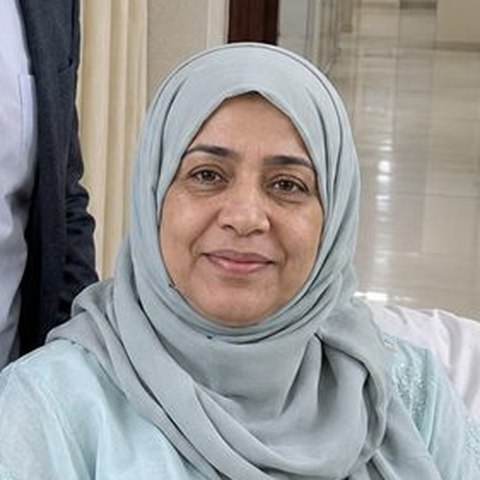
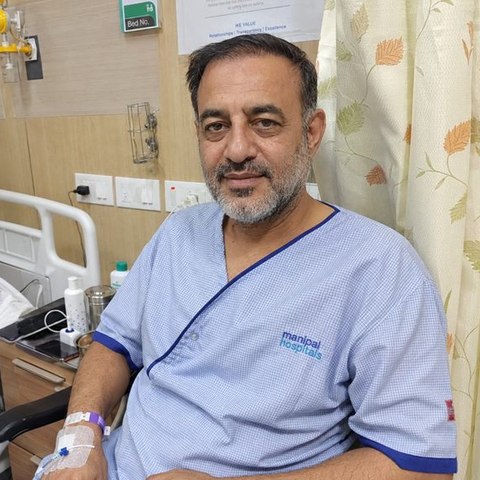
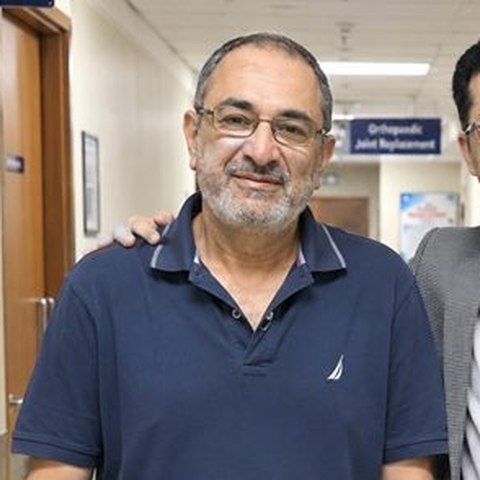
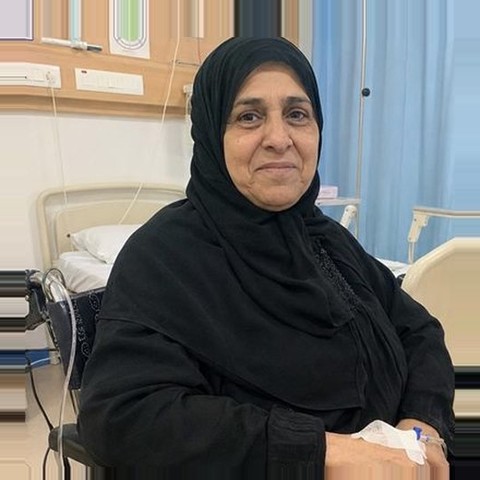
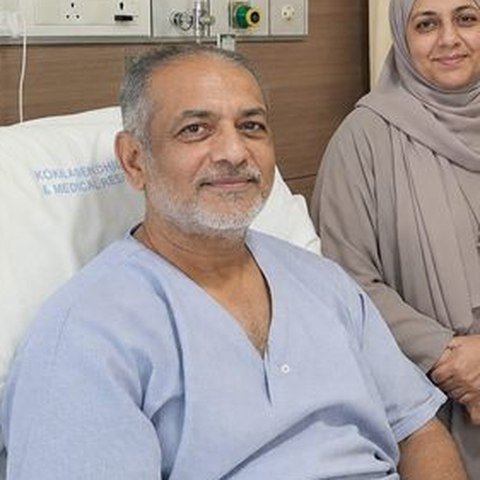
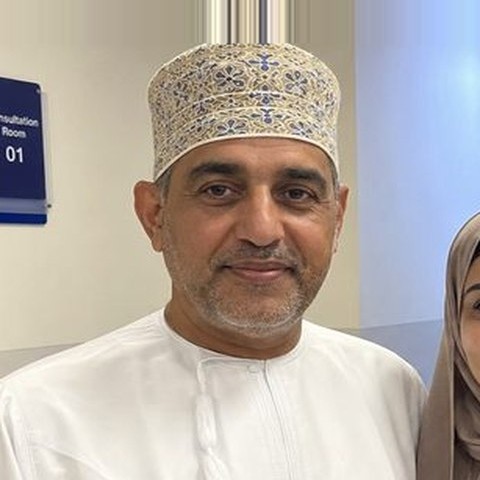
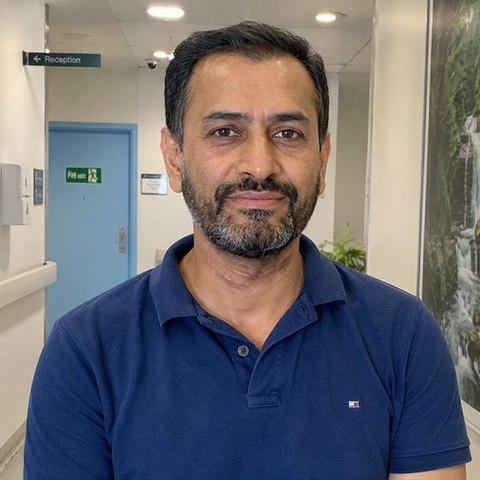
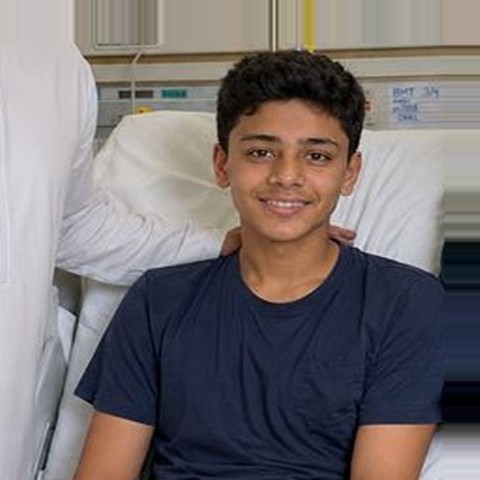
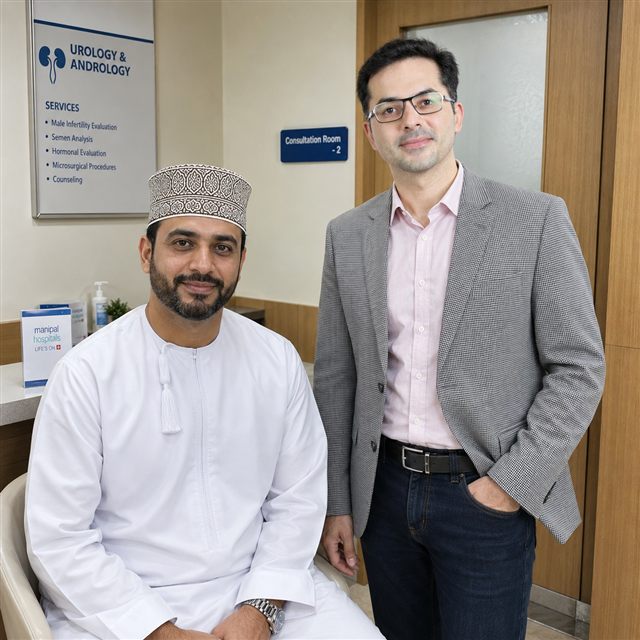
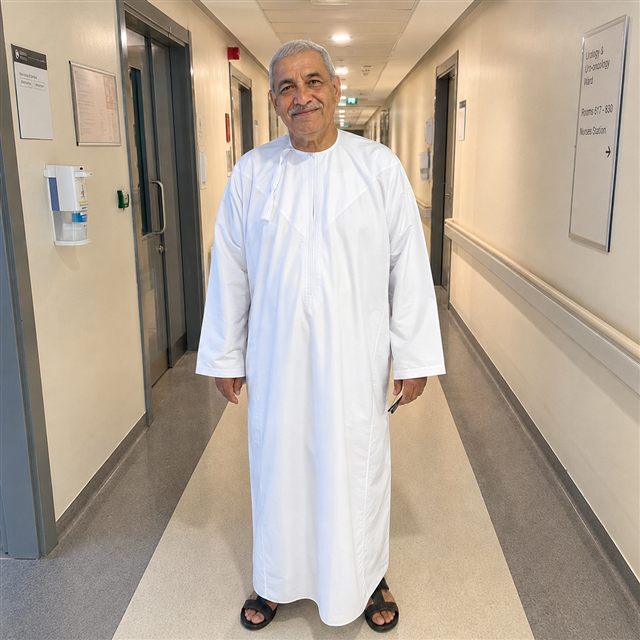
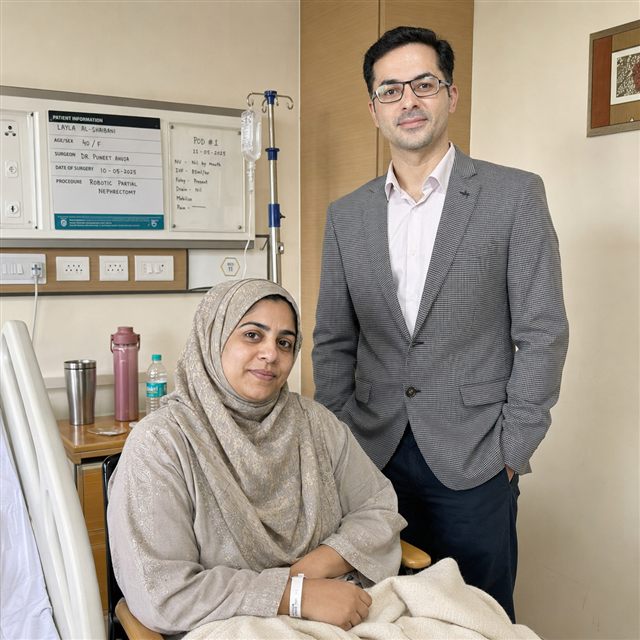
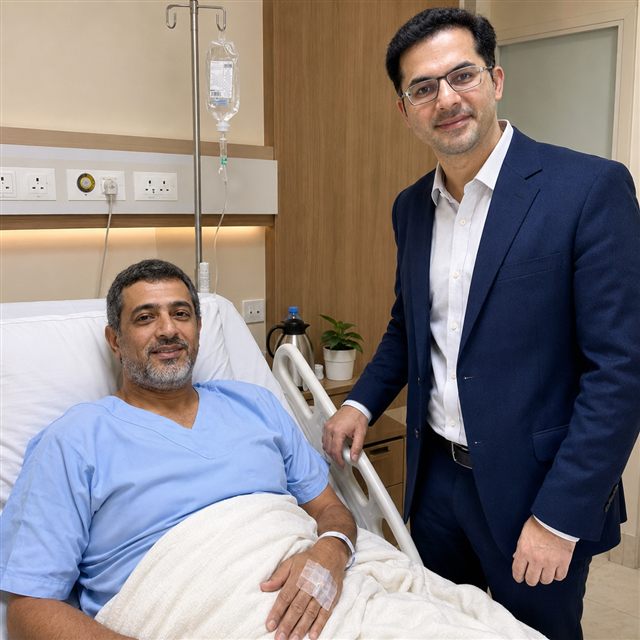
Healing Journeys of Omani Patients
Key Takeaways
- Not every scoliosis curve requires surgery. The guide explains that scoliosis is assessed using the Cobb angle, with surgery generally considered around 40–50 degrees, although the decision also depends on age, curve location and whether the curve is continuing to progress. Smaller curves may be managed through observation or bracing.
- Scoliosis correction is a major procedure involving instrumented spinal fusion with rods and screws. The objective is not necessarily to create a perfectly straight spine, but to achieve a safe, balanced and stable correction that stops further progression and improves quality of life.
- India's spine deformity centres in Delhi, Mumbai, Chennai and Bengaluru provide experience with adolescent idiopathic scoliosis and adult degenerative scoliosis. The guide highlights the importance of choosing a team experienced with curves of similar severity and pattern rather than relying only on general spine-surgery experience.
- The guide also highlights intraoperative neuromonitoring, which continuously monitors spinal cord function during correction. Modern spinal instrumentation can be selected according to the patient's age and the characteristics of the curve.
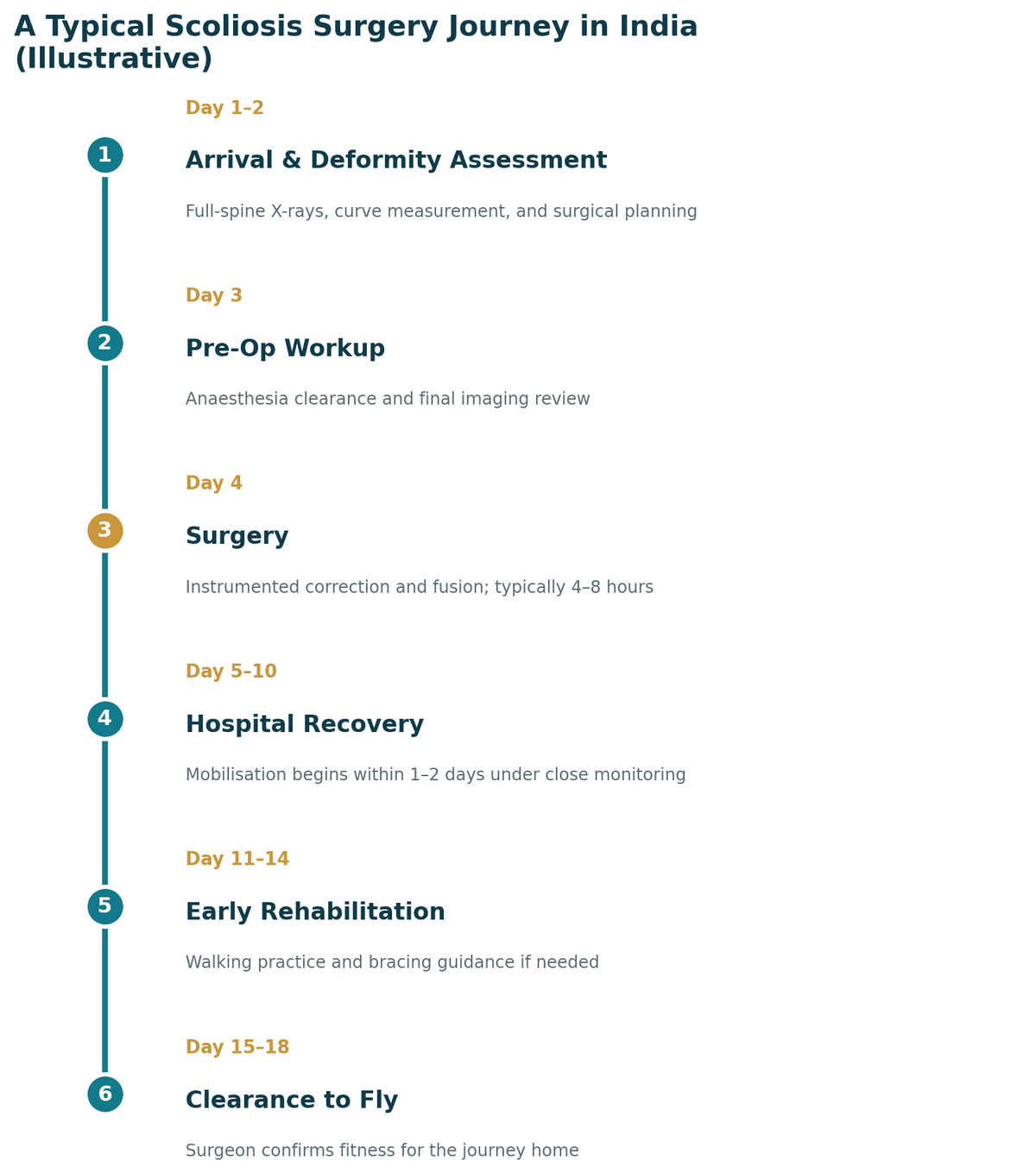
- The page 2 treatment journey diagram illustrates an example pathway beginning with full-spine X-rays and deformity assessment on days 1–2, pre-operative work-up on day 3, instrumented correction and fusion on day 4, hospital recovery during days 5–10, early rehabilitation on days 11–14 and clearance to fly around days 15–18.
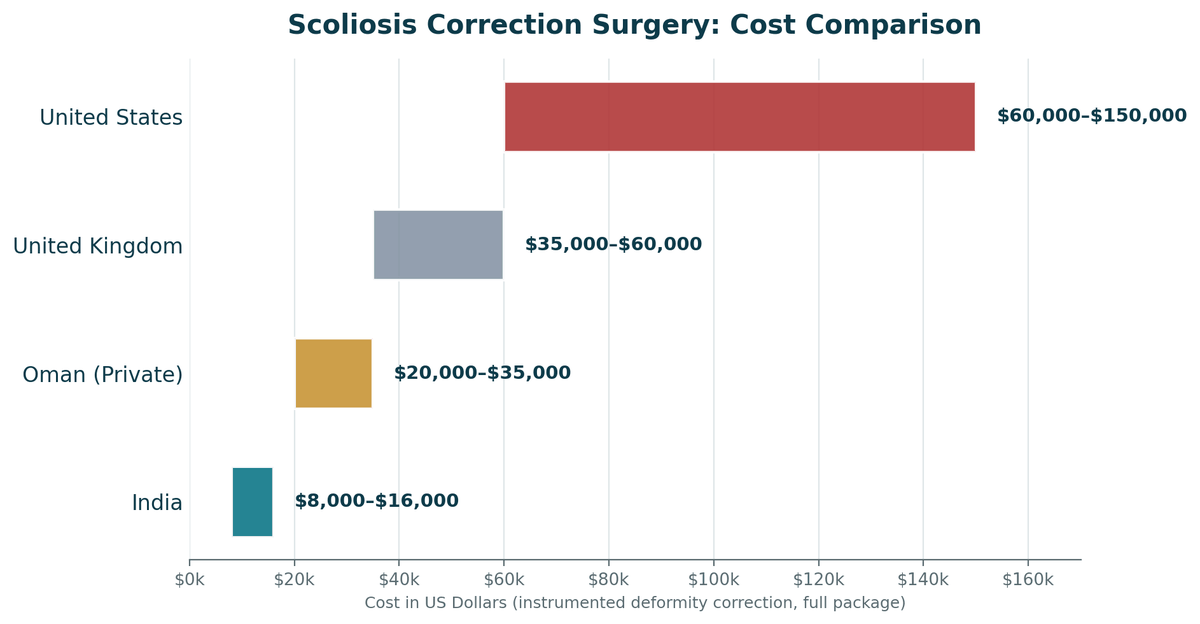
- The page 3 cost chart and comparison table gives a representative instrumented deformity correction cost of US$8,000–16,000 in India, compared with US$20,000–35,000 in private Oman, US$35,000–60,000 in private UK care and US$60,000–150,000+ in the United States.
- The guide identifies the number of vertebral levels fused as the single biggest cost driver. A four-level correction and a ten-level correction involve substantially different amounts of instrumentation and recovery, so Omani families should obtain a levels-specific quotation after imaging has been reviewed.
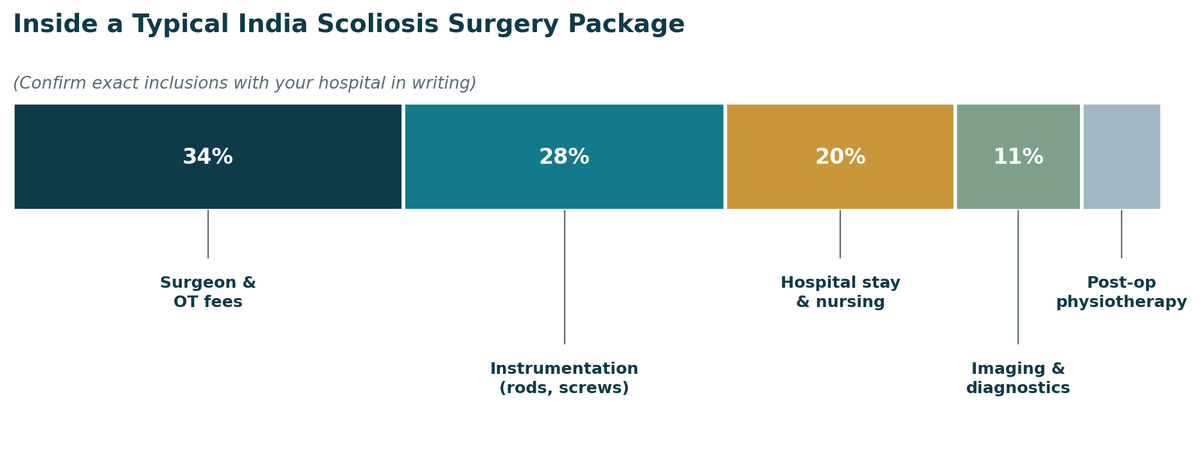
- The page 4 package graphic presents an illustrative India scoliosis surgery package: surgeon and OT fees account for 34%, instrumentation such as rods and screws 28%, hospital stay and nursing 20%, imaging and diagnostics 11%, and post-operative physiotherapy 7%.
- Children who are still growing may require a different treatment strategy from adults. The guide specifically recommends asking about growing-rod systems, which can involve repeated lengthening procedures rather than one definitive spinal fusion and therefore change both the treatment timeline and long-term cost.
- Long-term follow-up remains important after scoliosis surgery. The guide notes that periodic X-rays may be required for years to confirm that the correction remains stable, making coordination between the Indian surgical team and a spine specialist in Oman an important part of planning.
- Omani families should obtain an independent spine-deformity opinion before travelling. Full-spine X-rays should be reviewed to establish the precise Cobb angle, curve pattern and whether surgery is genuinely warranted at that stage.
- The guide recommends receiving an itemised treatment quotation covering surgeon fees, instrumentation, imaging and physiotherapy. Insurance and Ministry of Health arrangements should also be clarified before travelling because reimbursement for overseas treatment varies by plan.
Quick Facts
- Treatment
- Scoliosis correction surgery
- Primary Patients
- Omani children, adolescents and adults with significant spinal curvature
- Key Measurement
- Cobb angle
- Surgical Threshold
- Generally around 40–50 degrees, depending on individual factors
- Main Surgery
- Instrumented spinal fusion using rods and screws
- Main Conditions
- Adolescent idiopathic scoliosis and adult degenerative scoliosis
- Alternative for Growing Children
- Growing-rod systems in selected cases
- Key Technology
- Intraoperative neuromonitoring
- Key Specialist
- Spine Deformity / Scoliosis Surgeon
- Main India Cities
- Delhi, Mumbai, Chennai and Bengaluru
- India Cost
- US$8,000–16,000
- Oman Private Cost
- US$20,000–35,000
- UK Private Cost
- US$35,000–60,000
- US Cost
- US$60,000–150,000+
- Assessment
- Days 1–2
- Pre-Op Work-Up
- Day 3
- Surgery
- Day 4
- Hospital Recovery
- Days 5–10
- Early Rehabilitation
- Days 11–14
- Clearance to Fly
- Days 15–18
- Surgery Duration
- Typically 4–8 hours
- Mobilisation
- Usually begins within 1–2 days under close monitoring
- Package Breakdown
- Surgeon/OT 34%, instrumentation 28%, hospital/nursing 20%, imaging/diagnostics 11%, post-op physiotherapy 7%
- Main Cost Driver
- Number of vertebral levels fused
- Cobb Angle Check
- Obtain precise full-spine measurement before travel
- Growing-Child Check
- Ask whether growing rods are appropriate
- Surgeon Check
- Confirm experience with similar curve severity and pattern
- Neuromonitoring
- Confirm availability during surgery
- Insurance
- Check Omani insurance or employer reimbursement
- Ministry of Health
- Clarify overseas-treatment requirements
- Follow-Up
- Plan periodic X-rays and spine monitoring in Oman
- Author
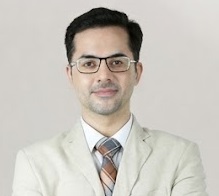
- Dr. Dheeraj Bojwani
- Experience
- 24+ Years
In Brief
Scoliosis correction surgery in India can be considered by Omani patients when a spinal curve is sufficiently severe or progressive to warrant surgical treatment. The guide focuses on Cobb angle assessment, instrumented spinal fusion, intraoperative neuromonitoring and specialised deformity-centre experience. A representative instrumented correction costs US$8,000–16,000 in India compared with US$20,000–35,000 in private Oman. For children who are still growing, growing-rod systems may provide an alternative to definitive fusion but can require repeated procedures. Long-term X-ray monitoring and follow-up in Oman remain important after treatment.
Understanding When Scoliosis Actually Needs Surgery
Not every curved spine needs an operation. Scoliosis is measured by its Cobb angle, and the threshold for considering surgery generally sits around 40 to 50 degrees, though this varies by the patient's age, curve location, and whether the curve is still progressing. Smaller curves are typically managed with observation or bracing, particularly in children who are still growing. Surgery becomes the recommended path when a curve is severe enough, or progressing quickly enough, to risk affecting lung function, causing significant pain, or continuing to worsen into adulthood.
The surgery itself — instrumented spinal fusion using rods and screws to straighten and stabilise the spine — is a genuinely major operation, not a quick fix. The goal is not always a perfectly straight spine, but a safe, balanced, and stable correction that halts progression and improves quality of life. Understanding this distinction helps set realistic expectations before you ever choose a surgeon.
What Makes India a Strong Option for Scoliosis Surgery
India's leading spine deformity centres, concentrated in Delhi, Mumbai, Chennai, and Bengaluru, treat a high volume of both adolescent idiopathic scoliosis and adult degenerative scoliosis cases each year, giving surgical teams extensive experience with the specific technical challenges of multi-level deformity correction — challenges that differ meaningfully from routine single-level spine surgery. This case volume matters because scoliosis surgery outcomes are closely tied to how often a team has managed curves of similar severity and pattern.
India also gives patients access to intraoperative neuromonitoring, which tracks spinal cord function continuously during surgery to reduce the risk of neurological injury during correction, and to a range of modern instrumentation systems suited to different curve types and patient ages. And because Indian hospitals have spent two decades building international spine care pathways for Gulf and African families, Omani patients arrive to a system with Arabic-speaking coordinators and a well-tested process for reviewing imaging before travel is even booked.
This does not mean every curve needs to travel for surgery. It means that for moderate to severe curves, and particularly for cases involving young, still-growing patients who may need specialised growing-rod techniques, a centre with deep specific experience in spinal deformity makes a genuine difference.
Cost Comparison: India vs. Oman vs. Western Countries
Scoliosis surgery is priced very differently from a routine single-level spine procedure, because it typically involves fusing many more vertebrae and substantially more instrumentation. Figures below are for a representative instrumented deformity correction, in approximate US dollars, for a full package at an accredited private hospital.
| Destination | Typical Cost (Instrumented Deformity Correction) | What This Usually Includes |
|---|---|---|
| India | US $8,000 – $16,000 | Surgeon and OT fees, instrumentation, hospital stay, and standard nursing and physiotherapy during admission |
| Oman (private) | US $20,000 – $35,000 | Surgeon fees, instrumentation, hospital stay; varies significantly by hospital tier and curve complexity |
| United Kingdom (private) | US $35,000 – $60,000 | Surgery and hospital stay; extended follow-up often billed separately |
| United States | US $60,000 – $150,000+ | Highly variable by state, hospital, and number of levels fused; national averages run considerably higher still |
A few honest caveats specific to scoliosis. First, the number of vertebral levels being fused is the single biggest driver of cost in every country — a four-level correction and a ten-level correction are simply different procedures, so insist on a levels-specific quote once your imaging has been reviewed. Second, young patients who are still growing may be candidates for growing-rod systems rather than a single definitive fusion, which changes both the surgical plan and the long-term cost picture, since these systems typically require repeat lengthening procedures. Third, scoliosis surgery requires periodic X-ray follow-up for years afterward to confirm the correction is holding, so ask specifically how this ongoing monitoring will work once you are back in Oman.
What a Typical Omani Family Should Weigh Before Deciding Scoliosis Surgery in India
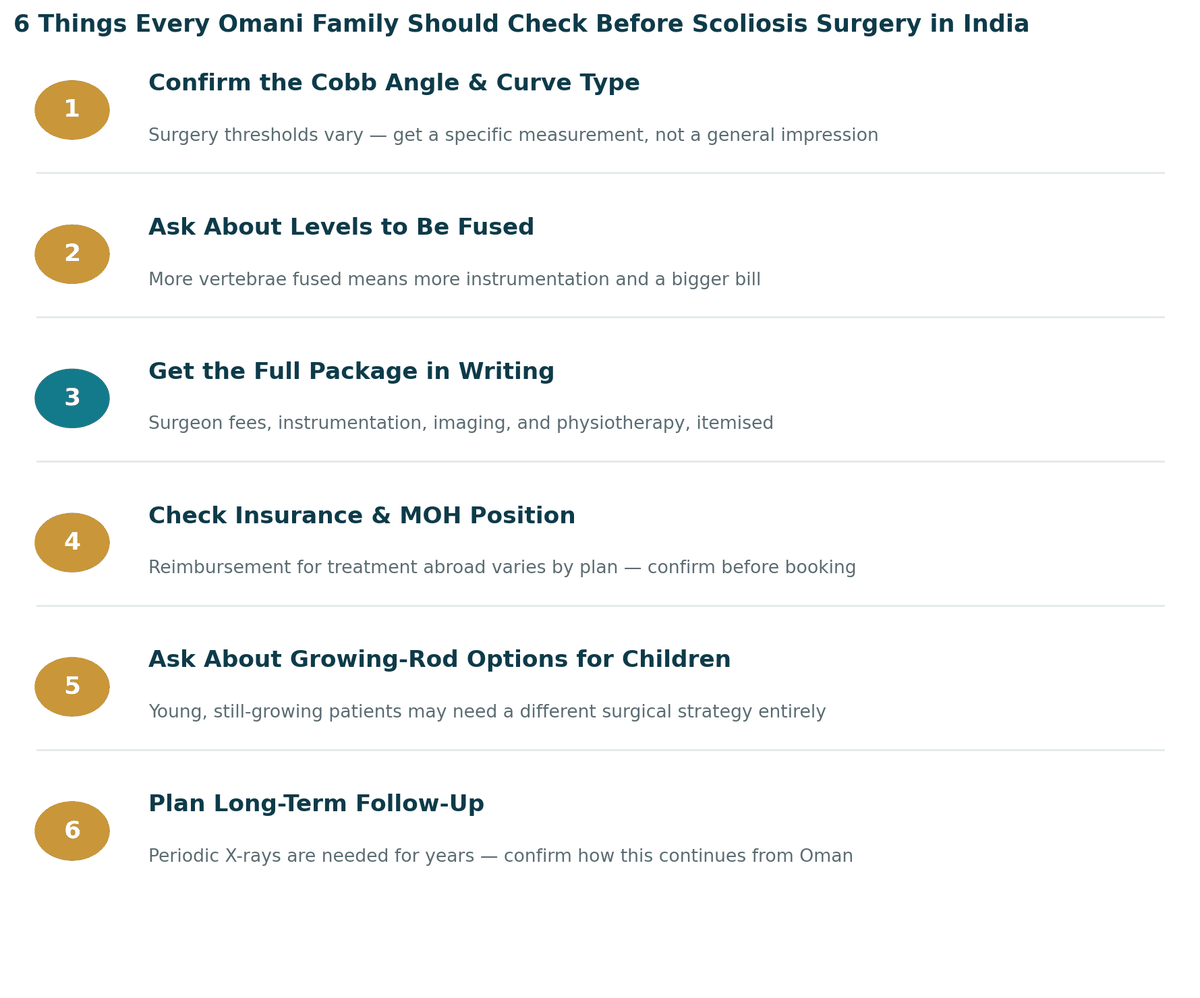
Having guided families through this exact decision for 24 years, here is what I encourage every Omani family to work through before committing to a hospital:
- Get a precise Cobb angle measurement, not a general impression. Send your (or your child's) full-spine X-rays to an independent spine deformity specialist in India before booking travel. Surgical thresholds are specific, and a responsible team will tell you plainly whether surgery is genuinely warranted now or whether continued monitoring is reasonable.
- Ask exactly how many vertebral levels will be fused. This single number drives most of the cost and recovery time difference between cases, and should be central to any quote you receive.
- Get the full package itemised in writing. Surgeon fees, instrumentation, imaging, and physiotherapy should each be clear, along with what happens if the surgical plan changes once the surgeon is operating.
- Check your insurance and Ministry of Health position. Some Omani insurance plans and employer health schemes offer partial reimbursement for treatment abroad; others do not cover it at all. Clarify this before you travel, not after.
- Ask specifically about growing-rod options if your child is still growing. A still-growing child may need a fundamentally different surgical strategy than an adult with a comparable curve. Make sure this has been explicitly addressed.
- Plan for years of follow-up imaging, not just the surgery itself. Ask how periodic X-rays will be reviewed once you are home, and whether your Indian surgical team is willing to coordinate with a doctor in Oman for long-term monitoring.
A Closing Thought
Scoliosis surgery asks a lot of a young patient and a great deal of the family supporting them — a long operation, a real recovery, and years of watchful follow-up afterward. The families who navigate this best are usually the ones who understood, early, exactly what curve they were dealing with and exactly what the surgery could realistically achieve. That clarity matters more than which city the operating room happens to be in. Sharing your imaging with a spine deformity specialist for an honest opinion, before any decision is finalised, tends to be time well spent.
Sources & Further Reading
- American Academy of Orthopaedic Surgeons (AAOS) — OrthoInfo: Scoliosis in Children and Adolescents (orthoinfo.aaos.org)
- MedlinePlus, U.S. National Library of Medicine (NIH) — Scoliosis (medlineplus.gov)
- National Institute of Arthritis and Musculoskeletal and Skin Diseases (NIAMS), NIH — Scoliosis in Children and Teens (niams.nih.gov)
- American Association of Neurological Surgeons (AANS) — Scoliosis, Patient Information (aans.org)
- NHS (UK National Health Service) — Scoliosis (nhs.uk)
Frequently Asked Questions by Omani Patients about Scoliosis Correction Surgery in India
Can Omani patients undergo scoliosis correction surgery in India?
Yes. The guide presents India as an option for Omani children, adolescents and adults who require specialised spinal deformity assessment or surgery, particularly for moderate to severe curves.
When might an Omani patient need scoliosis surgery?
The guide states that surgery is generally considered around a Cobb angle of 40–50 degrees, although age, curve location and progression also influence the decision. Smaller curves may often be observed or braced.
What is the main scoliosis surgery performed for Omani patients in India?
The guide describes instrumented spinal fusion using rods and screws to correct and stabilise the spine. The aim is a safe, balanced and stable correction rather than necessarily achieving a perfectly straight spine.
How much does scoliosis surgery cost in India for Omani patients?
A representative instrumented deformity correction costs US$8,000–16,000 in India. The final price depends heavily on the number of vertebral levels being fused and the complexity of the curve.
How does scoliosis surgery cost in India compare with private Oman?
The representative India range is US$8,000–16,000 compared with US$20,000–35,000 in private Oman. Omani families should compare levels-specific, itemised packages rather than general estimates.
How long does an Omani patient need to stay in India after scoliosis surgery?
The illustrated pathway runs from assessment on days 1–2 to clearance to fly around days 15–18. Recovery can vary according to the patient's age, curve complexity and number of levels fused.
What should Omani parents ask if their child is still growing?
They should specifically ask whether a growing-rod system is appropriate. A growing child may require a different surgical strategy from an adult and may need repeated lengthening procedures.
Why is the number of vertebral levels important for an Omani scoliosis patient?
The guide identifies the number of levels fused as the biggest cost driver and an important factor in recovery. A four-level correction and a ten-level correction can involve substantially different surgery and instrumentation.
Will an Omani patient need follow-up after returning from India?
Yes. The guide recommends periodic X-rays for years to confirm that the correction remains stable. Families should arrange long-term monitoring with a spine specialist in Oman and discuss coordination with the Indian surgical team.
What should an Omani family check before choosing scoliosis surgery in India?
Confirm the precise Cobb angle and curve type, the number of levels to be fused, the surgeon's deformity-specific experience, availability of neuromonitoring, growing-rod options for children, the complete written package, insurance and Ministry of Health requirements, and long-term follow-up arrangements in Oman.
Page Summary
This six-page guide explains scoliosis correction surgery in India for Omani patients, focusing on Cobb angle assessment, instrumented spinal fusion, specialised deformity surgery, costs, recovery and long-term monitoring. The page 2 journey diagram illustrates assessment, pre-operative work-up, surgery, hospital recovery, rehabilitation and clearance to fly over approximately 15–18 days. The page 3 cost chart compares India at US$8,000–16,000 with private Oman at US$20,000–35,000, while page 4 shows the main components of an illustrative scoliosis surgery package. Pages 5–6 emphasise precise curve measurement, levels to be fused, growing-rod options, insurance and Ministry of Health checks and years of follow-up imaging in Oman.
Citation Block
| Field | Details |
|---|---|
| Article / Topic | Scoliosis Correction Surgery in India |
| Country / Patients | India / Omani Patients |
| Key Measurement | Cobb angle |
| General Surgical Range | Around 40–50 degrees, depending on individual factors |
| Main Surgery | Instrumented spinal fusion |
| Main Conditions | Adolescent idiopathic and adult degenerative scoliosis |
| Growing Children | Growing-rod systems may be considered |
| Key Technology | Intraoperative neuromonitoring |
| Key Specialist | Spine Deformity / Scoliosis Surgeon |
| Main India Cities | Delhi, Mumbai, Chennai and Bengaluru |
| India Cost | US$8,000–16,000 |
| Oman Private Cost | US$20,000–35,000 |
| UK Private Cost | US$35,000–60,000 |
| US Cost | US$60,000–150,000+ |
| Assessment | Days 1–2 |
| Surgery | Day 4 |
| Hospital Recovery | Days 5–10 |
| Early Rehabilitation | Days 11–14 |
| Clearance to Fly | Days 15–18 |
| Surgery Duration | Typically 4–8 hours |
| Package Breakdown | Surgeon/OT 34%, instrumentation 28%, hospital/nursing 20%, imaging/diagnostics 11%, post-op physiotherapy 7% |
| Main Cost Driver | Number of vertebral levels fused |
| Cobb Angle Check | Obtain precise measurement from full-spine X-rays |
| Growing-Rod Check | Assess separately for still-growing children |
| Surgeon Volume | Confirm experience with comparable curve severity and pattern |
| Neuromonitoring Check | Confirm spinal cord monitoring during correction |
| Insurance / MOH | Clarify overseas-treatment reimbursement before travel |
| Long-Term Follow-Up | Periodic X-rays and monitoring for years |
| Key Selection Criterion | Specific spinal-deformity experience |
| Important Warning | Do not decide on surgery from a general impression of the curve; obtain a precise Cobb angle and specialist deformity assessment first |

Our Mission Statement
Our mission is to place patients at the centre of every healthcare decision by providing trustworthy, evidence-based, and unbiased medical information. We believe that informed patients make better decisions. Backed by personalised guidance from our experienced advisory team, we help patients understand their treatment options, compare them objectively, and confidently choose the path that best suits their medical needs and personal circumstances.
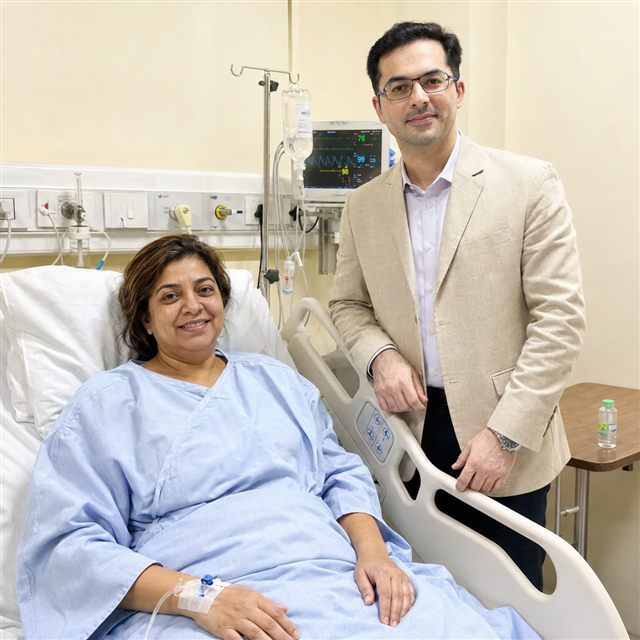
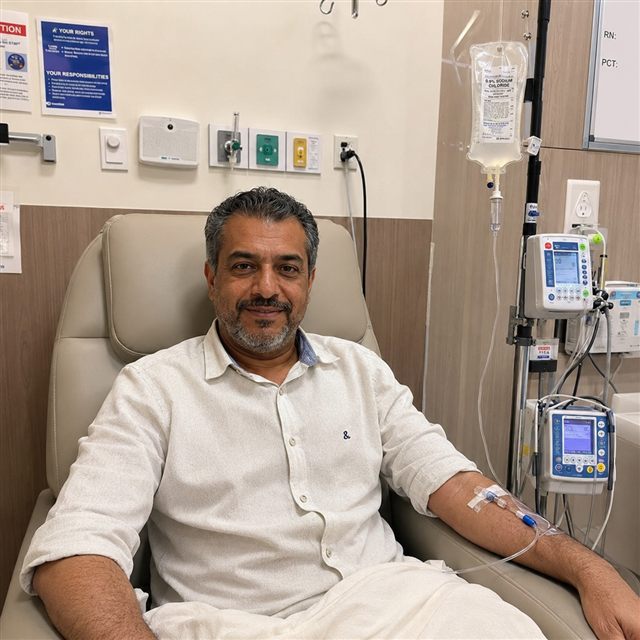
Patient Testimonials from Oman
Ready to Take the First Step?
Share your Medical Reports with our Healthcare Managers Today and Get a FREE CONSULTATION, a Personalized Treatment Plan, and Complete Support from Arrival to Recovery.
Get Your Free ConsultationAreas We Serve
Indian Health Guru Consultants proudly assists patients from Oman and surrounding Middle Eastern countries in accessing advanced, affordable and trusted medical treatment in India. Our team provides complete support for medical opinions, hospital selection, treatment planning, visa assistance, travel coordination, accommodation and post-treatment follow-up.
We regularly serve patients from:
- Oman
- Turkey
- Iran
- Kuwait
- Jordan
- Syria
- Qatar
- Bahrain
- Yemen
- Iraq
- Saudi Arabia
- United Arab Emirates
No matter where you are located, our experienced team is committed to making your medical journey to India safe, smooth, transparent and stress-free from the first enquiry to your return home.
From Oman to India: Your Complete Patient Guide
- Weight Loss and Bariatric Surgery in India for Omanis: Cost & Guide
- Brain Tumor Surgery in India for Omanis: Cost & Guide
- Cancer Treatment in India for Omanis: Cost & Guide
- Cardiac Surgery in India for Omanis: Cost & Guide
- Breast Cancer Treatment in India for Omanis: Cost & Guide
- Neurosurgery in India for Omanis: Cost & Guide
- Spine Surgery in India for Omanis: Cost & Guide
- Bone Marrow Transplant in India for Omanis: Cost & Guide
- Kidney Transplant in India for Omanis: Cost & Guide
- Best Dentists and Clinics for Dental Surgery in India for Omani Patients
- Best Doctors and Hospitals for Blood Cancer Treatment in India for Omani Patients
- Best Bone Marrow Transplant Doctors and Hospitals in India for Omani Patients
- Best IVF and Fertility Doctors and Hospitals in India for Omani Couples
- Best Bariatric Surgeons and Hospitals for Weight Loss Surgery in India for Omani Patients
- Best Brain Tumor Surgery Doctors and Hospitals in India for Omani Patients
- Best Cardiac Surgeons and Hospitals in India for Omani Patients
- Best Colorectal Cancer Surgeons and Hospitals in India for Omani Patients
- Best Surgeons and Hospitals for Complex Joint Revision Surgery in India for Omani Patients