

Selecting the Best Surgeons and Hospitals for Neuronavigation and Advanced Brain Surgery in India: A Guide for Omani Patients
A practical guide for Omani patients evaluating advanced brain surgery teams and hospitals in India based on neuronavigation technology, intraoperative imaging, functional mapping, specialist experience and follow-up.
Once an Omani patient has decided that advanced, image-guided brain surgery in India is the right path, a second, equally important decision remains: which surgeon, and which hospital. This is one of the areas in this entire series where the specific technology available, not just the surgeon’s general skill, genuinely changes what is possible during surgery. Over 24 years of advising Gulf families through exactly this decision, I want to walk through what matters most. Oman’s hospitals, including Apollo Hospital Muscat, Badr Al Samaa, Aster Al Raffah, and Burjeel Medical Centre, provide neurology consultation and can help confirm diagnosis and initial imaging before you ever begin comparing options abroad. This guide focuses specifically on how to evaluate the surgeon and hospital once advanced, technology-assisted surgery has been recommended.
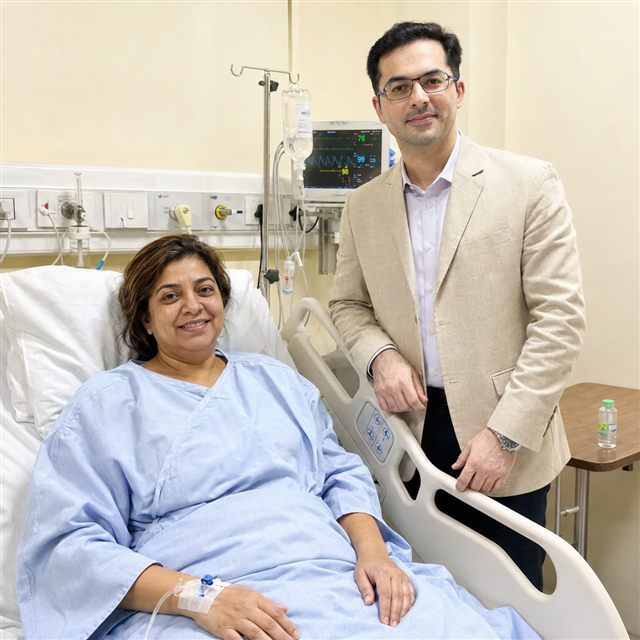
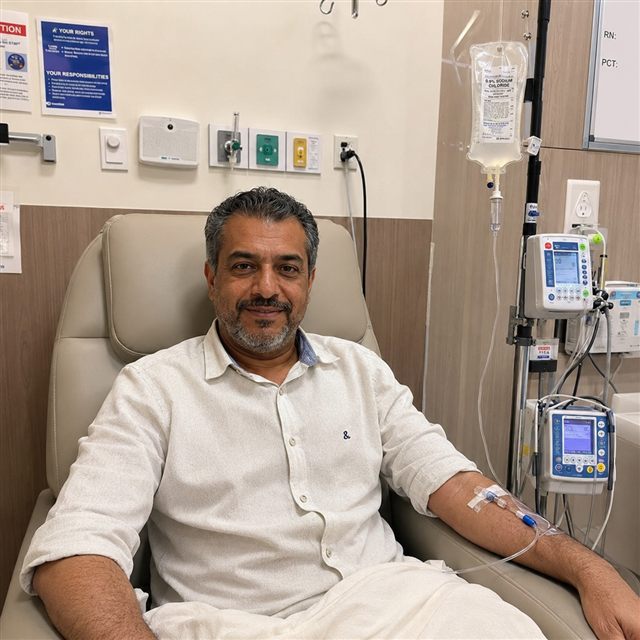
Healing Journeys of Omani Patients


Key Takeaways
- The guide explains that neuronavigation uses pre-operative imaging to guide the surgeon during brain surgery, but standard neuronavigation has an important limitation called brain shift. Once surgery begins, movement of brain tissue can make earlier images less accurate. The source therefore recommends asking whether the specific procedure will use intraoperative MRI or CT, which allows the surgical team to re-image the brain during surgery and assess remaining tumour in real time.
- The guide recommends asking about the surgeon’s personal experience with the specific technology, rather than simply accepting a hospital’s claim that it offers neuronavigation. For tumours located near areas controlling speech, movement or other critical functions, patients should also ask whether functional mapping or awake surgery techniques are available and appropriate.
- Hospital technology and infrastructure are presented as particularly important. Genuine intraoperative MRI capability requires a purpose-built hybrid operating theatre integrated with high-field MRI, specialised anaesthesia protocols and surgical and radiology teams experienced in working together. The guide distinguishes this from a hospital that simply has an MRI machine somewhere in the building.
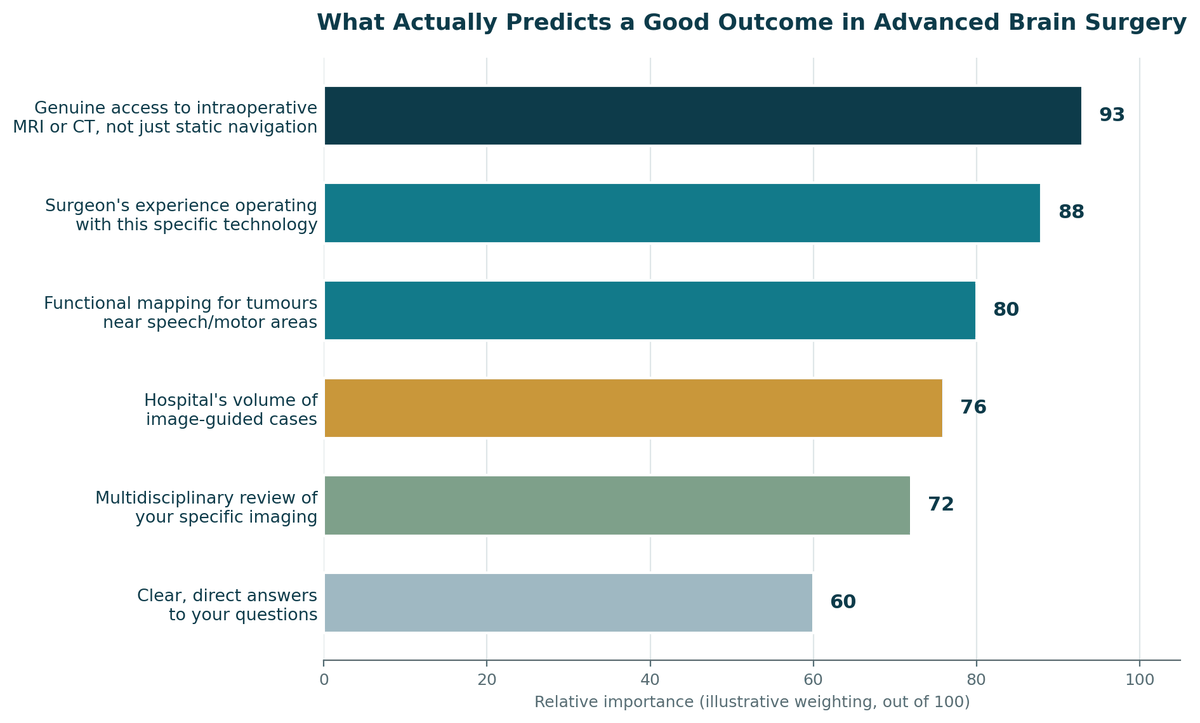
- The page 2 outcome chart gives illustrative importance scores of 93/100 for genuine access to intraoperative MRI or CT, 88/100 for the surgeon’s experience operating with the specific technology, and 80/100 for functional mapping when tumours are near speech, motor or other critical areas. Hospital volume of image-guided cases scores 76/100, multidisciplinary review of the patient’s imaging 72/100, and clear answers to patient questions 60/100.
- The page 3 verification checklist identifies positive indicators including independently verified neurosurgical certification, genuine access to intraoperative MRI or CT, functional or awake mapping where appropriate, repeated surgeon experience with the technology, routine rather than occasional image-guided surgery, a clear explanation of brain-shift management and genuine pre-travel imaging review. Warning signs include using the term "neuronavigation" without explaining the actual equipment and being vague about the technology’s capabilities.
- Independent verification is strongly recommended. Omani families should independently verify the surgeon’s registration and hospital accreditation rather than relying only on hospital marketing or facilitator recommendations. The guide also advises asking exactly what equipment the hospital means when it describes its service as "neuronavigation," because the term may be used loosely.
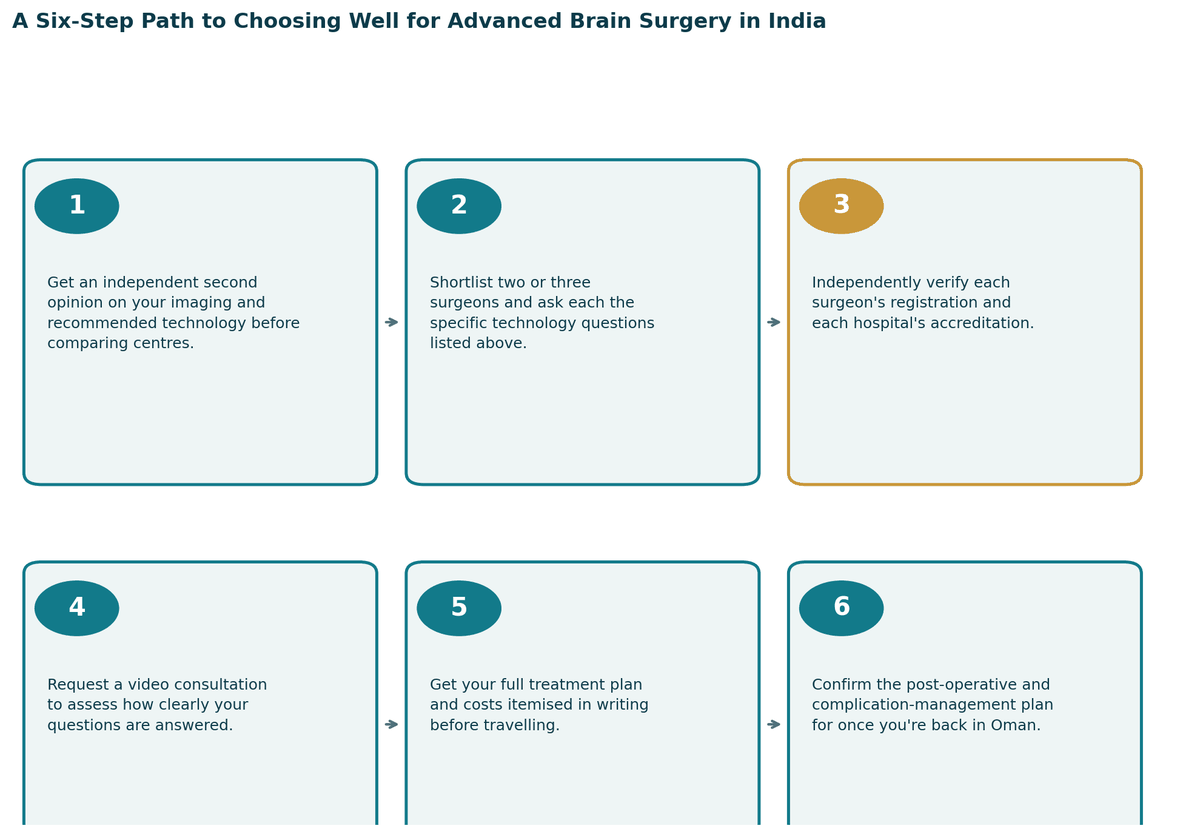
- The guide further recommends confirming who will actually perform the surgery, whether pre-travel imaging review and video consultation are available, and how post-operative complications will be managed after returning to Oman. The six-step pathway on page 4 recommends obtaining a second opinion, shortlisting surgeons, independently verifying credentials and accreditation, arranging video consultation, obtaining written treatment plans and costs, and confirming post-operative and complication-management arrangements in Oman.
Quick Facts
- Author
- Dr. Dheeraj Bojwani
- Experience
- 24+ Years
- Treatment
- Neuronavigation and advanced brain surgery
- Patients
- Omani Patients
- Key Specialist
- Neurosurgeon
- Technology
- Neuronavigation with intraoperative MRI or CT where appropriate
- Key Selection Factor
- Genuine access to advanced intraoperative imaging
- Surgeon Experience
- Specific experience using the technology
- Critical-Area Assessment
- Functional or awake mapping where appropriate
- Brain-Shift Management
- Intraoperative imaging and procedure-specific planning
- Hospital Requirement
- Established image-guided brain surgery capability
- Infrastructure
- Purpose-built hybrid operating theatre where intraoperative MRI is offered
- Accreditation
- NABH; JCI where available
- Pre-Travel Assessment
- Imaging review and video consultation
- Verification
- Independent surgeon registration and hospital accreditation
- Treatment Planning
- Written treatment plan with itemised costs
- Follow-Up
- Post-operative and complication-management plan in Oman
- Key Warning
- Neuronavigation claimed without specifying the actual equipment
- Key Warning
- Vague information about technology capabilities
- Decision Principle
- Prioritise verified technology, specific expertise and coordinated brain surgery care.
In Brief
For Omani patients considering advanced brain surgery in India, the guide recommends prioritising genuine intraoperative MRI or CT capability, specific surgeon experience with the technology, functional mapping where appropriate, a hospital experienced in image-guided brain surgery, independent credential verification and a clear post-operative care plan rather than choosing a centre based simply on the word "neuronavigation."
Part One: What to Look for in a Neuronavigation Surgeon in India
Neuronavigation uses pre-operative imaging to guide a surgeon in real time during surgery, much like GPS guides a driver. But standard neuronavigation has a genuine limitation worth understanding: once the skull is opened and surgery begins, the brain itself can shift, sometimes by several centimetres, as fluid is lost and tissue is removed — a phenomenon called brain shift, which can make earlier, pre-operative images inaccurate mid-surgery. Intraoperative MRI or CT addresses this directly by re-imaging the brain during the operation itself, letting the surgeon confirm, in real time, how much of a tumour actually remains. Ask directly whether your specific procedure will use intraoperative imaging, not just standard pre-operative neuronavigation, and how many procedures the surgeon has personally performed using this specific technology. For tumours near areas controlling speech, movement, or other critical functions, ask whether functional mapping or awake surgery techniques are available, since these help the surgical team distinguish tumour from healthy, essential brain tissue during the operation itself.
What to Ask a Prospective Surgeon
- Will intraoperative MRI or CT be used during my specific surgery, or only pre-operative neuronavigation?
- How many procedures have you personally performed using this specific technology?
- Is my tumour near an area controlling speech, movement, or other critical function, and if so, what mapping technique will be used?
- How is brain shift managed during my specific procedure?
- Who manages my care if a complication arises after I’ve returned to Oman?
Part Two: What to Look for in a Neuronavigation Hospital in India
Genuine intraoperative MRI capability requires substantial, purpose-built infrastructure — a hybrid operating theatre integrated with high-field MRI, specialised anaesthesia protocols compatible with the MRI environment, and a surgical and radiology team experienced in working together within this setup. This is meaningfully different from a hospital that simply owns an MRI machine elsewhere in the building and calls its neurosurgery "image-guided." Accreditation remains a useful starting filter. In India, look for NABH (National Accreditation Board for Hospitals) accreditation at minimum, and JCI (Joint Commission International) accreditation where available. Ask specifically how many image-guided procedures the hospital performs each year using this exact technology, not simply how many neurosurgeries overall.
A Practical Verification Checklist for Advanced Brain Surgery in India
Before committing to any specific surgeon or hospital, work through this list. A team confident in its own quality will answer these questions plainly; one that deflects or grows evasive is telling you something too.
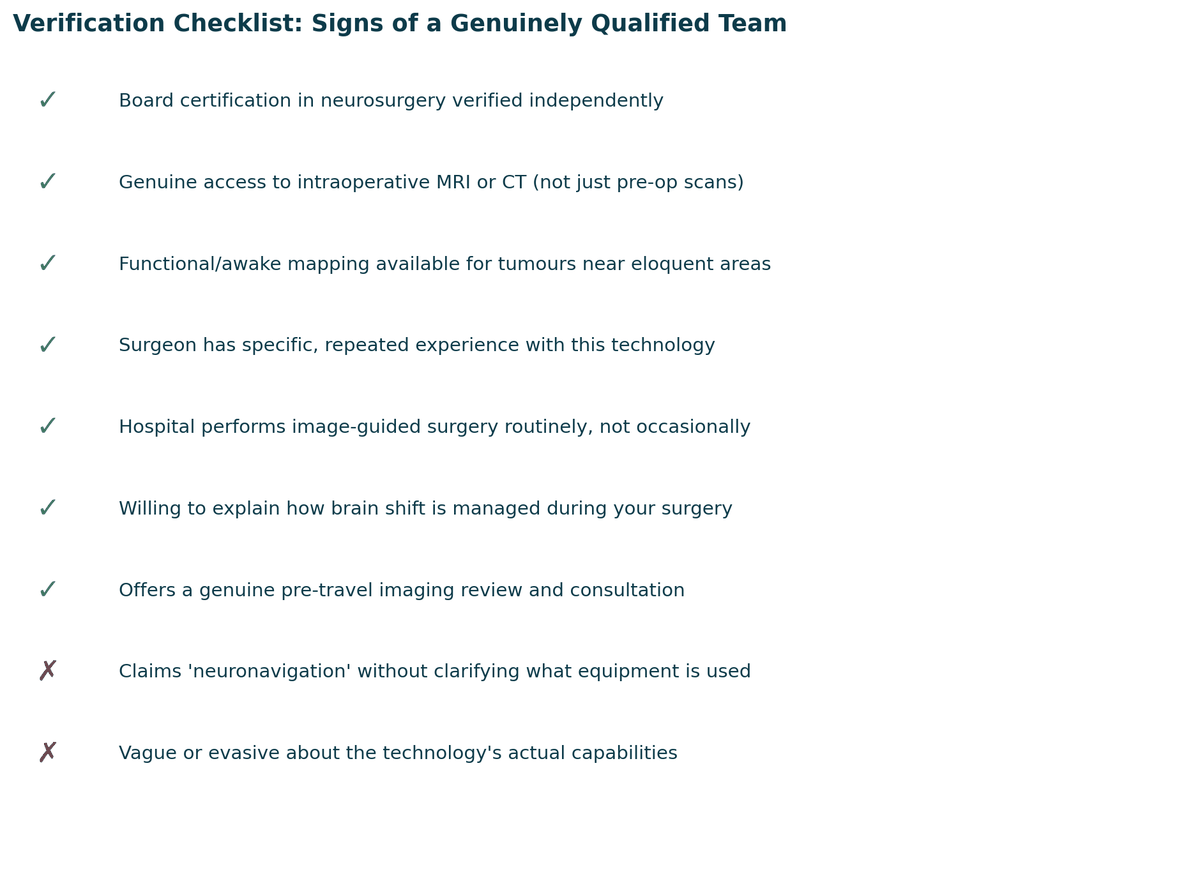
A note on independent verification: never rely solely on a hospital’s own marketing materials or a medical tourism facilitator’s recommendation. Cross-check a surgeon’s registration directly with the Medical Council of India or the relevant State Medical Council, and verify hospital accreditation directly through the NABH or JCI public accreditation databases, both of which are searchable online. Ask specifically what equipment "neuronavigation" refers to at a given hospital — the term is sometimes used loosely, and a genuinely equipped centre will describe its technology in specific, verifiable detail.
What a Typical Omani Family Should Weigh for Brain Surgery in India
Beyond the surgeon and hospital themselves, a few practical factors deserve real attention. Ask specifically whether the surgeon who consults with you will be the one actually performing your surgery, since in some larger practices this is not automatic. Confirm whether pre-travel imaging review and video consultation are genuinely available, allowing your family to get an informed opinion before committing to travel. And ask how post-operative complications, should they arise after you return to Oman, would be managed — a responsible hospital will have a clear answer, not a shrug.
A Six-Step Path to Choosing Well
A Closing Thought
The word "neuronavigation" alone tells you relatively little — what matters is the specific technology genuinely available, the surgeon’s specific experience using it, and whether it will actually be deployed for your specific procedure. Given how much precision this technology adds when used properly, and how little it adds when merely claimed, verifying these specifics directly is the single most useful thing an Omani family can do before committing to treatment. A properly verified surgeon and hospital, with genuine, specific technology capability confirmed in writing, is worth the extra week it takes to establish.
Sources & Further Reading
- American Association of Neurological Surgeons (AANS), non-profit professional association — Image-Guided Neurosurgery (aans.org)
- National Institute of Neurological Disorders and Stroke (NINDS), NIH — Brain Tumor Diagnosis and Treatment (ninds.nih.gov)
- PMC, National Library of Medicine (NIH) — Neuronavigation in Glioma Resection: Current Applications and Clinical Outcomes (pmc.ncbi.nlm.nih.gov)
- National Accreditation Board for Hospitals & Healthcare Providers (NABH), India — Accredited Hospital Directory (nabh.co)
- Medical Council of India / National Medical Commission — Registered Medical Practitioner Verification (nmc.org.in)
Frequently Asked Questions by Omani Patients about Neuronavigation Brain Surgeons and Hospitals in India
What is neuronavigation in brain surgery?
Neuronavigation uses pre-operative imaging to help guide the surgeon during brain surgery. The guide explains that brain shift during surgery can make earlier images less accurate, which is why intraoperative imaging may be important in selected cases.
Is standard neuronavigation the same as intraoperative MRI or CT?
No. Standard neuronavigation relies primarily on pre-operative imaging, while intraoperative MRI or CT allows the brain to be re-imaged during surgery and can help the team assess changes during the procedure.
Why should Omani patients ask about the exact technology being used?
The guide notes that the term "neuronavigation" can be used loosely. Patients should ask exactly what equipment is available and whether it will actually be used during their specific surgery.
When might functional or awake brain mapping be considered?
For tumours near areas responsible for speech, movement or other critical functions, the guide recommends asking whether functional mapping or awake surgery techniques are available and appropriate.
How important is the surgeon’s experience with neuronavigation technology?
It is highly important. The page 2 chart gives the surgeon’s specific experience with the technology an illustrative importance score of 88/100.
What type of hospital should Omani patients choose?
Look for a hospital with established image-guided brain surgery capabilities and, where intraoperative MRI is offered, purpose-built infrastructure and teams experienced in working with the technology.
What accreditation should I check?
The guide recommends NABH accreditation at minimum and JCI accreditation where available. Patients should independently verify accreditation rather than relying only on hospital claims.
Can my brain imaging be reviewed before travelling from Oman?
Yes. The guide recommends confirming whether the centre provides pre-travel imaging review and video consultation so the family can receive an informed opinion before travelling.
What are warning signs when choosing a neuronavigation centre?
Important warning signs include claiming to offer neuronavigation without explaining the actual equipment and being vague or evasive about the technology’s capabilities.
What should I confirm before returning to Oman after brain surgery?
Confirm how post-operative complications and ongoing care will be managed after returning home. The guide recommends establishing this plan and obtaining the treatment plan and costs in writing before travelling.
Page Summary
This guide explains how Omani patients can evaluate neurosurgeons and hospitals in India for neuronavigation and advanced brain surgery. It focuses on the difference between standard pre-operative neuronavigation and genuine intraoperative imaging, particularly because brain shift can affect the accuracy of earlier images during surgery. The page 2 chart identifies genuine access to intraoperative MRI or CT as the highest illustrative factor at 93/100, followed by the surgeon’s specific experience with the technology at 88/100 and functional mapping for tumours near critical areas at 80/100. The guide also recommends choosing a hospital with purpose-built technology and established image-guided brain surgery experience, while independently verifying surgeon registration, hospital accreditation and the exact equipment being offered. The page 3 checklist highlights specific technology experience, functional mapping, routine image-guided surgery and clear brain-shift management as positive indicators. The page 4 six-step pathway recommends a second opinion, specialist shortlisting, credential verification, video consultation, written treatment costs and confirmation of post-operative and complication management after returning to Oman.
Citation Block
| Field | Details |
|---|---|
| Information | Topic |
| Selecting the Best Surgeons and Hospitals for Neuronavigation and Advanced Brain Surgery in India for Omani Patients | Treatment |
| Neuronavigation and advanced brain surgery | Patients |
| Omani Patients | Specialist |
| Neurosurgeon | Key Selection Criteria |
| Specific technology capability and surgeon experience | Intraoperative Imaging |
| MRI or CT where appropriate | Functional Assessment |
| Functional or awake mapping for tumours near critical areas | Brain-Shift Management |
| Intraoperative imaging and procedure-specific planning | Hospital Requirement |
| Established image-guided brain surgery programme | Infrastructure |
| Purpose-built hybrid operating theatre for intraoperative MRI where available | Accreditation |
| NABH; JCI where available | Pre-Travel Assessment |
| Imaging review and video consultation | Verification |
| Independent surgeon registration and hospital accreditation | Treatment Planning |
| Written treatment plan with itemised costs | Follow-Up |
| Post-operative and complication-management plan after returning to Oman | Key Decision |


Our Mission Statement
Our mission is to place patients at the centre of every healthcare decision by providing trustworthy, evidence-based, and unbiased medical information. We believe that informed patients make better decisions. Backed by personalised guidance from our experienced advisory team, we help patients understand their treatment options, compare them objectively, and confidently choose the path that best suits their medical needs and personal circumstances.
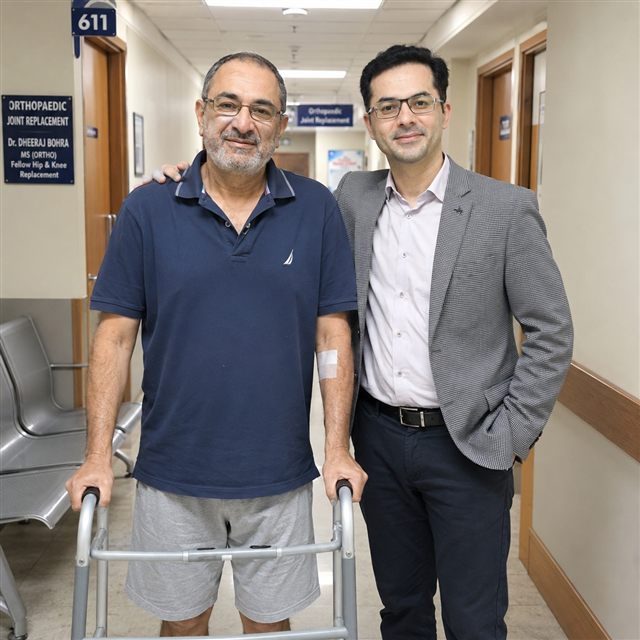
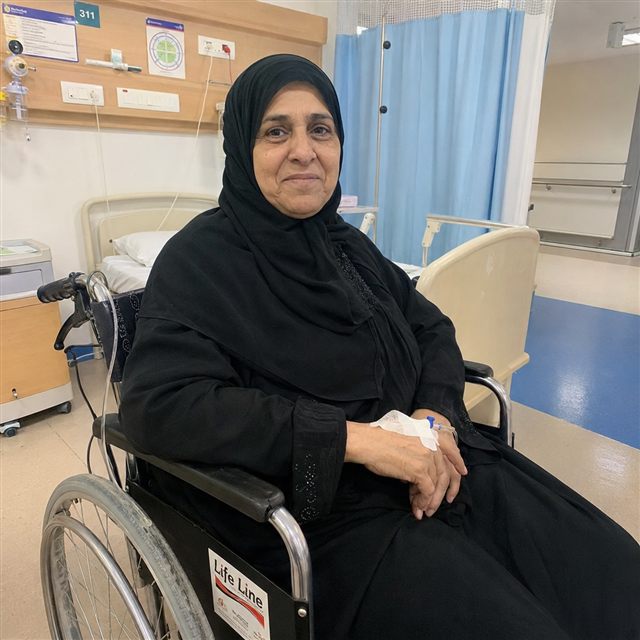
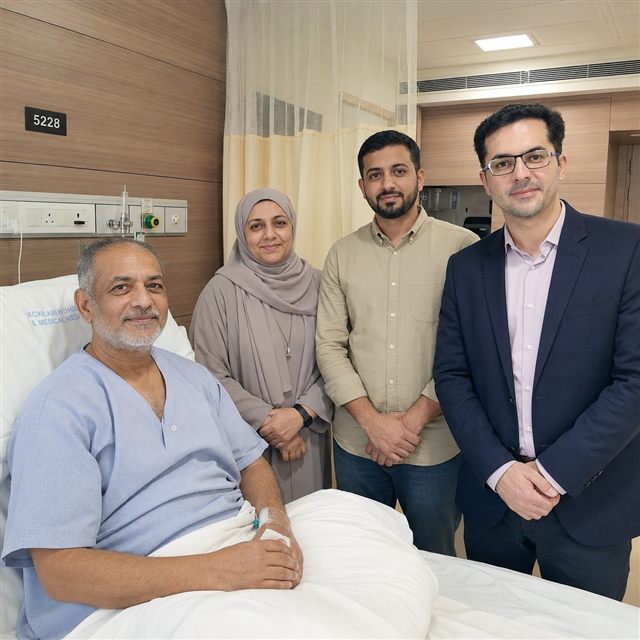
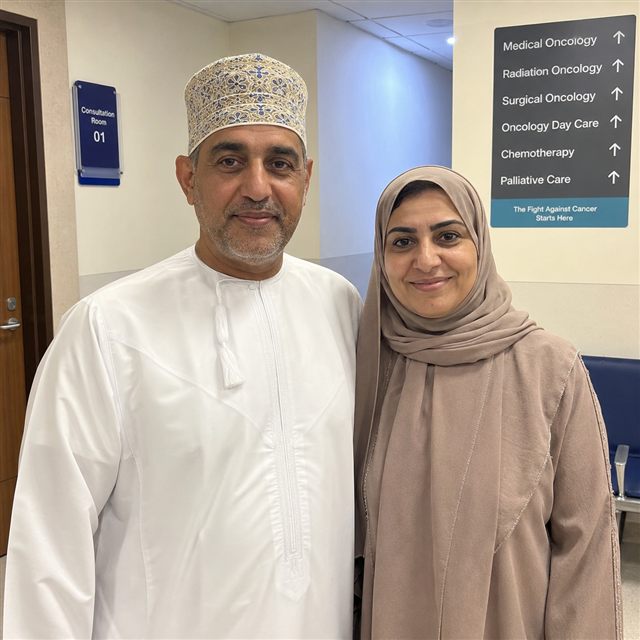
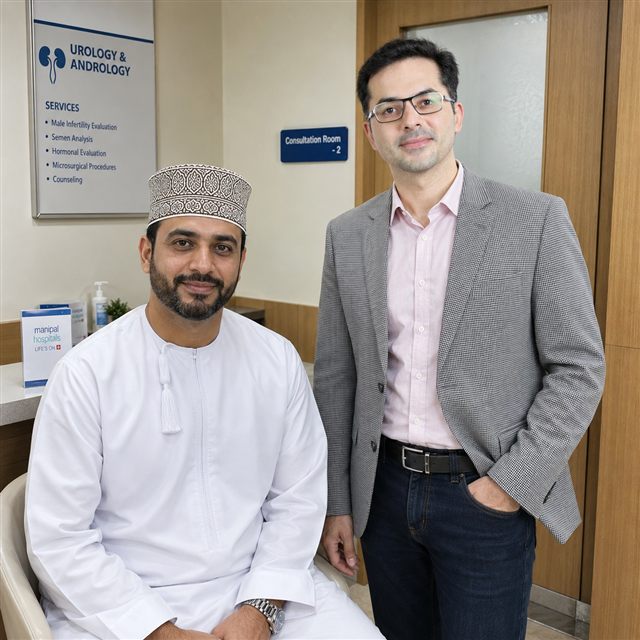
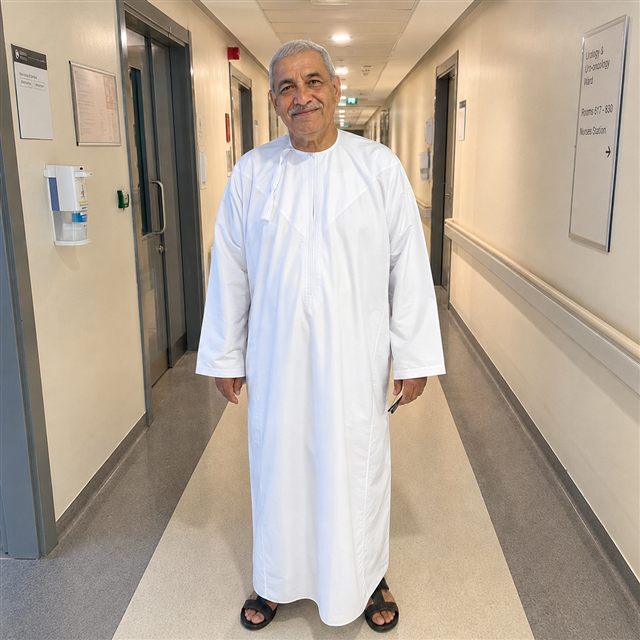
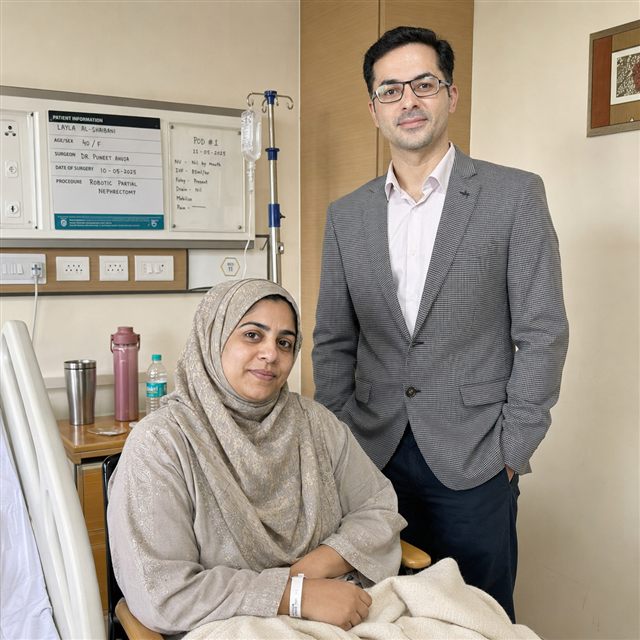
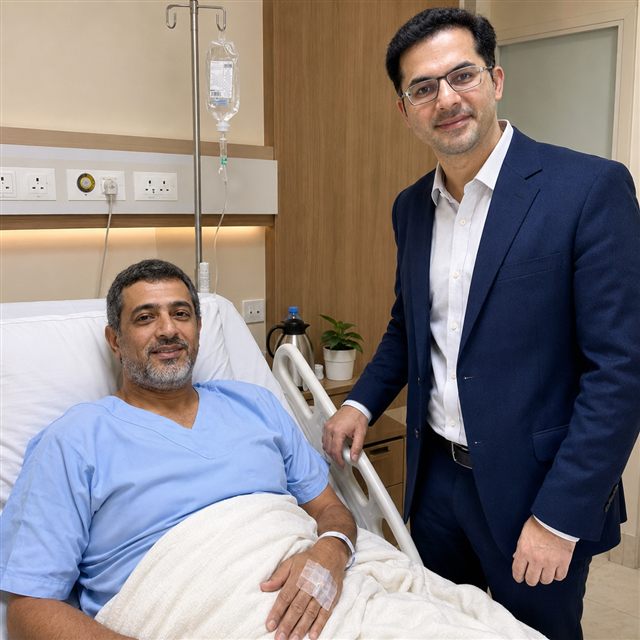
Patient Testimonials from Oman
Ready to Take the First Step?
Share your Medical Reports with our Healthcare Managers Today and Get a FREE CONSULTATION, a Personalized Treatment Plan, and Complete Support from Arrival to Recovery.
Get Your Free ConsultationAreas We Serve
Indian Health Guru Consultants proudly assists patients from Oman and surrounding Middle Eastern countries in accessing advanced, affordable and trusted medical treatment in India. Our team provides complete support for medical opinions, hospital selection, treatment planning, visa assistance, travel coordination, accommodation and post-treatment follow-up.
We regularly serve patients from:
- Oman
- Turkey
- Iran
- Kuwait
- Jordan
- Syria
- Qatar
- Bahrain
- Yemen
- Iraq
- Saudi Arabia
- United Arab Emirates
No matter where you are located, our experienced team is committed to making your medical journey to India safe, smooth, transparent and stress-free from the first enquiry to your return home.
From Oman to India: Your Complete Patient Guide
- Weight Loss and Bariatric Surgery in India for Omanis: Cost & Guide
- Brain Tumor Surgery in India for Omanis: Cost & Guide
- Cancer Treatment in India for Omanis: Cost & Guide
- Cardiac Surgery in India for Omanis: Cost & Guide
- Breast Cancer Treatment in India for Omanis: Cost & Guide
- Neurosurgery in India for Omanis: Cost & Guide
- Spine Surgery in India for Omanis: Cost & Guide
- Bone Marrow Transplant in India for Omanis: Cost & Guide
- Kidney Transplant in India for Omanis: Cost & Guide
- Best Dentists and Clinics for Dental Surgery in India for Omani Patients
- Best Doctors and Hospitals for Blood Cancer Treatment in India for Omani Patients
- Best Bone Marrow Transplant Doctors and Hospitals in India for Omani Patients
- Best IVF and Fertility Doctors and Hospitals in India for Omani Couples
- Best Bariatric Surgeons and Hospitals for Weight Loss Surgery in India for Omani Patients
- Best Brain Tumor Surgery Doctors and Hospitals in India for Omani Patients
- Best Cardiac Surgeons and Hospitals in India for Omani Patients
- Best Colorectal Cancer Surgeons and Hospitals in India for Omani Patients
- Best Surgeons and Hospitals for Complex Joint Revision Surgery in India for Omani Patients