

Neurosurgery in India for Omanis: A Doctor’s Guide to Making the Right Decision
A practical guide for Omani patients covering complex neurosurgery, aneurysm and AVM treatment, hydrocephalus, epilepsy surgery, costs and recovery.
Neurosurgery covers some of the most consequential decisions a patient or family will ever make — an unruptured brain aneurysm discovered on a routine scan, hydrocephalus in a newborn, epilepsy that has stopped responding to medication, or an arteriovenous malformation found only after a first, frightening symptom. Over 24 years of advising Gulf families on where to seek treatment, I have learned that neurosurgical decisions demand a particular kind of care: enough urgency to act, and enough patience to choose the right team. Oman's hospitals — Apollo Hospital Muscat, Badr Al Samaa, Aster Al Raffah, and Burjeel Medical Centre among them — provide neurosurgical consultation and can manage a meaningful share of cases locally. This guide is written to help Omani patients and families understand, honestly and without sales pressure, when travelling to India for neurosurgery changes the outcome for a specific condition, and what to verify carefully before choosing either path.
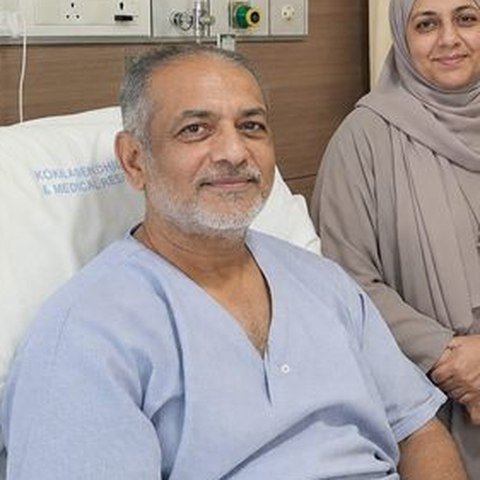
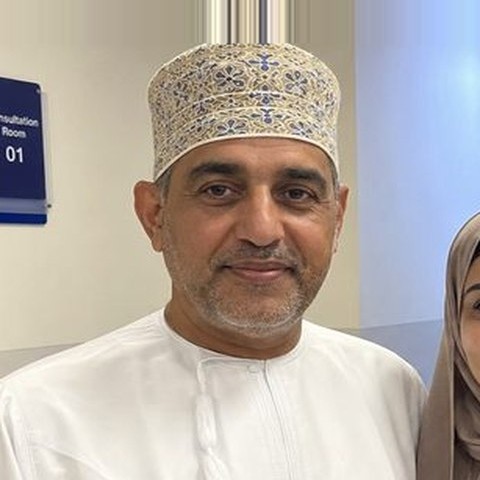
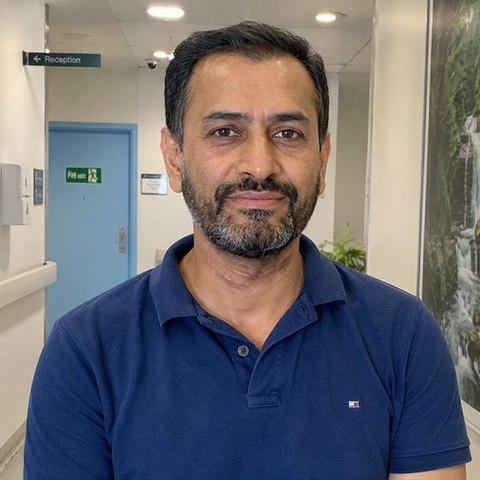
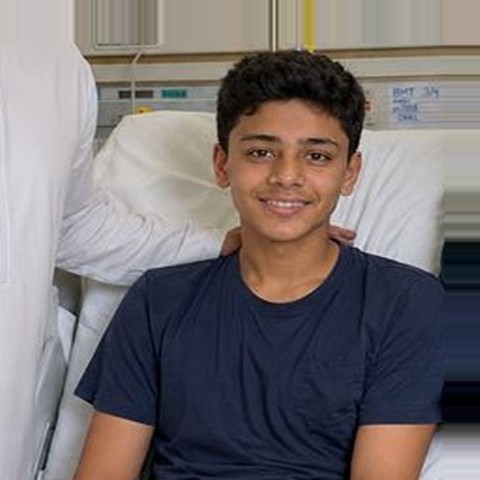
Healing Journeys of Omani Patients
Key Takeaways
- Neurosurgery covers a wide range of conditions, including brain aneurysms, arteriovenous malformations, hydrocephalus, epilepsy, trigeminal neuralgia and other complex neurological disorders. Because each condition requires a different treatment approach, the guide strongly recommends evaluating the specific procedure and surgical team rather than choosing a hospital simply because it offers neurosurgery.
- For vascular conditions such as aneurysms and AVMs, patients may have access to both open surgery and minimally invasive endovascular procedures. Aneurysm coiling and flow-diverter placement can provide less invasive alternatives to clipping for appropriately selected patients.
- India's leading neurosurgical centres in Delhi, Mumbai, Chennai and Bengaluru offer advanced facilities including neuro-interventional radiology, intraoperative neuronavigation, awake craniotomy, programmable shunts and advanced epilepsy monitoring units. The guide highlights the importance of regular use of these technologies rather than their simple availability.
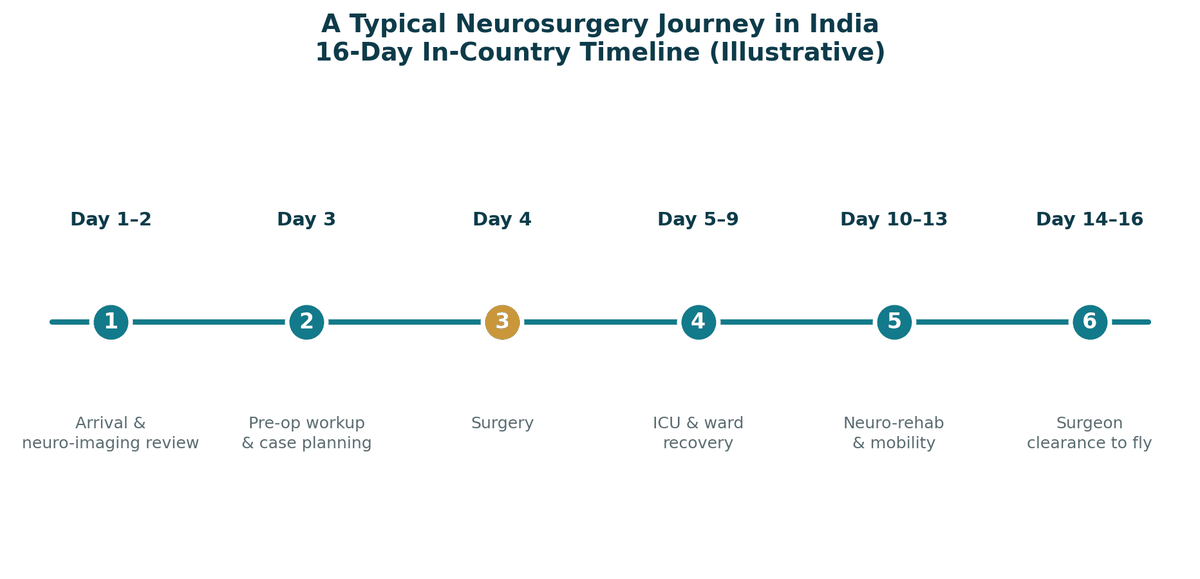
- The page 2 neurosurgery journey diagram presents an illustrative 16-day pathway: arrival and neuro-imaging review during days 1–2, pre-operative work-up and case planning on day 3, surgery on day 4, ICU and ward recovery during days 5–9, neuro-rehabilitation and mobility during days 10–13, and surgeon clearance to fly during days 14–16.
- The page 3 cost comparison chart and table gives a representative complex cranial procedure cost of US$7,000–18,000 in India, compared with US$20,000–35,000 in private Oman, US$32,000–60,000 in private UK care and US$35,000–70,000+ in the United States.
- The guide makes an important distinction between different procedures. A straightforward VP shunt may cost considerably less than aneurysm clipping or a complex vascular procedure, so Omani patients should obtain a procedure-specific quotation only after their imaging has been reviewed.
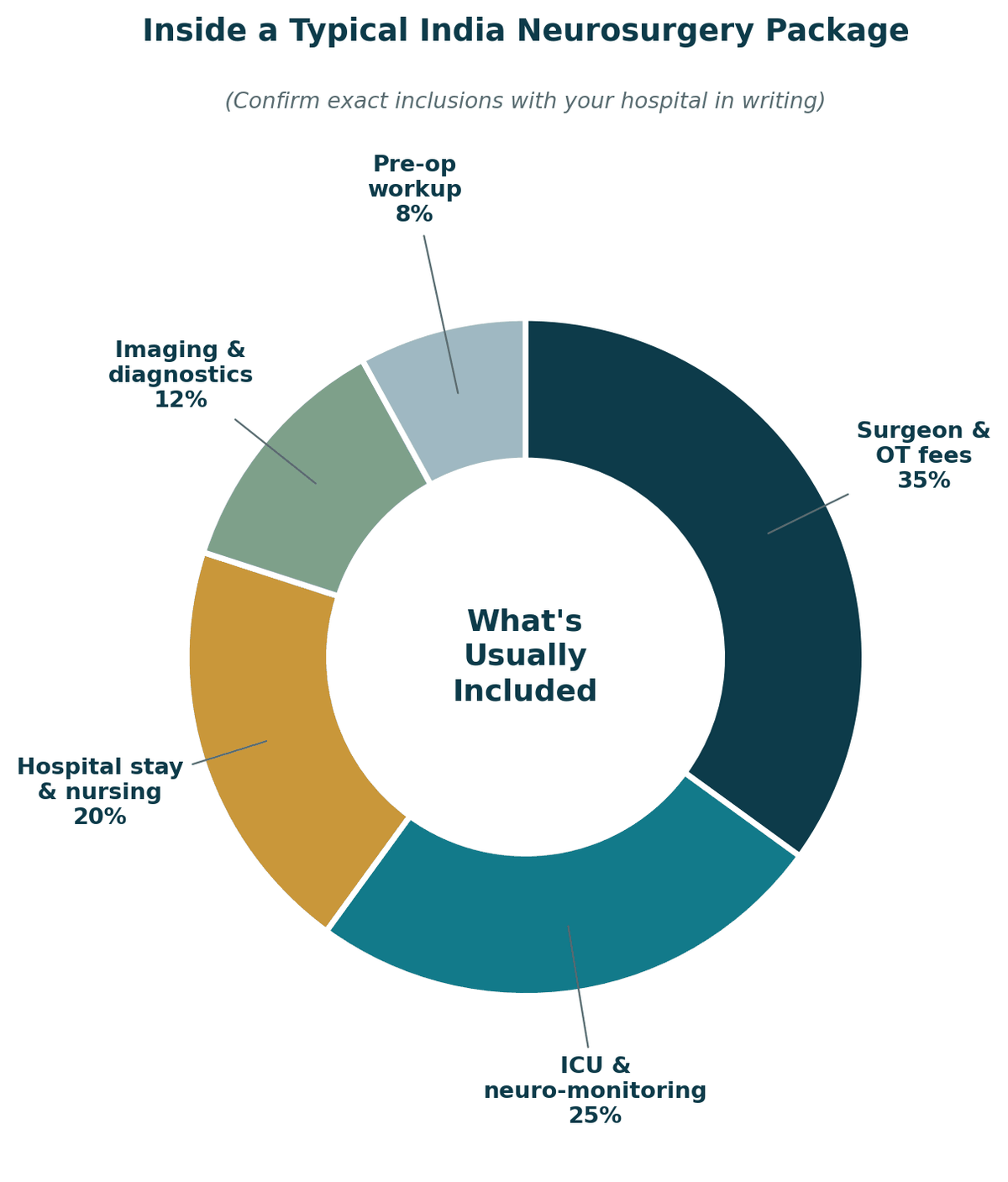
- The page 4 package graphic illustrates an India neurosurgery package with surgeon and OT fees at 35%, ICU and neuro-monitoring at 25%, hospital stay and nursing at 20%, imaging and diagnostics at 12%, and pre-operative work-up at 8%.
- The guide also notes that the choice between open and endovascular treatment can affect both cost and recovery time. Omani patients should ask why a particular technique has been recommended and whether a less invasive option is appropriate for their condition.
- An independent second opinion is particularly valuable before agreeing to major neurosurgery. The guide recommends sharing MRI, CT or angiography with an independent neurosurgical advisor or team in India so that the proposed treatment and its rationale can be reviewed before travel.
- The guide advises Omani families to examine surgeon-specific experience with their exact procedure. Asking how many aneurysm clippings, VP shunt placements, epilepsy surgeries or other relevant procedures the assigned team performs each year provides more meaningful information than the hospital's overall neurosurgery volume.
- Omani patients should plan for the complete treatment journey rather than the operation alone. The guide recommends budgeting for a companion, approximately 14–16 days in India for major neurosurgery, post-operative follow-up and continuing imaging or monitoring after returning to Muscat, Sohar or another location in Oman.
- The guide also recommends checking whether Omani insurance or employer health schemes provide reimbursement for treatment abroad and clarifying the Ministry of Health position before travel. It notes that neurosurgical costs can rise substantially if complications require additional care.
Quick Facts
- Treatment
- Neurosurgery and complex neurological procedures
- Primary Patients
- Omani patients requiring specialised neurosurgical care
- Main Conditions
- Aneurysms, AVMs, hydrocephalus, epilepsy and nerve-pain conditions
- Main Treatment Approaches
- Open surgery and minimally invasive endovascular procedures
- Advanced Procedures
- Aneurysm coiling, flow-diverter placement, neuronavigation and awake craniotomy
- Hydrocephalus Technology
- Programmable shunt systems
- Key Specialist
- Neurosurgeon / Neuro-interventional Team
- Main India Cities
- Delhi, Mumbai, Chennai and Bengaluru
- India Cost
- US$7,000–18,000 for a representative complex cranial case
- Oman Private Cost
- US$20,000–35,000
- UK Private Cost
- US$32,000–60,000
- US Cost
- US$35,000–70,000+
- Illustrated India Journey
- Approximately 16 days
- Surgery
- Day 4 in the illustrative pathway
- ICU / Ward Recovery
- Days 5–9
- Neuro-Rehabilitation
- Days 10–13
- Clearance to Fly
- Days 14–16
- Package Breakdown
- Surgeon/OT 35%, ICU/neuro-monitoring 25%, hospital/nursing 20%, imaging/diagnostics 12%, pre-op work-up 8%
- Second Opinion
- Review MRI, CT or angiography before committing to surgery
- Technique Check
- Compare open versus endovascular approaches where clinically appropriate
- Surgeon Volume
- Ask about annual experience with the exact procedure
- Insurance
- Check Omani insurance or employer reimbursement
- Ministry of Health
- Clarify overseas-treatment requirements
- Accreditation
- Check JCI or NABH accreditation
- Follow-Up
- Confirm longer-term imaging and monitoring in Oman
- Travel Planning
- Budget for a companion and extended recovery period
- Author
- Dr. Dheeraj Bojwani
- Experience
- 24+ Years
In Brief
Neurosurgery in India can be considered by Omani patients requiring treatment for complex vascular, functional, paediatric or other neurological conditions. The guide highlights advanced options such as aneurysm coiling, flow-diverter placement, neuronavigation, programmable shunts and epilepsy monitoring, while stressing that not every patient needs to travel. A representative complex cranial procedure costs US$7,000–18,000 in India compared with US$20,000–35,000 in private Oman. The illustrated treatment pathway takes approximately 16 days, and patients are advised to obtain an independent imaging review, confirm procedure-specific surgeon experience, understand the proposed technique and establish long-term follow-up in Oman.
The Breadth Behind the Word “Neurosurgery”
Few specialities cover as wide a range as neurosurgery. It includes vascular conditions such as aneurysms and arteriovenous malformations, hydrocephalus and cerebrospinal fluid disorders, epilepsy surgery, trigeminal neuralgia and other nerve-pain conditions, and a range of both open and minimally invasive endovascular techniques. Each of these carries its own risk profile, its own ideal surgical approach, and its own volume-dependent learning curve for the surgical team.
This is precisely why a general reassurance that “the hospital does neurosurgery” is not enough. The right question is always procedure-specific: how many aneurysm clippings, or VP shunt placements, or epilepsy surgeries has this specific team performed, and with what outcomes?
What Makes India a Serious Option for Neurosurgical Care
India's leading neurosurgical centres, concentrated in Delhi, Mumbai, Chennai, and Bengaluru, manage an exceptionally high volume of both common and complex neurosurgical cases each year — supported by dedicated neuro-interventional radiology teams for endovascular procedures such as aneurysm coiling and flow-diverter placement, which are often a safer, less invasive alternative to open clipping for suitable cases. This volume translates directly into refined outcomes for procedures where technique and team coordination matter enormously.
India also gives patients access to intraoperative neuronavigation, awake craniotomy for eloquent-area lesions, programmable shunt technology for hydrocephalus, and advanced epilepsy monitoring units — often at a scale a single Gulf hospital cannot practically replicate. And because Indian hospitals have spent two decades building international neurosurgery programmes for Gulf and African patients, an Omani family arrives to a system with Arabic-speaking coordinators, structured second-opinion review of imaging before travel, and a well-tested visa and logistics process.
This does not mean every neurosurgical case needs to travel. A straightforward, low-risk procedure may be very reasonably handled locally. It is the more complex vascular, functional, or paediatric cases — and any case where a family wants a genuinely independent second opinion before agreeing to open surgery — where India's depth of specific experience matters most.
Cost Comparison: India vs. Oman vs. Western Countries
Neurosurgery costs vary enormously by procedure and complexity. Treat the figures below as a benchmark for a complex cranial procedure such as aneurysm clipping or coiling — a genuinely representative “major neurosurgery” case — in approximate US dollars, for a full package at an accredited private hospital.
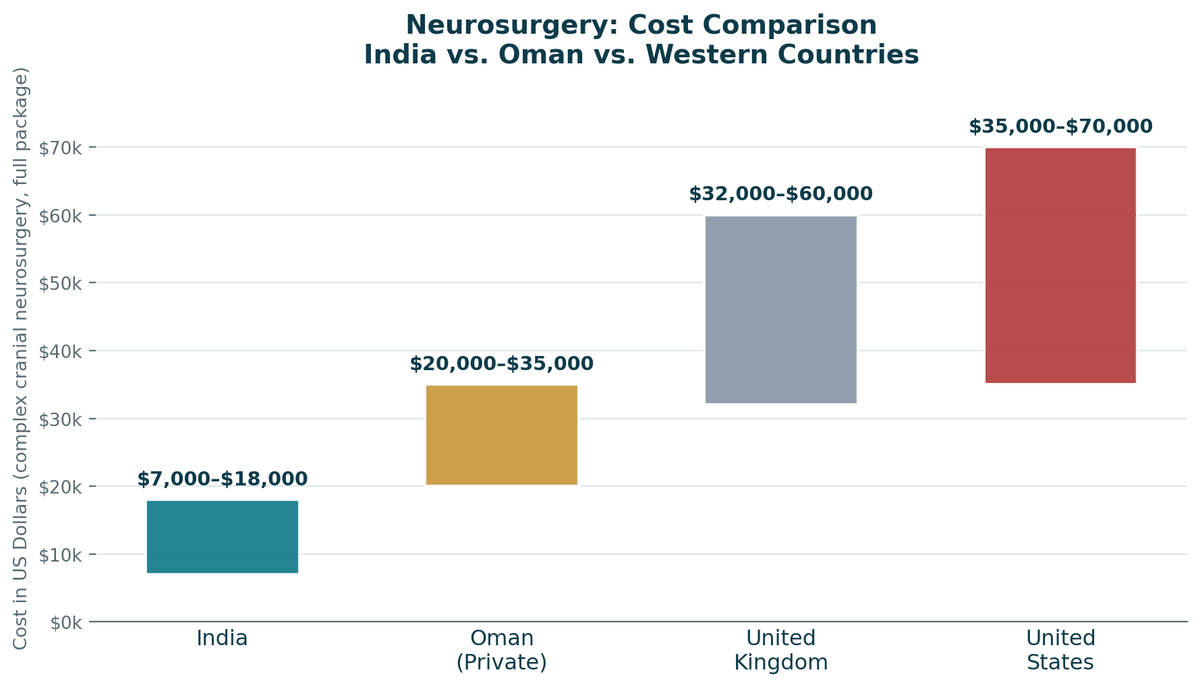
| Destination | Typical Cost (Complex Cranial Case) | What This Usually Includes |
|---|---|---|
| India | US $7,000 – $18,000 | Surgeon and OT fees, ICU and ward stay, imaging, and standard nursing care |
| Oman (private) | US $20,000 – $35,000 | Surgeon fees, hospital stay, imaging; varies significantly by hospital tier and case complexity |
| United Kingdom (private) | US $32,000 – $60,000 | Surgery and hospital stay; extended follow-up often billed separately |
| United States | US $35,000 – $70,000+ | Highly variable by state and hospital; complex or emergency cases can exceed this range substantially |
A few honest caveats. First, procedure type and technique change the price more than country does — a straightforward VP shunt placement can cost a fraction of an aneurysm clipping or complex vascular case, in every country on this list, so insist on a procedure-specific quote once imaging has been reviewed. Second, whether the case is managed by open surgery or a minimally invasive endovascular approach also shifts cost and recovery time meaningfully; ask which is being proposed and why. Third, Oman's public-sector and subsidised government pathways can bring the local cost down for eligible citizens and are worth exploring in parallel with any decision to travel.
What a Typical Omani Patient Should Weigh Before Deciding Neurosurgery in India
Having guided patients and families through this exact decision for 24 years, here is what I encourage every Omani family to work through before committing to a hospital:
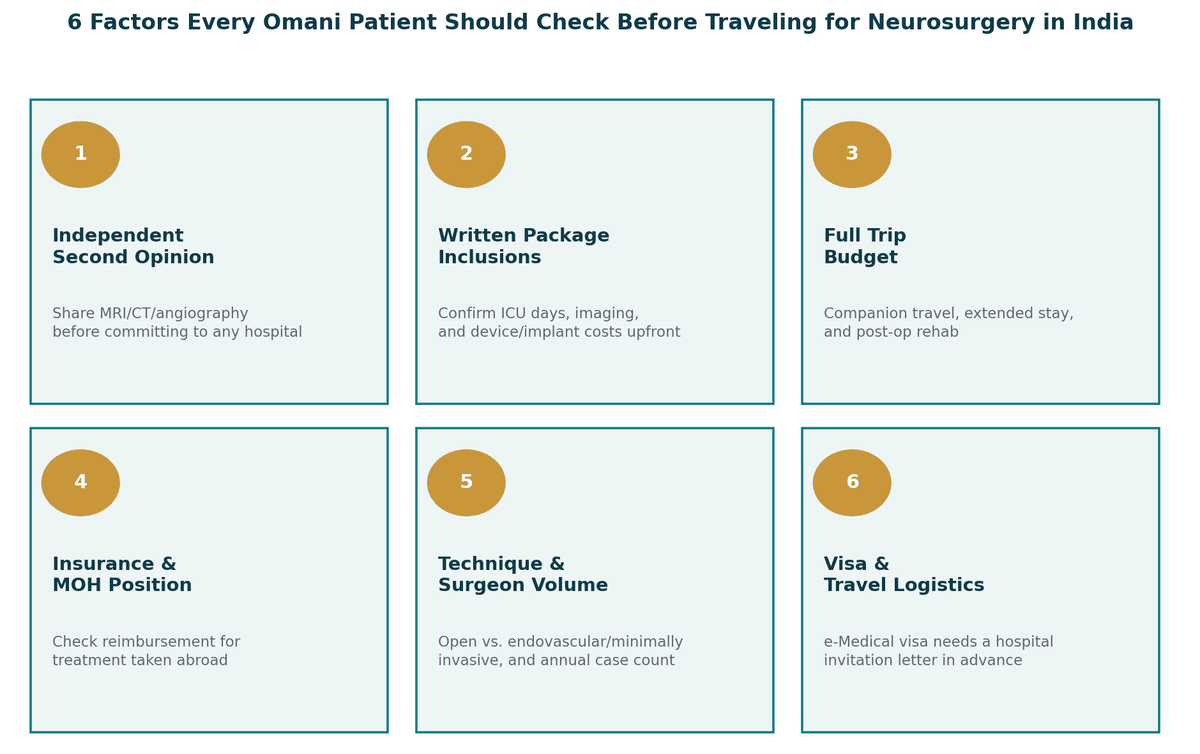
- Get a genuine second opinion before agreeing to surgery. Send your MRI, CT, or angiography imaging to an independent neurosurgical advisor or team in India before committing. A responsible team will tell you plainly what they see, what approach they would recommend, and why.
- Understand exactly what your package includes. Ask specifically what is covered if ICU stay extends, if additional imaging is needed intraoperatively, or if a complication arises. Get this in writing before you travel.
- Factor in the full trip, not just the surgery. Budget for a companion's travel and an extended stay (patients should not travel alone for this category of surgery), typically 14–16 days in India for surgery, ICU and ward recovery, and the surgeon's clearance to fly home, plus continuing follow-up once you return to Muscat, Sohar, or wherever you're based.
- Check your insurance and Ministry of Health position. Some Omani insurance plans and employer health schemes offer partial reimbursement for treatment abroad; others do not cover it at all, and neurosurgical costs escalate quickly if complications arise. Clarify this before you travel, not after.
- Ask specifically about technique and surgeon-specific volume. Whether open or endovascular, ask how many procedures of your specific type — not neurosurgery broadly — your assigned surgeon and team perform each year.
- Plan the visa and travel logistics early, but do not let them delay diagnosis. India's e-Medical Visa process is generally efficient, but it requires an invitation letter tied to your specific hospital and case. Begin the imaging review and hospital selection process immediately, even while travel logistics are arranged.
- Confirm accreditation and ask about the full follow-up pathway. Look for JCI or NABH accreditation, and ask how longer-term follow-up imaging or monitoring would be coordinated once you are back home.
A Closing Thought
Neurosurgery, across all its forms, rewards a calm and specific approach to decision-making far more than urgency does. The right question is never simply “should I go to India,” but “which team, anywhere, has the deepest specific experience with exactly what I am facing.” Whether that team is in Muscat or in India, take the time to ask direct, specific questions, and do not let fear replace careful, informed decision-making. If you are weighing this decision, an independent, no-obligation review of your imaging — by someone with no financial stake in which hospital you choose — is often the single most useful thing you can do before deciding anything else.
Sources & Further Reading
- National Institute of Neurological Disorders and Stroke (NINDS), NIH — Cerebral Aneurysms (ninds.nih.gov)
- National Institute of Neurological Disorders and Stroke (NINDS), NIH — Hydrocephalus (ninds.nih.gov)
- American Association of Neurological Surgeons (AANS) — Patient Information (aans.org)
- Brain Aneurysm Foundation (non-profit organization) — Patient & Family Resources (bafound.org)
- MedlinePlus, U.S. National Library of Medicine (NIH) — Aneurysm in the Brain (medlineplus.gov)
Frequently Asked Questions by Omani Patients about Neurosurgery in India
Can Omani patients travel to India for neurosurgery?
Yes. The guide presents India as an option for selected complex neurosurgical cases, particularly vascular, functional and paediatric conditions. Straightforward low-risk procedures may still be appropriately managed in Oman.
What neurosurgical conditions can Omani patients consider treating in India?
The guide covers aneurysms, arteriovenous malformations, hydrocephalus, epilepsy and nerve-pain conditions. The appropriate treatment depends on the specific diagnosis and imaging findings.
How much does major neurosurgery cost in India for Omani patients?
A representative complex cranial procedure is estimated at US$7,000–18,000 in India. The actual quotation depends heavily on the procedure, complexity and whether open or endovascular treatment is required.
How does neurosurgery cost in India compare with private Oman?
The guide gives a representative range of US$7,000–18,000 in India compared with US$20,000–35,000 in private Oman. These are benchmarks for complex cranial procedures rather than every type of neurosurgery.
Can Omani patients receive minimally invasive neurosurgery in India?
Yes. The guide describes endovascular procedures such as aneurysm coiling and flow-diverter placement as options that may be less invasive than open clipping for suitable patients.
How long should an Omani patient stay in India after major neurosurgery?
The illustrative journey covers approximately 16 days, including surgery, ICU and ward recovery, neuro-rehabilitation and surgeon clearance to fly. Complex cases may require a longer stay.
Should an Omani patient obtain a second opinion before neurosurgery in India?
Yes. The guide recommends sharing MRI, CT or angiography with an independent neurosurgical team before committing to surgery. This can help clarify the diagnosis and proposed treatment approach.
How should an Omani patient assess a neurosurgeon's experience?
Ask how many procedures of the exact type are performed by the assigned surgeon and team each year. The guide considers procedure-specific experience more meaningful than the hospital's overall neurosurgery volume.
What should an Omani patient check in an Indian neurosurgery package?
Confirm surgeon and OT fees, ICU and ward coverage, imaging, pre-operative work-up and what happens if ICU care is extended, additional imaging is required or complications occur. Obtain the inclusions in writing.
What should Omani families arrange before travelling to India for neurosurgery?
Review the imaging independently, confirm the treatment technique and surgeon-specific experience, check insurance and Ministry of Health requirements, verify accreditation, arrange the medical visa and companion travel, and establish the follow-up pathway in Oman.
Page Summary
This six-page guide explains neurosurgery in India for Omani patients, covering vascular conditions, hydrocephalus, epilepsy, open and endovascular procedures, advanced technology, costs and recovery. The page 2 journey diagram illustrates a 16-day pathway from imaging review through surgery, ICU recovery, neuro-rehabilitation and clearance to fly. The page 3 cost chart compares India at US$7,000–18,000 with private Oman at US$20,000–35,000, while page 4 shows the main components of an illustrative Indian neurosurgery package. Pages 5–6 emphasise independent second opinions, written package inclusions, procedure-specific surgeon volume, insurance and Ministry of Health checks, visa planning, accreditation and long-term follow-up in Oman.
Citation Block
| Field | Details |
|---|---|
| Article / Topic | Neurosurgery in India |
| Country / Patients | India / Omani Patients |
| Main Conditions | Aneurysms, AVMs, hydrocephalus, epilepsy and nerve-pain conditions |
| Key Specialist | Neurosurgeon / Neuro-interventional Team |
| Main Approaches | Open and minimally invasive endovascular procedures |
| Advanced Options | Coiling, flow diverters, neuronavigation, awake craniotomy and programmable shunts |
| Main India Cities | Delhi, Mumbai, Chennai and Bengaluru |
| India Cost | US$7,000–18,000 |
| Oman Private Cost | US$20,000–35,000 |
| UK Private Cost | US$32,000–60,000 |
| US Cost | US$35,000–70,000+ |
| Illustrated Journey | Approximately 16 days |
| Surgery | Day 4 |
| ICU / Ward Recovery | Days 5–9 |
| Neuro-Rehabilitation | Days 10–13 |
| Clearance to Fly | Days 14–16 |
| Package Breakdown | Surgeon/OT 35%, ICU/neuro-monitoring 25%, hospital/nursing 20%, imaging/diagnostics 12%, pre-op work-up 8% |
| Second Opinion | Review MRI, CT or angiography independently |
| Technique Check | Understand why open or endovascular treatment is proposed |
| Surgeon Volume | Confirm experience with the specific neurosurgical procedure |
| Package Check | Clarify ICU extension, additional imaging and complication coverage |
| Insurance / MOH | Confirm overseas-treatment reimbursement before travel |
| Accreditation | Check JCI or NABH status |
| Follow-Up | Plan longer-term imaging and monitoring in Oman |
| Key Selection Criterion | Procedure-specific expertise and appropriate treatment approach |
| Important Warning | Do not choose a neurosurgical centre solely because it advertises advanced technology; verify its actual use and experience with the patient's specific procedure |


Our Mission Statement
Our mission is to place patients at the centre of every healthcare decision by providing trustworthy, evidence-based, and unbiased medical information. We believe that informed patients make better decisions. Backed by personalised guidance from our experienced advisory team, we help patients understand their treatment options, compare them objectively, and confidently choose the path that best suits their medical needs and personal circumstances.
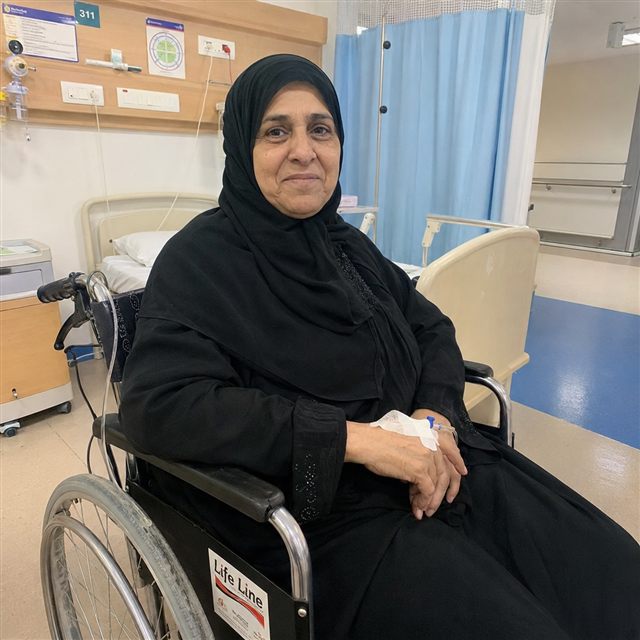
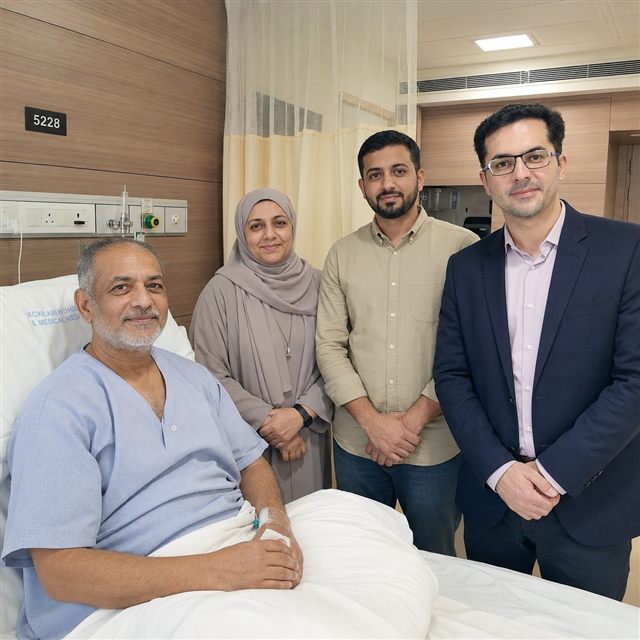
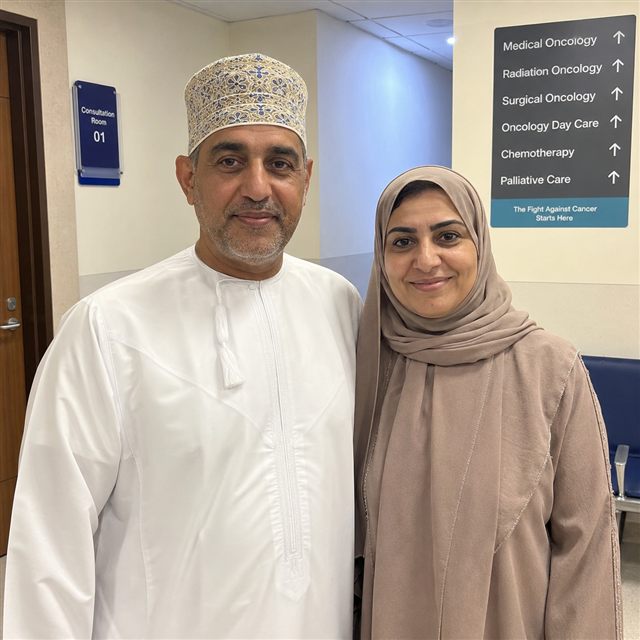
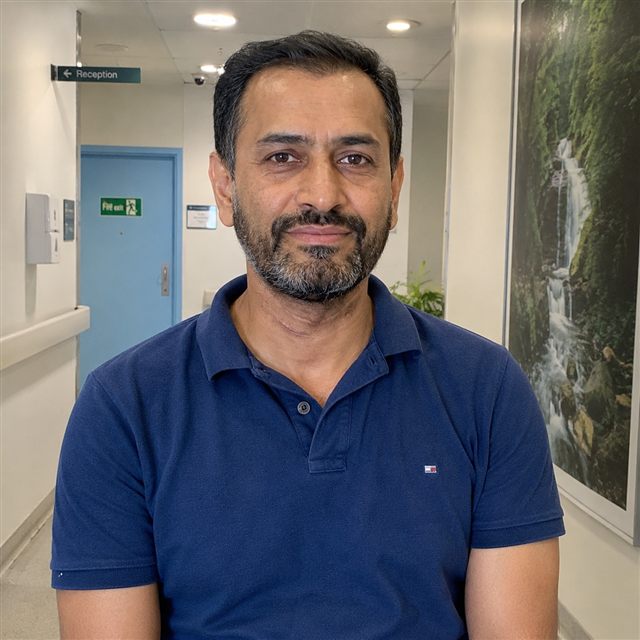
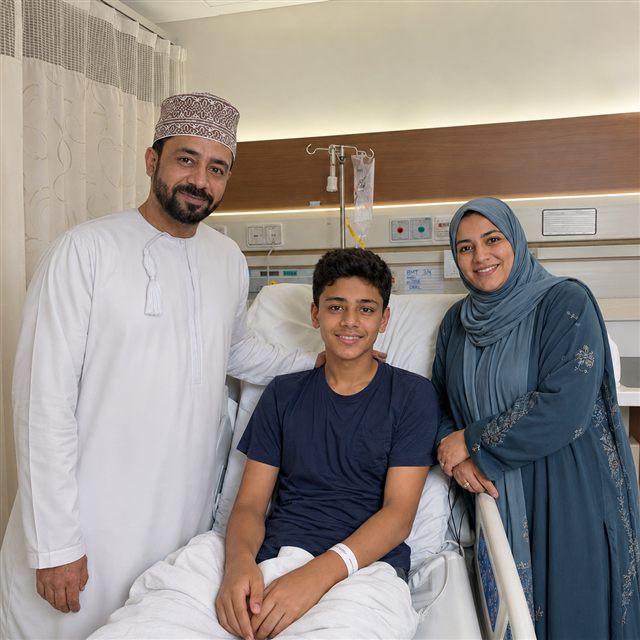
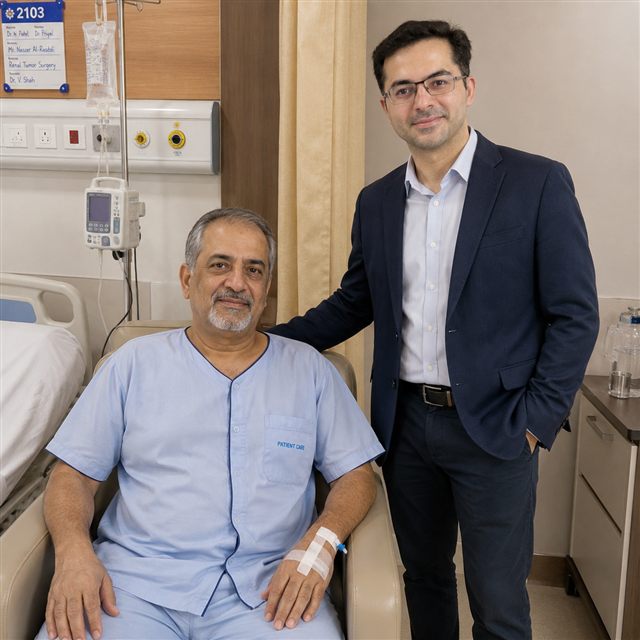
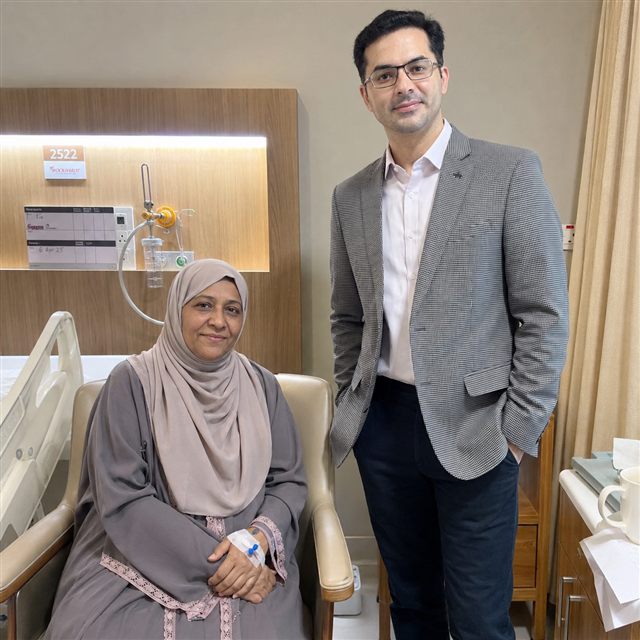
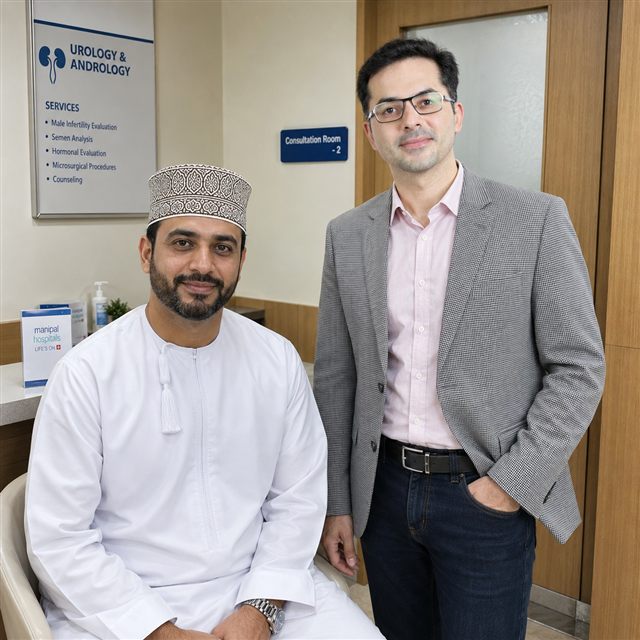
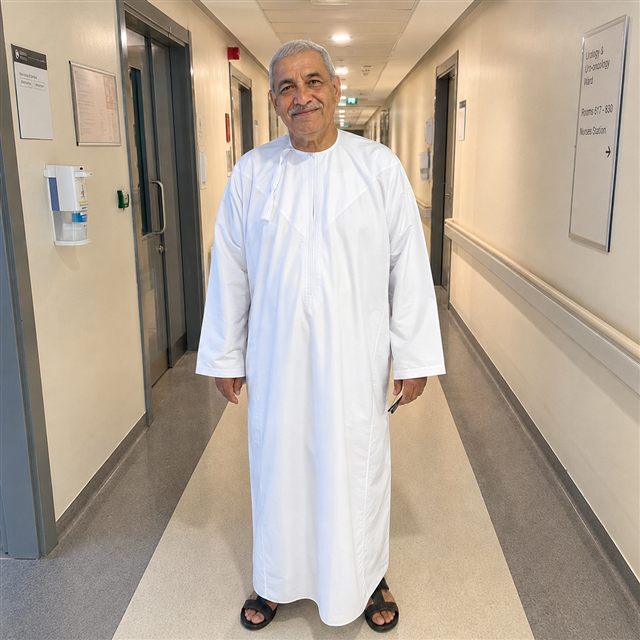
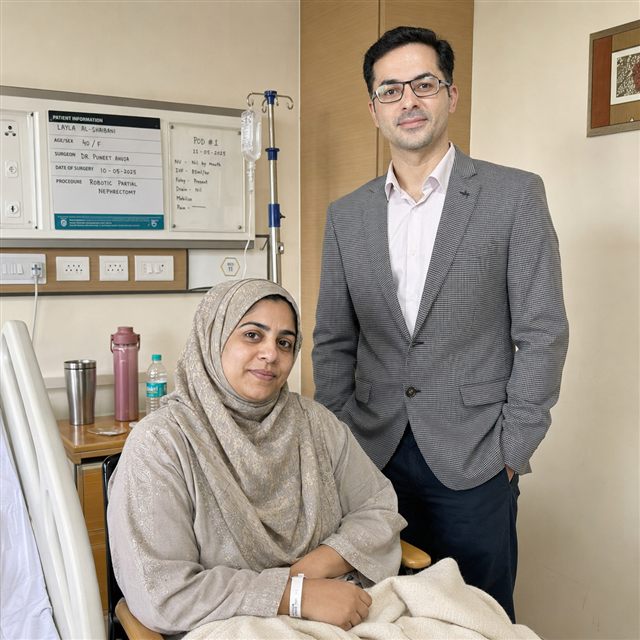
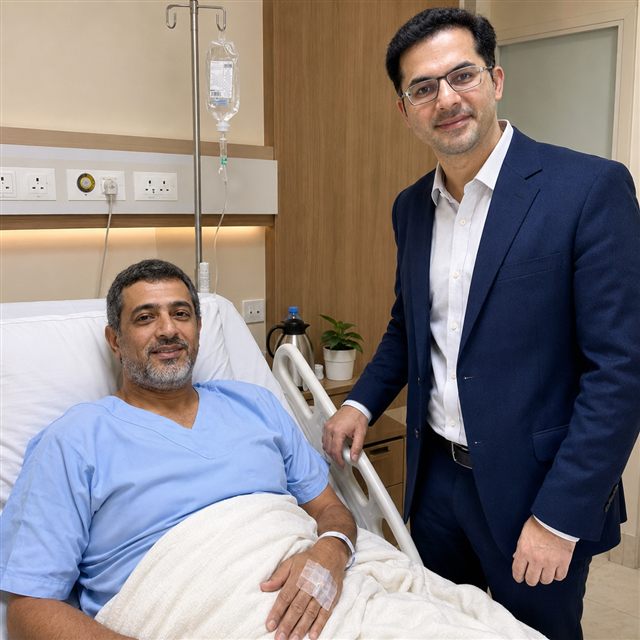
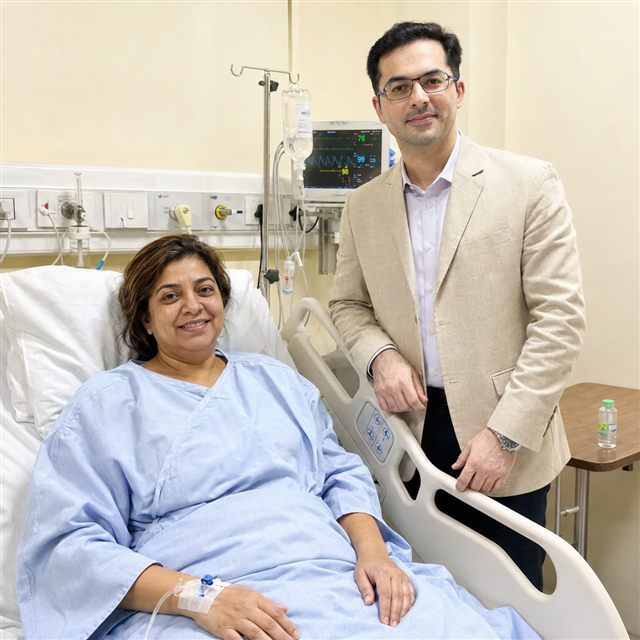
Patient Testimonials from Oman
Ready to Take the First Step?
Share your Medical Reports with our Healthcare Managers Today and Get a FREE CONSULTATION, a Personalized Treatment Plan, and Complete Support from Arrival to Recovery.
Get Your Free ConsultationAreas We Serve
Indian Health Guru Consultants proudly assists patients from Oman and surrounding Middle Eastern countries in accessing advanced, affordable and trusted medical treatment in India. Our team provides complete support for medical opinions, hospital selection, treatment planning, visa assistance, travel coordination, accommodation and post-treatment follow-up.
We regularly serve patients from:
- Oman
- Turkey
- Iran
- Kuwait
- Jordan
- Syria
- Qatar
- Bahrain
- Yemen
- Iraq
- Saudi Arabia
- United Arab Emirates
No matter where you are located, our experienced team is committed to making your medical journey to India safe, smooth, transparent and stress-free from the first enquiry to your return home.
From Oman to India: Your Complete Patient Guide
- Weight Loss and Bariatric Surgery in India for Omanis: Cost & Guide
- Brain Tumor Surgery in India for Omanis: Cost & Guide
- Cancer Treatment in India for Omanis: Cost & Guide
- Cardiac Surgery in India for Omanis: Cost & Guide
- Breast Cancer Treatment in India for Omanis: Cost & Guide
- Spine Surgery in India for Omanis: Cost & Guide
- Bone Marrow Transplant in India for Omanis: Cost & Guide
- Kidney Transplant in India for Omanis: Cost & Guide
- Best Dentists and Clinics for Dental Surgery in India for Omani Patients
- Best Doctors and Hospitals for Blood Cancer Treatment in India for Omani Patients
- Best Bone Marrow Transplant Doctors and Hospitals in India for Omani Patients
- Best IVF and Fertility Doctors and Hospitals in India for Omani Couples
- Best Bariatric Surgeons and Hospitals for Weight Loss Surgery in India for Omani Patients
- Best Brain Tumor Surgery Doctors and Hospitals in India for Omani Patients
- Best Cardiac Surgeons and Hospitals in India for Omani Patients
- Best Colorectal Cancer Surgeons and Hospitals in India for Omani Patients
- Best Surgeons and Hospitals for Complex Joint Revision Surgery in India for Omani Patients
- Hip Surgery in India for Omanis: Cost & Guide